Editors Are People, Too (Just So You Know)

As a writer myself, I totally understand the frustration of trying to read an editor’s mind and understand the why behind lengthy edits or outright rejections. What’s going on?

I’ve been encouraging my professional writing students to be aware of and submit to literary magazines as an outlet for their creative writing. Some of them were only aware of a few such locations to send their writing, others didn’t know about lit mags at all, others knew only about contests and didn’t enter often because of the submission fee. But with the thousands of literary magazines out there (I just discovered Duotrope and used it to help me locate lit mags that publish in my genre), anyone can build a list of locations for future submissions. Literary magazines don’t generally pay (although a few do), but the by-line and exposure are invaluable. So this semester, each of my students will be researching lit mags and building lists.

As with any publishing house, however, the writing needs to pass muster for any number of reasons in order to get published.

That’s why I love this article by Savannah Thorne over at one of my favorite websites for following the world of literary magazines, “The Review Review” (and thanks to Becky Tuch for creating it!). Savannah was accepted for publication in a literary magazine called Conclave: A Journal of Character, only to find that the magazine was possibly going to close down. So she took the amazing step of taking it on as managing editor and turning it around.

Her article, “What the Editor Sees (That the Writer Does Not)offers wonderful insight from a writer turned editor into the world of editing a literary magazine. She describes for writers what happens after you’ve hit “submit.” And why it takes so long to hear back. And what you should do when you get a rejection. And why you should keep trying. And, yes, why it takes so long to hear back.

I’ll wait while you click on the link above and read her article . . . [pause for a refill on whatever I’m currently drinking]

What’s the takeaway? Do your research, write well, keep on writing, keep on submitting. Editors have any number of reasons for accepting some pieces and rejecting others–and often it’s just a gut feeling about a particular piece.

As I said in this post about how editors really aren’t “failed writers” with, as Martin Eden would say, nothing but failure in their past causing their desire to make life miserable for writers who are still trying. Instead, editors are slogging through piles of submissions, many of which are probably great, looking for the excellent, something that sings to them, something that they want to publish in the magazine about which they care so much.

No, you can’t know what that is necessarily. But write your best. Get critiqued. Keep writing. Keep submitting. If someone rejects it, try somewhere else.

Don’t give up, my friend. Keep writing what is truly you. As Herman Melville once wrote, “It is better to fail in originality, than to succeed in imitation. He who has never failed somewhere, that man cannot be great.”
Great Editors–Sol Stein Helps Us Learn to Edit Ourselves

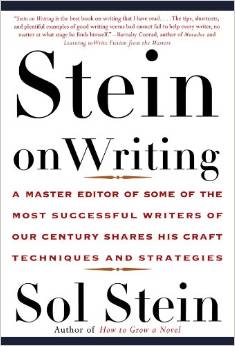
I just finished reading Sol Stein’s excellent book, Stein on Writing–A Master Editor of Some of the Most Successful Writers of Our Century Shares His Craft Techniques and StrategiesI found myself marking passage after passage, “This will be great to teach my students in my feature article writing class,” or “Wow, that’s a real encouragement to me,” or “I never thought of it that way before.”

Born in 1926 and now 88 years old, Sol Stein founded the book publishing firm of Stein and Day in 1962 which operated until 1989. During his tenure there, according to his website, Stein “edited and published some of the outstanding writers of the 20th century, including James Baldwin, David Frost, Jack Higgins, Elia Kazan, Dylan Thomas, Lionel Trilling, W. H. Auden, Jacques Barzun, and three heads of state.”

Describing his editing of Elia Kazan, Stein says,

The author I have spent more time editing than any other is Elia Kazan, winner of two Academy Awards and director of five Pulitzer Prize Stein on Writingplays who turned to fiction and became a number-one bestselling novelist. In his autobiography Kazan said, “I was now in a new profession. My publisher Sol Stein was my producer, and my editor Sol Stein was my director. . . . He saw quickly . . . that I delighted in saying the same thing over and over, thereby minimizing its impact (‘One plus one equals a half,” Sol would say’).” (205)

Throughout this book, Stein offers advice to writers of both fiction and nonfiction on the basics of plot, pacing, dialog, characterization, and just plain how to be a better writer and get noticed by editors. To flesh out the concepts he teaches, Stein uses anecdotes from his editing of great writers and from working with students in his classrooms. Speaking of his advice to Kazan:

Eliminating redundance was an important factor in [Kazan’s] novel The Arrangement remaining number one on the bestseller charts for thirty-seven consecutive weeks. . . . Catching “one-plus-ones” is a function of what is called “line editing.” Shouldn’t writers rely on editors to catch things like that? The hard fact is that editors do a lot less line editing than they used to. If a novel requires a lot of line editing, it is less likely to be taken on by a publisher, who has to consider the cost of editing. Which is why it is incumbent upon writers to become, in effect, their own editors. (205-206)

I know, I know. You want to be a writer. And I do know how difficult it is to see the forest for the trees. And, yes, you do indeed need readers in a critique group, you need editors and copyeditors who will see things that completely escape you. But here’s the deal. Write that article or essay or book and then let it simmer for awhile. Go away from it. Let others read it. Reread it yourself–slowly, carefully, out loud. If you’re fortunate enough to get published, editors and copyeditors will still bleed red ink all over it (or at least Microsoft Word comments), but it won’t be because you didn’t do your job.

Stein continues:

The biggest difference between a writer and a would-be writer is their attitude toward rewriting. The writer, professional or not, looks forward to the opportunity of excising words, sentences, paragraphs, chapters that do not work and to improving those that do. Many a would-be writer thinks whatever he puts down on paper is by that act somehow indelible. . . .

Judith Applebaum quotes Hemingway as saying to an interviewer, “I rewrote the ending of A Farewell to Arms thirty-nine times before I was satisfied.” Asked what stumped him, Hemingway said, “Getting the words right.”

Of the most successful authors I have worked with, I can think of only one who fiercely resisted revising. . . .Unwillingness to revise usually signals an amateur. (277)

Sure, we all want to be published. Sure, we’re in a hurry to get our words out into the world. But let’s make that writing, when published, something of which we can be proud.

Like Hemingway, let’s take our time getting the words right.


What Martin Eden (aka Jack London) Teaches about Writing and Editing

As I continue to write about editors and editing, I came across some very interesting insights in Jack London‘s masterful work, Martin Eden. Written as a thinly veiled autobiography, the story follows a low-class man and his desire for self-improvement in order to impress a high-class woman with whom he has fallen in love. He reads voraciously; learns language, grammar, and syntax; and teaches himself manners, politics, and philosophy. Eventually, he decides to become a writer–after all, he has many stories to tell from his travels around the world as a sailor.

Alas, every story he sends in is rejected and returned in what we would call the SASE (self-addressed stamped envelope). For years, he toils. He goes back and rereads the magazines to which he’s submitting to discover the “secret formula” for getting accepted. He spends hours and hours working at his craft, steadfastly refusing to bow to pressure from the woman he loves (and everyone else in his world) to just “get a job.”

He knows he’s a writer. He can feel it in his bones. He knows he has stories to tell, and he knows his stories are better than anything he’s reading in the magazines.

His money runs out. He barely survives. And the rejections keep coming. Martin begins to wonder:

He began to doubt that editors were real men. They seemed cogs in a machine. That was what it was, a machine. He poured his soul into stories, articles, and poems, and entrusted them to the machine. . . . There was no human editor at the other end, but a mere cunning arrangement of cogs that change the manuscript from one envelope to another and stuck on the stamps. (160-61)martin eden

The chief qualification of ninety-nine percent of all editors is failure. They have failed as writers. Don’t think they prefer the drudgery of the desk and the slavery to their circulation and to the business manager to the joy of writing. They have tried to write, and they have failed. And right there is the cursed paradox of it. Every portal to success in literature is guarded by those watch-dogs, the failures in literature. The editors, sub-editors, associate editors, most of them, and the manuscript-readers for the magazines and book-publishers, most of them, nearly all of them, are men who wanted to write and who have failed. And yet they, of all creatures under the sun the most unfit, are the very creatures who decide what shall and what shall not find its way into print–they, who have proved themselves not original, who have demonstrated that they lack the divine fire, sit in judgment upon originality and genius. (322-23)

Ever felt that way as a writer? Ever felt like the editors either don’t exist or are simply cogs in machines that send out nothing but rejections?

As an editor, I do have to take a bit of offense that Martin sees me as “unfit.” But as a writer, yes, I have at times wondered if anyone with any taste receives–and rejects–my queries, my articles, my blood-and-guts pieces of creative nonfiction.

I’m sure many writers feel the same.

But let me put in a little bit of a plug on behalf of myself and my editor friends.

  • We truly do want the very best writing. But, you need to understand how subjective that is. It’s a gut reaction to a piece of writing. And if you get rejected one place and you really believe in your piece, keep trying.
  • Everything needs to be edited–everything. Trust us. We will work with you to make your writing the best it can be.
  • Editors are human, and each one of us is different. No two editors will edit a piece the same way. Take the advice, but also understand that we are in a conversation with you when we edit.
  • We are busy. Sure, no one wants to wait months for a response, but we’re reading hundreds (sometimes thousands) of pieces. Hence, the form letters that get returned in your SASE. We simply don’t have time to give personal responses to everything. (That said, if you get any kind of response–such as a quick hand-written note on that rejection letter–take that as a huge compliment and keep on trying with that editor.)
  • And generally we aren’t failed writers who defaulted to editing. Many of us write on the side (and get the same treatment from fellow editors). There’s no club. Our work has to stand on its own, just as with everyone else. Many of us have no desire to write at all–editing is our calling and we’re committed to that.
  • Rejection doesn’t mean failure. A piece can be rejected for any number of reasons. It may be that your writing isn’t good–but if you’re in a critique group and you’re taking advice, that probably isn’t the case. It could be things you have no way of knowing–maybe a story like yours has already been accepted and now yours isn’t needed. It could be that gut thing I wrote of above.
  • We really do care about the submission guidelines, the formatting advice we give you, etc. Read these guidelines and follow them. Because we receive hundreds of manuscripts, if it’s apparent you can’t follow the simplest guidelines, then we won’t take the time to read what you sent.

Eventually, Martin Eden does find the success he so long sought, but it comes at a price. He discovers the down side of fame and some of the hypocrisy in publishing, which begins his undoing.

Bottom line, Martin Eden teaches us that it takes persistence, faith in yourself, and hard hard hard work to be a writer.

Don’t give up. Don’t let the editors get you down. Realize that they aren’t “rejection machines.”

Nothing’s perfect, but work with us. Your great writing will find its home.

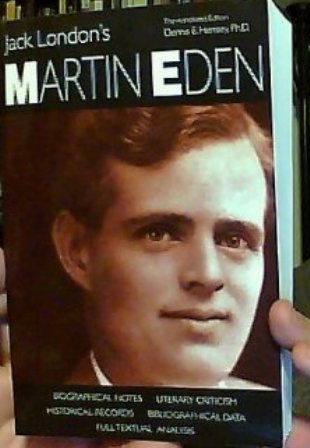
Quotations taken from Jack London’s Martin Eden: The Annotated Edition by Dennis E. Hensley, Ph.D. Upland, IN: Taylor University Press, 2006. This edition is pictured above.

Great Editors: An Interview with Stephanie Rische

Continuing to sing the praises of some of the unsung heros of publishing, I bring to you today an interview with my friend Stephanie Rische, who is a senior editor at Tyndale House Publishers. Stephanie works mainly with nonfiction–so that includes memoirs, inspirational books, devotionals, Bible studies, etc. I love that fact that she loves her work so much. Below, Stephanie answers some questions I asked her about her own process of editing and how it works at Tyndale.

stephanieHow long have you been working as an editor?
I’ve been at Tyndale House for almost a dozen years now. Before I started here full time, I edited curriculum on a freelance basis. I started out as a copy editor at Tyndale, and now I’m a senior editor, working with authors at a developmental level and managing one of our nonfiction teams. I wake up every morning marveling that God would allow me to read books for a living!

You generally edit nonfiction, but do you ever cross over into fiction? In your opinion, how familiar does an editor need to be in a genre in order to edit it well?
I love to read just about anything, but I edit nonfiction (memoir, devotional books, Christian living, children’s Bible storybooks, etc.). I think the best training to be a good editor is to read good writing. Part of your job as an editor isn’t solely to work on the manuscript in front of you; it’s also to do background reading in the genre you edit in so you know what readers are expecting, what the competition is doing, and what makes your manuscript stand out.

Give us a sense of your career path. Did you always know you wanted to do this job? Did you prepare for it in college, or did other circumstances lead you where you are today?
I have always loved to read. I remember missing my bus stop in second grade because my nose was in a book. I didn’t know much about editing until later in life, but in a sense I was being prepared for it through my love of books and writing and words in general. I’m not sure if this was a direct part of my career path, but I’ve always been a noticer. I enjoy observing and exploring, whether it’s little grammar details or big ideas.

In terms of my education, I received a strong foundation in English and writing from Taylor University, and then I taught English for several years. There’s nothing that solidifies your understanding of grammar and writing techniques like having to explain it to a roomful of teenagers who would rather be dong something else!

At Tyndale House, what is the process for acquiring manuscripts, and at what point do you receive the manuscript to begin your work?
At Tyndale the manuscript comes to me after the contract has been signed. In some companies, editors acquire and do developmental editing, but here those two roles are separated. There are advantages to each approach–the consistency is helpful when those roles are combined, but I appreciate that the division here allows me to be more of a purist about the editing process–to be devoted to the content and what’s best for the manuscript without having to weigh the financial and contractual side of things.

What is your process for editing? When a new manuscript lands on your desk, what tools do you gather and then what steps do you take to go from A to Z?
First, I do a manuscript review and make a plan for editing. At that point I talk to the team that acquired the manuscript and make sure we’re all in agreement about the vision for the book as we move forward. The next step is to meet the author (usually over the phone) and let him or her know what the editing process will look like. Depending on how much work the manuscript needs, I’ll go through it two more times–once to make the big-picture, structural edits, and once more to fine-tune and make line edits. It’s a funny thing about the way the brain is wired–it’s almost impossible to do the more creative, right-brained edits at the same time as the analytical, left-brained work. When I’m finished, I’ll send it on to a copy editor, who will do the fact checking and take a close look at the grammar and spelling.

Do you generally work back and forth with the author? What are the guidelines or expectations for that process—that is, do you always have to defer to the author or how much can you, as editor, press your point?
The back-and-forth process with authors is one of my favorite parts of editing. When people find out I’m an editor, they sometimes ask, “How do you decide who wins: you or the author?” But I don’t see the author/editor relationship as an adversarial one; it’s more of a collaboration. Both parties have the same goal: to make the book the best it can be. I marvel at how often the collaborative process of editing produces a third way–a solution that’s better than what the author or the editor would have come with individually. As an editor, I have the privilege of shaping and sharpening someone’s story, and it’s a responsibility I don’t take lightly.

For my students who are learning editing and want to eventually work in a publishing house, what would you tell them is the most important skill to acquire in their preparation so they can hit the ground running when the arrive in an editorial department for an internship or a job?

  1. Read a lot, and read widely.
  2. Read critically. As you read, be aware of what’s happening under the surface. Are there parts you’re tempted to skim? If so, why? If you’re hooked, what has the author done to make that happen?
  3. Learn the basics. Even if you want to do higher-level editing, those grammatical building blocks will help you understand language in a deeper way.bird by bird

Any favorite books about editing? What has been most helpful?

Anything else you want to add?
In his memoir On Writing, Stephen King offers these words of thanks to his editor: “One rule of the road not directly stated elsewhere in this book: ‘The editor is always right.’ The corollary is that no writer will take all of his or her editor’s advice; for all have sinned and fallen short of editorial perfection. Put another way, to write is human, to edit is divine.” His words are a bit tongue in cheek, but there is some truth in the idea that editing is a divine practice. As editors, we have a high calling to take someone else’s words and be part of that mysterious process of iron sharpening iron.


Maxwell Perkins on Film? Oh Yes! (Thank You, Colin Firth)

While most of the editors I’m telling you about tend to be in the shadows, behind the scenes, I am thrilled to announce today that my hero Maxwell Perkins (you can read Part 1 and Part 2 of my posts about him) is about to be immortalized on film.

Yep! Really.

And the lineup includes Nicole Kidman, Michael Fassbender, and Colin Firth (be still my heart!), who is playing Maxwell Perkins.

The film is called Genius. The indiewire.com website explains that:

The film is an adaptation of the National Book Award-winning non-fiction work “Max Perkins: Editor of Genius” by A. Scott Berg, and focuses on Perkins’ (Firth) relationship with the (excellent, underappreciated) author Thomas Wolfe (Fassbender). A writer who poured words onto the page, Wolfe worked with and battled Perkins over the length of his books, with the editor cutting 90,000 words from his first novel “Look Homeward, Angel” (later restored in an updated version of the book, “O Lost!“). In time, Wolfe became resentful of what he perceived was Perkins receiving far too much credit for his work. But on his deathbed at the age of 37, Wolfe penned a tribute to Perkins who certainly helped make his career.

And according to Filmnation,

GENIUS centers on the real-life relationship between literary giant Thomas Wolfe and renowned editor Max Perkins (Firth).

Finding fame and critical success at a young age, Wolfe is a blazing talent with a larger-than-life personality to match. Perkins is one of the most respected and well-known literary editors of all time, discovering such iconic novelists as F. Scott Fitzgerald and Ernest Hemingway.

Wolfe and Perkins develop a tender, complex friendship. Transformative and irrepressible, this friendship will change the lives of these brilliant, but very different men forever.

While I’ve discussed Maxwell Perkins’s relationship with the likes of F. Scott Fitzgerald and Ernest Hemingway, I haven’t delved into the complex relationship he had with Thomas Wolfe. WolfeIn the book I’ve referenced in previous blogs and from which the film is being made, Max Perkins: Editor of Genius, Berg recounts the piles and piles of manuscript that Wolfe laid on Perkins–leaving Perkins to attempt to make a manuscript that could actually be printed, bound, and published. Max would ask Wolfe to cut, only to discover that Wolfe had cut a few words and then added several hundred more!

So after reading about Wolfe, I decided to go to the source himself and read his book, The Autobiography of an American Novelist (originally published by Scribner’s in 1936; the version I have is Harvard University Press, 1983). This book, actually a collection of a few of his addresses, gives us, in Wolfe’s own words, a window into his intense emotions as a writer, his overwhelming feelings of inferiority, and his concern that nothing he did would be good enough. But, referring to Perkins, Wolfe writes:

During this time, however, I was sustained by one piece of inestimable good fortune. It was my good fortune to have for a friend a man who is, I believe, not only the greatest editor of his time, but  man whose character is also a character of immense and patient wisdom and gentle but unyielding fortitude. I think that I may say the chief reason I was not destroyed at this time  by the sense of hopelessness and defeat which these gigantic and apparently fruitless labors had awakened in me was largely because of the courage and patience of this man. I did not give in because he would not let me give in. . . . I was, myself, engaged in that battle, covered by its dust and sweat and exhausted by its struggle, and I think it is certain that at this time I understood far less clearly than my friend the nature and the progress of the struggle in which was I engaged. At this time there was little that this man could do except observe, and in one way or another keep me at my task, and in one way or another, in many quiet and marvelous ways he succeeded in doing this.

. . . My friend, the editor, has likened his own function at this trying time to that of a man who is trying to hang on to the fin of a plunging whale, but hang on he did, and it is to his tenacity that I owe my final accomplishment. (55-56)

One of the issues occurring in Wolfe’s personal life was an affair with Aline Bernstein. The Wall Street Journal article from Friday, October 24, explains that “[Kidman] is about to play Thomas Wolfe’s lover, the costume designer Aline Bernstein, in the film ‘Genius,’ about the book editor Max Perkins. . . . ‘She is a fiery, dark-haired, strong woman, flamboyant, ahead of her time. My kind of stuff,’ Ms. Kidman said.” Berg describes their relationship:

Aline Bernstein was forty-two and Tom Wolfe was twenty-four when they met on the deck of the S.S. Olympic in 1925. . . . She was settled in a passionless marriage. During their affair, Aline Bernstein supported Wolfe in every way through his struggles as an unproduced playwright and then inspired him to write his first novel. (Berg, 138-39)

However, by 1929, Wolfe’s passions had cooled but, unfortunately, Bernstein’s had not. The drama of this affair continued to affect Wolfe for many years.

Sounds like a story made for Hollywood.

But me? I’ll be watching it to see how Hollywood portrays my real hero, Maxwell Perkins.

Great Editors–Arthur Levine (and Harry Potter)

potterOne thing I’m discovering in my quest to sing the praises of the unsung heroes of publishing is that, too often, the unsung heroes like it that way. They’re quiet. They stay in the background. They enjoy the vicarious experience of watching their authors bask in the fame of a book that becomes a phenomenon.

Chances are, you’ll know the name of the author, but the editor of said book? Not so much.

So you know the author of the Harry Pottter series. (Who doesn’t?)

But do you know the name of her editor? (I’m guessing you don’t.)

Today meet Arthur Levine, the man behind the magic.

He actually has his own imprint (Arthur A. Levine Books founded in 1996) within Scholastic.  I just finished reading an interview with him in The Washington Post, published in July 2007 just prior to the release of the seventh and final book in the Harry Potter series, Harry Potter and the Deathly Hallows. Of course he, as editor, knew how the saga ended before the rest of us anxious readers. But he didn’t get caught up in the hype (well, he was thrilled, but he kept his focus in the right place).

“I’m responsible for the books,” he says.

I’m going to mention a couple of his great quotes from that article here, but I encourage you to read the entire interview by Bob Thompson: “The Wizardly Editor Who Caught the Golden Snitch.”

As I wrote about with Maxwell Perkins and F. Scott Fitzgerald, we might not have had J. K. Rowling and Harry Potter if not for Arthur Levine. The Harry Potter series was first published in Great Britain by Bloomsbury Children’s Books, but . . .

It wasn’t Bloomsbury’s responsibility to sell the U.S. rights to Harry. The company didn’t even own them. But when Levine showed up in Bologna seeking future classics for his new Scholastic imprint, Bloomsbury’s rights director gave him a set of Potter galleys. He read them on the plane home. When the book came up for auction, he kept bidding until, at $105,000, his last competitor dropped out. “I would have been willing to go further than that if I had to,” he says.

Levine must have told this story a thousand times by now. But there’s still excitement in his voice as he describes how he got instantly hooked — “first chapter, first pages” — on Harry.

I recall having the same feeling. I knew from the first page of the first book that I was in for an extraordinary ride–it was Rowling’s incredible writing that blew me away. Not just the extensive plotlines and characters and pacing and all of those things an editor looks for; it was her use of words. I remember how, when the first movie came out, and the camera pans into the great hall, I thought to myself, Yep, that’s it. That’s how I saw it when I read it. Her writing and descriptions absolutely astounded me.

Imagine being her editor! Levine lets us in on a little bit of the process:

He [Levine] was as surprised as any ordinary fan, he says, by plot and character developments as they arose. Which is exactly how he and Rowling wanted it. . . .

Sometimes, he would say, “I do not know what’s going on here,” and Rowling would say, “I didn’t want you to have that reaction at this point, so I think I’m going to move some information.”

At other times, when he asked about something in one of the earlier volumes, she would say, “That’s a good question. I’m okay with your wondering that here. I will answer that in Book 5.”

Blown away!

But Levine understands that aside from the hype and the merchandising and the trinkets and the Disney World theme park, it all comes back to where it started. With the books.

For a while, he’d felt as though he were living his own version of the Harry Potter story: Mild-mannered editor becomes publishing wizard. “I can still remember thinking: ‘Wow — even more people have discovered Harry Potter,’ ” he says. But eventually he decided “to be happy whenever something great happened” and then to bring “my focus back to where it needed to be.”

On the books.

Which, he maintains, are what’s driving the phenomenon in the first place.

And that’s where all great editors land. No, they aren’t at the book signings. No one is chanting their name. No one is standing in line awaiting a copy of their book at the worldwide midnight release date . . .

But for the great editors, that’s just fine. Great books are being put out into the world.

And that’s what matters.

Great Editors–Robert Loomis at Random House

My decision to use my blog to focus on the unsung heroes of publishing–the editors in the trenches–has sent me on an adventure of websites and book reading and rather intense study. But I am loving every minute of it. It’s just not all happening as quickly as my self-imposed blogging schedule might like. But I’m learning along the way about what makes great editors, and I want to pass what I’m learning along to you.

In any case, my trail led me from Maxwell Perkins (see Part 1 and Part 2 of my homage to him) to Bennett Cerf (one of the founders of Random House publishers, more about him later) to Robert Loomis, legendary editor at Random House who retired in 2011 after 54 years.

Right there. That should make him a hero.

You’ve probably not heard of him. But chances are, you’ve heard of some of the people he edited, such as Maya Angelou and William Styron (Loomis edited Sophie’s Choice, among others).

Indeed, the title of an article in The New York Times about his retirement announcement captures his essence: “Nurturer of Authors Is Closing the Book.”

The New York Times article says that upon hearing of his retirement, Maya Angelou said in an email, “Robert Loomis has been my editor since 1968. He has guided and encouraged me through 31 books. I can’t imagine trusting a manuscript in the hands of anyone else. I am not finished writing, so I cannot let him retire.”

That’s the kind of relationship great editors have with writers. The writers need those editors. They love them. They entrust their works and words to them. They know those editors make them that much better as writers. As the article title says, great editors are nurturers of writers.

In fact, from The New York Times archives is this tidbit from “Making Books; Familiarity Breeds Content“:

But while the news accounts go to the authors and editors who pop from one publishing house to another, the less celebrated but more interesting tales are those of continuity and loyalty. Sometimes they even become the stuff of literary legend.

Which brings us back to Ms. Angelou. Her editor is Robert Loomis, an executive editor at Random House, one of publishing’s hall of fame editors. “We are an item,” Ms. Angelou said. ”I would go with Bob if he left and went to a university press. He knows what I hope to achieve in all my work. I don’t know anybody as fierce, simply fierce, but he’s as tender as he’s tough.” . . .

Here’s an insight to a writer-editor relationship. Ms. Angelou said: ”He’s a nuisance. He asks these questions: ‘Why did you put a semicolon there, to give the thought some breath? Is that the word you really want?’ I’ve said to him many times you’re bullheaded, I’ll never speak to you again and then I send him night letters or telegrams telling him he’s right.

”When he finished the manuscript of my last volume he said: ‘Maya, thank you. This is great.’ In 33 years he never used that word for me. Great is good to him.”

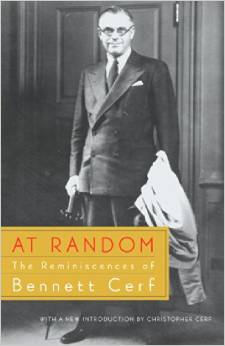
In fact, Bennett Cerf, co-founder of Random House (did you know they were so named because they printed “random” books?), counted on the relationships his editors had with their authors to bring those authors into Random House and onto their publication lists. If Random House was able to lure an editor away from a competitor, often that editor’s authors came along.

at random

In his book, At Random: The Reminiscences of Bennett Cerf (Random House, 1977), Cerf describes great editors like this:

A good editor, I think, like a good author, has to be born with some of the necessary talents, like a good memory and some imagination. But he also needs to have acquired a fairly broad range of interests, a working knowledge of the English language and a good supply of general information–the more the better–so that he can understand what an author is trying to do and be of help to him in doing it. An editor has to have read widely enough to be able to recognize and appreciate good writing when he sees it. . . .

An editor has to be able to get along with authors–which is not always easy. When the relationship is a good one, an editor can be extremely helpful by serving as a kind of sounding board for an author’s ideas and intentions, and by making suggestions aimed at sharpening and clarifying what the author wants to say. Also, the editor can be of value in pointing out parts of a manuscript that should be cut out because they are repetitive, or dull, or unnecessary. (219)

Being a good editor means caring about books, caring about language, and being a constant learner. Being one of the greats takes perseverance, relationship-building, honesty coupled with kindness, and a big dose of nurturing.

All of that because of a deep desire to help an author write the best book possible.

Great Editors–Maxwell Perkins, My New Hero (Part 2)

As I noted in last week’s post, I want to talk about the role editors play–and how vitally important they are. We can thank Maxwell Perkins for believing in F. Scott Fitzgerald and helping get his debut novel published. In his book, Max Perkins: Editor of Genius, A. Scott Berg describes the relationship between Perkins and Fitzgerald and quotes some of the correspondence back and forth as Fitzgerald worked on his novels.

After the great commercial success of This Side of Paradise, the publisher was ready and willing for more (funny how that works . . . ). Fitzgerald wrote short stories and another book for Scribner’s, and eventually he told Perkins about his next project, a book titled Among the Ash-Heaps and Millionaires. Perkins didn’t like the title. Fitzgerald had thrown out several other ideas, and The Great Gatsby was one, but Fitzgerald preferred Trimalchio in West Egg.

The Great Gatsby
The Great Gatsby

When the manuscript finally landed on Perkin’s desk, Fitzgerald sent a letter explaining that he wanted his latest title, but he wasn’t altogether happy with the middle of the book. “Do tell me the absolute truth, your first impression of the book, & tell me anything that bothers you in it” (64). Perkins reported that he loved it, but “said he had several points of criticism, all of which stemmed from his dissatisfaction with the character of Gatsby himself” (65). Perkins felt that he could spot Tom Buchanan if he met him on the street, but Gatsby’s character was vague. Perkins suggested that Fitzgerald describe Gatsby as distinctly as he had described Tom and Daisy.

Perkins also understood that Gatsby’s past needed to maintain a certain air of mystery, but Perkins didn’t want to shortchange the readers. He suggested that Fitzgerald pepper in some phrases that would give the reader some clues, “The total lack of an explanation through so large a part of the story does seem to be a defect” (65). That caused a problem at the novel’s fulcrum–the scene in the Plaza Hotel. Tom calls Gatsby’s bluff, but it wasn’t effective because the reader didn’t know what the “bluff” was.

Perkins wrote to Fitzgerald, “I don’t know how to suggest a remedy. I hardly doubt you will find one and I am only writing to say that I think it does need something to hold up to the pace set, and ensuing.” Perkins was also concerned that the parts of Gatsby’s past that Fitzgerald did divulge were all dumped together in one spot. Perkins suggested, “I thought you might find ways to let the truth of some of his claims like ‘Oxford’ and his army career come out bit by bit in the course of actual narrative,” although he added, “The general brilliant quality of the book makes me ashamed to make even these criticisms” (66).

Fitzgerald began his revisions–from the title page. He went back to the title Perkins had liked, The Great Gatsby. He responded to everything Max suggested. He broke up the block of information about Gatsby’s past and sprinkled the details into earlier chapters. He made Gatsby’s claim of his time at Oxford come up in several conversations. And one key change:

Again stimulated by something Perkins had said, Fitzgerald worked a small wonder with a certain habit of Gatsby’s. In the original manuscript Gatsby had called people “old man,” “old fellow,” and a number of other affected appellations. Now Fitzgerald seized upon the one Perkins had liked so much, adding it a dozen times, making it into a leitmotive. The phrase became so persistent a mannerism that in the Plaza Hotel scene it provoked Tom Buchanan into an outburst: “That’s a great expression of yours, isn’t it? All this ‘old sport’ business. Where’d you pick that up?” (69)

Through the process of writing, Perkins encouraged, advised, and offered suggestions, but always knew that the brilliance lay with the author. He simply wanted to make what was already great that much better. In the end, Fitzgerald wrote that it was Maxwell Perkins who helped him write a book he was proud of.

That’s what we editors do. We try to take what’s already brilliant and make it that much better. We hope we can help authors publish books that they, too, can be proud of.

You authors out there, have you worked with an outstanding editor? I’d love to know who that person is so we can all learn from the best!


Great Editors–Maxwell Perkins, My New Hero (Part 1)

So as it turns out, if it weren’t for an editor, there might not have been The Great Gatsby.

Yay for editors!

I have decided that–while it’s terrific to review books and interview authors–I’m going to go a slightly different direction in my blog in the coming weeks. I’m going to study up on some great editors from the past, and I’m going to interview some great editors of the present.

Because, well, I’m an editor. I know what it takes to work in the salt mines of editing manuscripts to make the good–the great–that much better. I know what it means to study typeset pages until your eyes cross, making sure no typos slip through because I want the author to look good. I know what it means to be in the background and let the author have the credit (as it should be).

I just want to bring some of these people out of the shadows and learn from them and, in so doing, pass along some info to you, my readers, and to the students in my editing classes.

After my last post about teaching editing, Rich Adin (who writes the blog “An American Editor“) commented, “We can teach people to be editors like me; we cannot teach people to be an editor like Maxwell Perkins. Perkins had that rare gift that made him the Michelangelo of editing.” Thanks so much for that comment, Rich, because that sent me on a quest to learn from the best.

perkinsAnd that sent me to A. Scott Berg’s book, Max Perkins: Editor of Genius (New York: E. P. Dutton, 1978).

Seriously, I’m so excited about what I’m reading I can barely stand it.

Maxwell Perkins (1884-1947) was the editor at Charles Scribner’s and Sons for the likes of F. Scott Fitzgerald, Ernest Hemingway, and Thomas Wolfe. The book is filled with quotes from correspondence between Perkins and these writers and anecdotes of how he worked with them–cajoling them, encouraging them, offering insight and advice on the big picture of each manuscript, and advocating for them at the meetings of the editorial board.

Mind officially blown.

No, I will never be Max Perkins–and, no, I cannot teach anyone to be Max Perkins. The next Max Perkinses will arise from folks with that internal “gift” that is, simply put, God-given.

But I want to learn from the best and pass along to my students what they, too, can learn from the best.

And for my students out there–I tell you this all the time–you probably won’t start out as full-fledged editors. Max didn’t even study literature or writing in college (Harvard); instead, he studied economics. But his real love was words, and it was a freshman English instructor who, as Berg puts it, “certainly . . . developed Max’s editorial instincts” (32). After graduation, Max went to work writing for The New York Times as the writer who hung around all night and picked up the “suicides, fires, and other nocturnal catastrophes” (33).

His first job at Charles Scribner’s and Sons was in the advertising department where he spent four and a half years before ascending to the hallowed fifth floor–the editorial floor.

And, students, guess what he did there . . .

He was a proofreader!

For the most part, Maxwell Perkins’s duties as an editor were limited to proofreading galleys–long printed sheets, each containing the equivalent of three book pages–and to other perfunctory chores. Occasionally he was called upon to correct the grammar in a gardening book or arrange the selections in school anthologies of classic short stories and translations of Chekhov. The work demanded little creativity. (12)

But then here’s what happened. A regular Scribner author named Shane Leslie became friends with a young author from Minnesota. Leslie sent this young author’s manuscript to the editors at Scribner. It got passed from editor to editor (no one liked it) until it ended up on Perkins’s desk. While he liked it, he was forced to write to the author and decline it (the lowly proofreading editor didn’t have much sway at first). But Perkins saw something in the young man’s writing, and the rejection letter held out some hope and encouragement to the young man who went to work revising and revising and revising.

The manuscript came back much improved, and Perkins went to work doing everything he could (and it was a lot) to get Scribner’s to publish it. At one tense editorial meeting, he said, “My feeling is that a publisher’s first allegiance is to talent. And if we aren’t going to publish talent like this, it is a very serious thing” (15-16).

The young author was F. Scott Fitzgerald. The book was This Side of Paradise (Scribner’s 1920).

What about The Great Gatsby? More on that next week.

Suffice it to say, Maxwell Perkins is my new editorial hero. And I’m his newest student.


Is It Possible to Teach Editing?

I’m working on my syllabi for my fall classes. It’s always an interesting challenge.

I like to use a white board--I can erase easily!
I like to use a white board–I can erase easily!

Today I’m working on the syllabus for my Editing class for the sixth time. The first time I taught it, it was a marathon course (in a “special topics” category) where I had four Saturdays across the semester to get it all in. The next two times I taught it, it was a once-a-week evening class. Then, the next two times, it was a twice-a-week class. And now, for the first time, it’s a three-times-a-week class, with each class a mere fifty minutes.

So as I laid out the skeleton of the syllabus yesterday with all of the dates (taking into account holidays), what started out as four classes is now thirty-nine classes.

A part of me loves that. It feels like I have so much more opportunity to teach everything that is so important to editing.

But it’s also always a huge challenge. Editing is difficult to teach. In fact, some would maintain that it can’t be taught at all. In his post titled, “Is Editing Teachable?” Rich Adin says this:

Editing …. is a craft, a skill. It is more than knowing an adjective from an adverb, a noun from a pronoun. It is more than being able to construct and deconstruct a sentence or a paragraph. We know that grammar and spelling are things that can be taught. Computers can be “taught” these tasks, even if they perform them rigidly and are unable to distinguish between “rain,”  “rein,” and “reign” in context. But editing has an air of unteachability about it.

True there are “editing” courses. But what is it that they teach? They teach the mechanics; they have to because it is not possible to teach one to be a good or great editor. If it were possible, there would be more great editors and fewer average editors.

Editing is art with words. Every artist knows how to mix colors and how to apply paint to canvas, but few artists master the craft of art. Every generation produces a handful of Vermeers and Rembrandts and Gauguins; every generation would produce millions of them if the trick to their artistry could be taught.

Editing is similar. There are many very good editors; there are few elite editors. Editing is a skill that can be nurtured and developed but which cannot be taught.

Well, that just takes the wind out of my sails . . . but I have to partially agree. Editing is a skill, a craft, indeed it’s “art with words.” It’s a way of putting together a manuscript that takes it from ho-hum to grabbing you and holding you in page-turning mode (which is why, by the way, great editors need to be good writers and voracious readers).

While many in the comments section of the above blog post opined about how editing can or can’t be taught, here’s what I try to do differently. I try to help my students find their “sweet spot.”

Here’s what I mean. Through the course of the class, I expose them to the three main types of editing and I let them know that these are very different skills. When we get to the end of the class, inevitably some have said they really like the big-picture editing, but proofreading–not so much. Others hated proofreading because they couldn’t, at that point, make any (or many) changes to the typeset pages; they preferred copyediting where there was still opportunity to improve the sentences. One or two may go out of my class realizing that they hate editing, it’s not in their “genes” (as one comment on that blog put it)–and that’s a good thing. College should be helping you sort out what you like and don’t like, where you’re gifted and where you’re not.

So can it be taught? I’d like to think it can–at least, what I teach are the basics that help my students find that sweet spot, that hot button, that then sends them on their own trajectories. If they love it, they’ll work to further develop that skill on their own.

After all, the great elite editors all started somewhere. I’m hoping a few of them start out in my class.