Just a little over 10 years ago, we started this conference, wondering, “If we build it, will they come?” Well, came they did, and we’ve been running a successful conference ever since. The conference is a natural outgrowth of the Taylor University Professional Writing major, where students are trained, among other things, to navigate the world of publishing. Meeting and networking (and sometimes interning) with agents, authors, editors, and social media experts from across the Christian publishing industry is just one of the many plusses of our program.
Here are 4 reasons you should attend our 2025 conference:
1. It’s short and inexpensive.
Our General Conference runs a day and a half and is packed with sessions and fun. It runs from Friday, July 25 at 1:00 to Saturday, July 26 at 5:00. During that time are options of 32 different sessions, 3 keynotes, open mic readings, faculty book signing, and one-on-one appointments.
And all of that (including meals) for just $139. You’ll get Friday dinner, and Saturday breakfast and lunch, and all of the activities above. If you’d like to stay overnight on campus, you can for an extra fee of $70/night.
2. Add a day for some extra, advanced training.
For $139, including meals, you can opt to come to one of our pre-conference tracks. Beginning at 1:00 on Thursday, July 24 and ending with lunch on Friday, July 25. This is an opportunity to go deeper with a particular topic. You can choose from the following two options.
Option A: Deep POV / Prepping Your Proposal
In this Advanced Track, you’ll be privileged to learn from literary agent, Linda Glaz, who had been acquiring manuscripts, editing them, and coaching writers for 13 years. You’ll learn on Thursday about deep POV, the kind of writing that will deepen the experience of the reader and allow him/her to stay in the characters’ points of view. Then, on Friday, you’ll do a deep dive into how to write a solid book proposal–one of your first steps for the gatekeepers in the publishing work.
Option B: Comics Unlocked
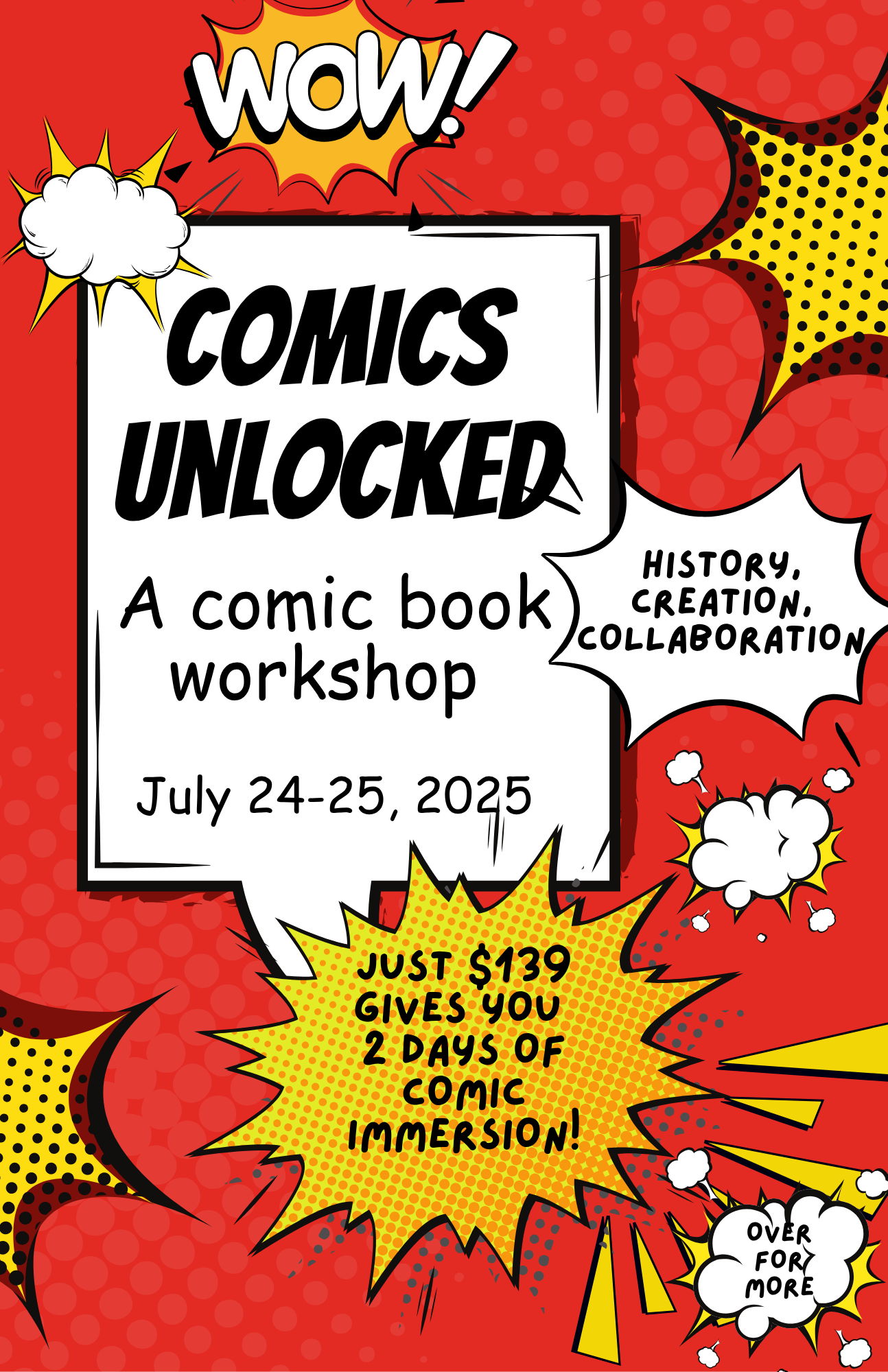
Your teachers (two Taylor U students) have been interested in comic books for their entire lives and are excited to share their knowledge with you. In their Comics Unlocked sessions, you’ll learn the history of comics, the craft of comic book creation (including formatting, script writing, pacing, and page layout), the artist/writer collaboration process, and possible paths to publication. You’ll also have the opportunity to work on your own comic book pitch and plan.
3. Do both a pre-conference track and the general conference for a reduced price.
If you choose one of the pre-conference tracks AND the general conference, you get both for $249. You’ll move seamlessly from having lunch on Friday after your pre-conference session to the general conference that begins at 1:00 p.m.
Some snapshots from our 2024 conference.
4. We’re great for all ages, types, and levels of writers.
Never been to a conference before? We’re ready to help you navigate with our friendly faculty and helpful staff (who just happen to be Taylor U Professional Writing students).
Just getting your feet wet in the writing world? We’re great for beginning writers to learn about what it takes and how to get started when it comes to being a writer.
Think you’re too old to start writing? You’re never too old. Lots of Bible characters have taught us that.
Think you’re too young? If you’re at least 16, we especially want to invite you to the conference. You’ll get to take part in all the sessions and networking, plus our college student staff will give you evening activities and a sense of what college life is all about.
Thinking you’re too advanced to need a conference? Maybe you’ve been around the industry a long time; maybe you’re a published author. Even so, there is never a time that you don’t need a refresher or some encouragement. And even better, you bring your expertise to those newer writers.
Check out the conference website at www.tupwc.com and register today!
A “Find Your Tribe” gathering of nonfiction writers at the 2024 conference.
I’ve seen it happen one too many times (and one time is too many) — well-meaning writers get caught in the net set by predatory “publishers.” The writers thought they were getting published, only to find themselves with an inferior product (if indeed they end up with any product at all) and out a whole lot of money.
In a writers Facebook group recently, someone posted that they had received a phone call from a publisher who wanted to publish her book. She had some red flags (how did they even get her number, she wondered), so she asked the group for advice. Thankfully, every response warned her that this is a scam. I so appreciate all those seasoned writers in the online world helping one more person to not be a victim.
It’s sad to say, but the world is full of folks who are ready to take money from us moony-eyed writers who simply want to get our words out there. So how do you spot a scam?
You can spot these “publishers” by how eager they are to publish your book. Their process is simple. They will target you, do a sales job, flatter you and your book, make big promises, and then ask for money.
The fact that they target you is the first red flag. That’s not how the publishing process works. Generally, literary agents and acquisitions editors are wading through piles of proposals. They are working with the folks who know the process, not out seeking newbie writers and calling them on the phone offering to publish for a fee.
Let’s say you wrote a post on Facebook about finally finishing the writing of your book and then, magically, you receive an email or phone call from a company that effuses about your book and says they want to publish it!
Wow, you think, I didn’t realize it could be so easy!
Well, my friend, it isn’t. These folks are simply preying on new authors who haven’t yet gained the knowledge and experience of what it takes to publish a quality book. In short, they will publish anything as long as they get their money from you up front. They have no editorial standards. Their goal is not to create a quality product or see your book do well.
They are going to approach you first, flatter you, do a sales job, ask you to send them your manuscript, and ask for a credit card number for a large chunk of money (we’re talking in the thousands: $4K, $5K, $12K) for a list of services that they say they will provide (some of which are virtually meaningless, others that may or may not be delivered or may not be up to industry standards — such as their editorial process). They will send you a contract but generally the terms are not standard in the industry.
Hear me say this: These publishers are not trying to work with you to create a book of high quality. They just want your money.
You see, with traditional or independent publishers, they invest in your book so they have an interest in it selling well. They vet your work before publishing by studying your book proposal and sample chapters. They edit and copyedit and proofread and lay it out and create a compelling cover design and help with marketing. Because they make an investment in your book, they want to see it do well. They want to make back their investment and make money on it so that you also can make money on it.
Not so with these scam publishers. You will pay money and have no say over anything. Most detrimental of all, they contractually often take away your rights to your book — meaning you actually no longer own your book. You’ll have paid out of pocket and lost control of everything — including your book. It’s a lose-lose. These predatory publishers can afford to publish anything (no matter how poorly written or how poorly someone they hire edits it) because they aren’t making money on the sale of quality books — they are making money off you, the client. You pay them up front, so they get their money regardless of what happens with your book sales.
There is absolutely no risk to them. Some may offer up a little bit of service, but very often you will find yourself with a poor quality product that only works against you. Again, it’s a lose-lose for you.
Note that I’m focusing on those places who contact you. These may fashion themselves as “publishers” or “hybrid publishers” or “self-publishers.” And unfortunately this puts a bad face on the legitimate self-publishing or hybrid companies that, while they do charge money for their services, are working on a business model that is trying to help you create a superior product. See the link in the bulleted list below of ratings of self-publishing companies.
The key is, if it sounds too easy and too good to be true, it probably is. So before you outlay a chunk of your life’s savings, do some thorough research.
Look for information about the company online, especially complaints.
Insist on receiving a sample contract that you can review. (If they want money first, don’t give it to them.)
Ask for some names of books the company has published that you can review. (Even if the company is legit, you do want to see what other types of books they publish so you know if you want to be part of their catalog.) If you can get your hands on physical books, even better, so you can check the quality. Get in contact with those authors online to ask about their experience.
Chances are, you do all of the above with that publisher who called and flattered you, and you’ll discover a scam. Steer clear. Ultimately, you may continue your quest to get traditionally published, or you may steer toward a hybrid or self-publishing route. But you’ll be in charge, you’ll research and contact legitimate companies, and you’ll be able to create a product you can be proud of.
One of the joys of having written a book about the publishing process is gaining the opportunity to step out of the pages and help people in person. I wrote the book to advise writers who have a manuscript (or maybe at this point, just an idea) and are asking, “Now what?” My book lays out the pathway to publication. And while I hope lots of writers find help in the pages, I also know that sometimes coming to a gathering to discuss the process and get answers to their questions is even more helpful.
So I’m offering up just that. I’d love to meet your writers group, come and hang with you at one of your meetings, share some of what is in the book, and do a brief workshop to help writers get started.
The workshop will walk writers through the basic questions that publishers want to know — whether you’ve got a book idea or an article idea. I’ll help the writers in your group articulate the focus of their writing and make a plan to move forward.
I’m happy to come and do a one-hour session, or even a couple of hours. Let me know where your group is at, the questions, they have, and the type of advice that would best help them. If you’re beyond my driving distance, I can set up a Zoom call for as long as you need.
Contact me for availability and charges. I promise, I’m very affordable! We’ll work together.
Let me help take the mystery out of the publication process. Let me help the writers in your group take their first steps on the pathway to publication.
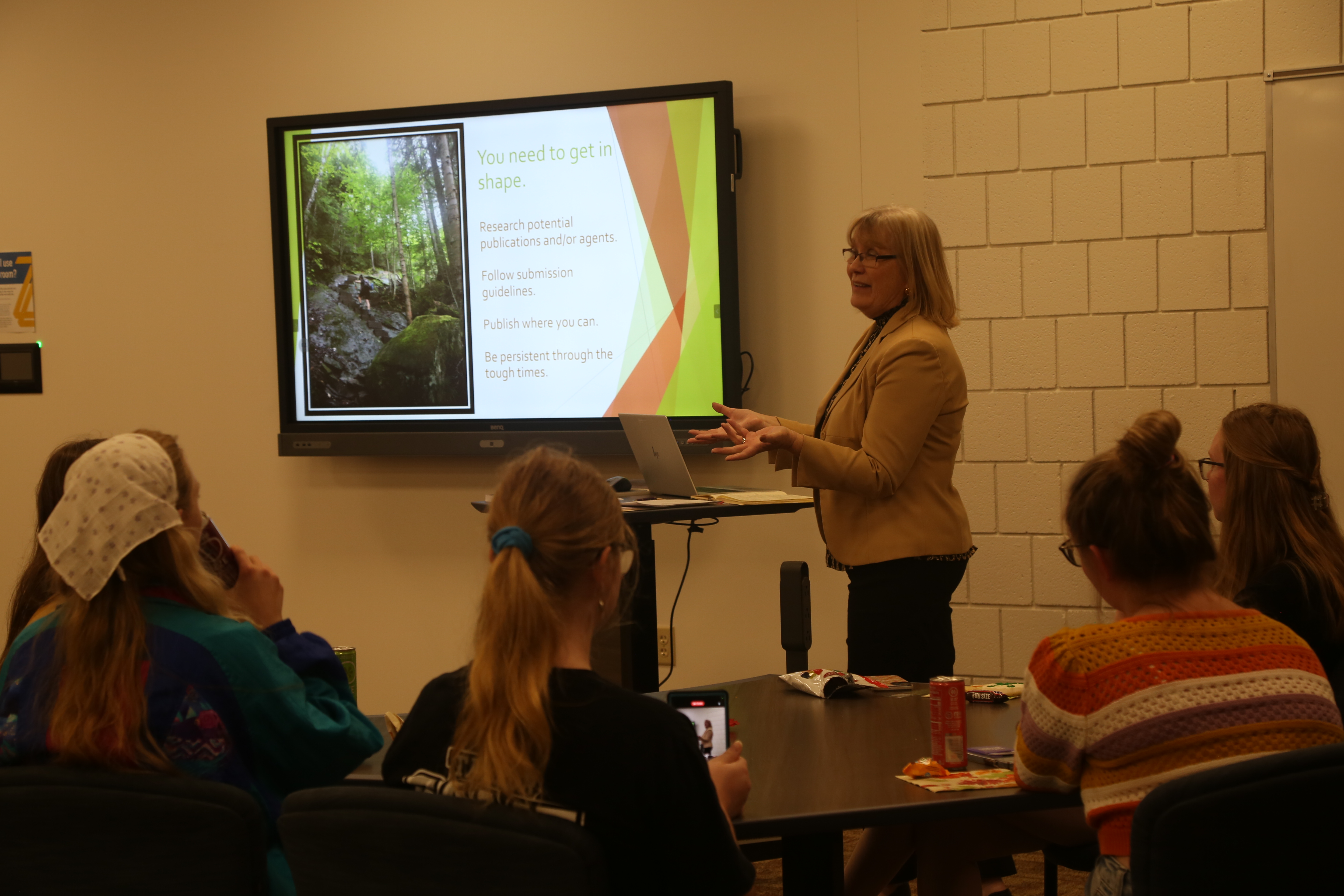
Following are a few photos from my book talk/workshop at Taylor University. (Cookies may or may not be included!)
As noted in Part 1 of this topic, quoting material from the Bible (and indeed any source) can be tricky. Editors need to be sticklers when it comes to sacred texts (and indeed, with any quoted material).
I offered 5 guidelines in Part 1. Here are 6 more guidelines when quoting (and then copyediting) material from the Bible.
(6) Watch your punctuation.
In addition to the quotation marks noted in Part 1, watch for other types of punctuation. The style for typing a verse within the text of a manuscript is generally quotation followed by punctuation. Notice in the following example that there is no punctuation at the end of the verse itself; instead, the period follows the close parenthesis of the reference.
“In the beginning the Word already existed” (John 1:1 NLT).
If your verse ends in a question mark or exclamation point, put that inside the close quote and put a period after the close parenthesis.
“Who has a claim against me that I must pay?” (Job 41:11 NIV).
“And Abraham said to God, ‘If only Ishmael might live under your blessing!’” (Genesis 17:18 NIV).
Notice in the Genesis verse that I had to add the open and close quotation marks around the entire verse, which means I had to put single quotations marks around Abraham’s words. The exclamation point stays, and the period is placed after the close parenthesis.
However, note that when you have a text in a block, the punctuation closes out the block with the reference without punctuation following.
You saw me before I was born. Every day of my life was recorded in your book. Every moment was laid out before a single day had passed. How precious are your thoughts about me, O God. They cannot be numbered! I can’t even count them; they outnumber the grains of sand! And when I wake up, you are still with me! (Psalm 139:16–18 NLT)
(7) Watch how you use ellipses.
Most publishers are fine with quoting a portion of a verse without ellipses at the beginning or the end. That is, if you’re talking about Jesus and what he said, and you want to drop off the “Jesus said” at the beginning of the verse and just quote what he said, you don’t need to include ellipses to indicate that you dropped the words “Jesus said.” The same often goes if you’re quoting just the first part and not the end; you don’t necessarily have to include the ellipses trailing at the end. Of course, you must use ellipses if you’re dropping material from the middle of the verse, or dropping a verse from a series of verses, to indicate that material is missing.
However, I would advise you to make these kind of changes carefully. Always remember that you’re working with God’s Word. Be respectful of it for its own sake and for the sake of your readers. Be careful not to cause contextual problems with ellipses. Make sure that you are letting the verse say what it says, without causing confusion by dropping out parts of it.
(8) Follow consistency in references.
While it’s important to know what to do with the Bible book name throughout your references, you will need to make several other consistency decisions as well—or you might ask your publisher how they want you to do it by requesting their style guide. (You can also get advice from The Christian Writer’s Manual of Style.) This attention to consistency may seem like overkill, but trust me, if you make these decisions early on and are consistent, your manuscript will make so much more sense to an editor and ultimately to your readers. For instance, in the Christian Writer’s Manual of Style, you’ll find an alphabetized text that includes extensive word lists of Christian terms and suggested spellings and capitalizations, along with every other question you might have and want to look up (for example, “Clerical titles and clerical positions” and how to use them is in the section for the letter C).
If you’re going to be quoting several verses from the same chapter (say, you’re discussing the story of Daniel in the lions’ den and your readers know you’re in Daniel 6, but throughout the coming pages you’re working your way through different verses), decide how to handle each reference. It might look awkward to put the full book name or even the abbreviated book name and chapter in each reference after each quote. Maybe opt for saying (verse 6) and (verse 7) and (verses 8–9), or maybe even (v. 6) and (v. 7) and (vv. 8–9). Or maybe keep just the chapter without the book name (6:6), (6:7), (6:8–9). The most important consideration is clarity for your readers.
(9) Let readers know if you are using emphasis.
Perhaps you want to emphasize a portion of a verse you’re quoting. Do that by putting it in italics, but let your readers know that the emphasis is yours. (This rule is true for quoting from anything anywhere, not just Scripture.) After the reference, say something like “italics mine” or “emphasis mine.” If you want to focus on the word patience in these verses about the fruit of the Spirit, do this: “But the Holy Spirit produces this kind of fruit in our lives: love, joy, peace, patience, kindness, goodness, faithfulness, gentleness, and self-control” (Galatians 5:22–23 NLT, emphasis mine).
(10) Use brackets to indicate added material.
As we’ve established, quoting from anywhere is sacrosanct. Leave the quote exactly as it is rendered—and this rule is obviously extremely important in Scripture. But sometimes, you’re quoting and must give your readers some context. Indicate that you are editing the direct quote by putting the edited material in brackets.
For example, quoting Genesis 45:25, “So they went up out of Egypt and came to their father Jacob in the land of Canaan” (NIV). You might need to explain who “they” refers to. Revise the verse to explain who “they” is by replacing the word and putting the referent in brackets, as follows: “So [Joseph’s brothers] went up out of Egypt and came to their father Jacob in the land of Canaan.”
Don’t use parentheses, because parentheses could be part of the quote. The brackets make it clear that you have added the material.
(11) Stay true to the Bible version.
Take care to always use the place and people names as rendered in the version you’re using. For example: Is that son of Saul named Ishbosheth or Ish-bosheth or Ish-Bosheth or Ish Bosheth? It’s actually all of them, depending on the Bible version. Some versions have John the Baptist’s mother spelled with a z “Elizabeth,” some with an s “Elisabeth”; some have his father as Zechariah and some as Zacharias. In some, Esther is married to King Ahasuerus; in others, King Xerxes.
Did the Israelites wander for 40 years in the “desert” or in the “wilderness”? Depends. In some Bible versions, place names are rendered as two words, others hyphenate, others just run them together, and capitalizations vary: Baal Peor, Baalpeor, Baal-peor, or even Baal of Peor.
This is not an issue of error; it’s an issue of translation and sources and Greek and Hebrew—and I suppose, whatever the translation committee eventually agreed upon.
And then, of course, some versions include upper-case deity pronouns (such as the NKJV) and some do not. So in some cases God is Him, His, Himself; in others, him, his, himself.
Even if a publisher’s style guide says not to capitalize deity pronouns, if in that same book you quote from a Bible text that does capitalize those pronouns, then always quote the Bible text as it is.
I know it seems like a lot, but, as with anything, the more you do it the easier it will become.
When quoting anything from printed material, always be exact, always give the source, always double check yourself.
After all, if someone quotes you, you would want it to be your exact words.
Because I worked in Christian publishing for many years, I have learned a thing or two about copyediting and proofreading quotations of Scripture.
Authors have a tendency — no matter how careful they are — to inadvertently misquote the words of a verse, miss punctuation, or (often) give the wrong reference.
That’s where careful copyediting and proofreading comes in. (This post will focus on the technical details; it goes without saying that you as copy editor will want to make sure that your author is quoting the verse in context and correctly handling the word of truth, as noted in 2 Timothy 2:15.)
Some authors decide that they will quote just from one version of Scripture throughout their self-help book or devotional; others want to use a variety of versions. All versions read differently, and these authors may want to change up and quote different versions just because of the way it renders a passage. If you’re an author, please always tell your editor what version of the Bible you’re quoting.
If your author has quoted from only one version throughout the manuscript, there is no need to give the Bible version after all of the references. The line on the copyright page stating that “All Scripture quotations are taken from …” is sufficient. However, if the author at one point decided to quote from another version—even just one verse—at that verse reference the author will need to note the version, and then you as copy editor need to make sure that the correct copyright clause for that Bible version has been added to the copyright page.
Some publishers follow the Bible quoting and sourcing guidelines in the Chicago Manual of Style, others follow The Christian Writer’s Manual of Style. In addition, all Christian publishers have their own style guides for how to abbreviate Bible book names (Deut., or Deu., or Dt.), how to write references (hyphen, comma or en-dash between verse spans), and the capitalizations of various scriptural words (temple or Temple; rapture or Rapture). Some publishers use the lowercase letters a or b to indicate in the reference that the author is using the first or second part of a verse (Psalm 139:14a); others don’t do that. If you are editing for a particular publisher, ask for their style guide. If not, make your decisions at this point and note them on your style sheet so that you’ll be consistent.
Over the years, I’ve gathered up a list of items important to remember when quoting from or otherwise using Scripture in writing. Following are the first five of ten key rules for quoting and sourcing Scripture (the other five will be in the next blog post).
(1) Know what version(s) you’re using—and quote it correctly.
“Be careful, for writing books is endless” (Ecclesiastes 12:12, NLT).
“Of making many books there is no end” (Ecclesiastes 12:12, NIV).
“There’s no end to the publishing of books” (Ecclesiastes 12:12 MSG).
Follow the various style guides or the style guide from the publisher for the details; barring that, be consistent. Use your style sheet to make note of how you write the references (1:3, 4 or 1:3-4 or 1:3–4) and whether you’re writing Bible book names out in full or abbreviating them (and how you abbreviate them). The moral of the story is, be consistent.
By far the most important key to quoting Scripture is to quote it accurately. I can’t stress enough: Read the verses carefully, word by word. If I had a nickel for every time I’ve seen typos in quoted verses … well, I’d have a lot of nickels. And if the author has copied verses from Bible Gateway or some other electronic Bible, still double check it. Do a comparison read, a phrase at a time—read aloud and read the punctuation as well. If you’re working with an electronic Bible, minimize both screens so that you can see the document and see the electronic page at the same time. That makes it much easier than trying to flip back and forth between screens.
(2) Be sure that “Lord” or “God” is small caps where appropriate.
Throughout the Old Testament (and in the New Testament when it’s quoting the Old), the word Lord will be rendered as LORD, with the “ORD” as small caps and, in a few cases, GOD is that way as well. (Note that my WordPress program isn’t allowing me to make those small caps, but take a look in your Old Testament and you’ll see what I mean.) When you see Lord in small caps, you’re seeing the translators using this special formatting to show that the word is the Hebrew word for the name of God, YHWH or Yahweh, as opposed to other names of God (Elohim or Adonai, for example). It is important that when you quote Bible verses that have small caps, you include those small caps.
If you’re not seeing a verse quoted with the small caps and it should be, you can quickly create small capitals by highlighting the “ord” (make sure that you start with the letters in lower case) and then pressing Control + Shift + K. You can also highlight the three letters, navigate to the Home ribbon and Font tab with the dropdown to open up the Font menu, and then click on the box for “Small caps.” Mac users, do Command + Shift + K.
(3) Don’t worry about italics.
Some Old Testament texts italicize words that have been added for readability in English but are not technically in their source texts. You may not see these on the electronic Bibles, but if you’re copying from your Bible, you may see various words italicized. Unless the words are italicized for other purposes (for example, in the New Testament where Jesus speaking in Aramaic), then don’t worry about copying the italics. Most publisher style guides specify not to do that.
For example, Genesis 1:10 in the King James Version reads, “And God called the dry land Earth; and the gathering together of the waters called the Seas: and God saw that it was good.” Notice the italics on “land” and “it was.” When you copy this verse into your manuscript, you don’t need to italicize those words. (However, note that you do need to maintain the capital letters beginning Earth and Seas.)
However, if you’re quoting Jesus as here in Matthew 27:46 in the New International Version (2011): “About three in the afternoon Jesus cried out in a loud voice, ‘Eli, Eli, lema sabachthani?‘ (which means ‘My God, my God, why have you forsaken me?’),” then preserve the italics because this verse is following the rule of putting foreign language words in italics.
(4) Use quotation marks accurately.
Generally, when you’re going to quote a verse, you will put it in quotation marks, as here, “But God showed his great love for us by sending Christ to die for us while we were still sinners” (Romans 5:8 NLT). However, if you’re quoting a passage with more than five lines, generally you’ll put that in a block, so then you will not use open and close quotes (this line-count rule applies to quoting any kind of block text—not only Scripture). For example:
We can rejoice, too, when we run into problems and trials, for we know that they help us develop endurance. And endurance develops strength of character, and character strengthens our confident hope of salvation. And this hope will not lead to disappointment. For we know how dearly God loves us, because he has given us the Holy Spirit to fill our hearts with his love. When we were utterly helpless, Christ came at just the right time and died for us sinners. (Romans 5:3–6 NLT)
If you’re running a quoted Scripture verse into your text that has a quote within it, you will need to change the double quotes to single quotes, such as, “Jesus told him, ‘I am the way, the truth, and the life’” (John 14:6 NLT). Notice that since I had to enclose the quote in quotation marks to quote it here in this paragraph, I needed to change the original double quotation marks around Jesus’ words to single quotation marks. Also, if you need to capitalize a letter at the beginning or lower case a letter because you’re folding the quote into a sentence you wrote, do so.
The exception is when you do a block (as above). Since there are no open or close quotes around a block of text, any internal quotation marks will remain as in the original.
(5) Don’t include verse numbers.
When you’re quoting more than one verse, either running into your text or in a block quote, you don’t need to include the verse numbers at each verse. These verse numbers may carry over from electronic Bible software if you copy a block of material, so be sure to remove them.
“Versification” refers to those Bibles where each verse starts in a new paragraph; that is, the verses are not run together to create paragraphs. When you’re copying from such Bibles, you do not need to keep the verses separate. That is simply a stylistic decision made by the Bible publisher. For your purposes when quoting, run the material together into one paragraph.
The same rule applies to quoting poetry in Scripture. You can preserve the poetic lines or type the poetry into paragraph form. Also note that when presenting poetry together into paragraph lines, you may need to lowercase some letters. The text may have capital letters at the beginning of each new line or verse, but when run together, these would be incorrect. Fix the capitalization to match sentence case.
I know! There’s a lot to keep track of!
So that gets us started! We need to be very careful as we work with material that quotes Scripture. Watch for rules 6-10 in an upcoming post.
Here she is. All 332 pages of her. I told you about this book contract and, well, after some weeks of imposter syndrome and some constant worry about if I could actually write this book … well. Ta-da.
The working title is Pathway to Publication. I’m still trying on some subtitles, such as “A publishing professional turned college prof leads the way” or “guides you.” Not sure yet. But we have a little time to hone that part.
The writing process has not been easy. I look at these pages and honestly am astounded.
But it wasn’t done alone. It took a team of people to help me get to this point (and I’m not even at the publisher yet!).
A dear publishing friend helped me see beyond the “this has already been written a million times” dilemma to look instead at my personal perspective on this publishing process. She helped me see that I could write this from the college professor angle — so the book is shaped by the college classes I teach in Professional Writing and is very hands-on, including worksheets to help readers go from the theoretical to the practical. (Thank you, Kim.)
Another publishing friend recommended that I revise my website to focus on the teaching angle and build on that. (Thank you, Rhonda.)
My sister has been talking to me about preparations for her thru-hike of the Appalachian Trail next year. The more she talked, the more I discovered a hook I could hang this book on — preparing for the months on the AT could be compared to preparing a book for publication. That metaphor helped me lay out the chapters. (Thank you, Carol.)
A former student who now has a business helping authors promote their books will help me create a pre-publication marketing strategy. (Thank you, Jori.)
A high schooler I met at our writers conference teen track, who is new to the publishing process, is reading some chapters to help me know if I’m answering her questions. (Thank you, Eliana.)
A current student and another writer friend are reading to see if I’m staying true to the content and my voice, writing clearly, and speaking in the right way to my target audience. (Thank you, Anna and Dave.)
And, finally, yet another student who has started his own freelance editing business just completed an astounding copyedit of the manuscript. He caught me in my wordiness and in my tics. He smoothed and refined and questioned and commented. And, as I taught him in editing class, he remembered to offer a few positive comments as well. And boy, did I need them! (Thank you, Kipp.)
And I’m thankful to the many publishing professionals I’ve learned from across my almost forty years in the industry. Their wisdom guided this book. I’ve added their titles to a recommended books list and quoted several of them throughout. Instead of feeling like “this is just another book on the same topic,” I simply feel humbled to add my voice to the many others who have a passion to help writers.
All of this to say, we writers need folks around us — some with publishing advice, some with writing advice, some with editorial skill, some with marketing skill, some acting as the target audience readers — to bring out the best in our manuscripts.
I still have a week to go with this pile of paper before it goes off to the publisher. That’s why I printed it. I always need to see it on physical paper to highlight and mark the final changes I need to make.
Then, of course, the editor at the publisher will tear it apart — but I already know that. I teach about this. (Thank you, Bold Vision Books.)
I tell my students this all the time: “You want to be a writer? You want to get published? You want to get your writing into the hands of readers? Then develop a thick skin.”
Sounds tough, I know. But it’s 100 percent true.
And this theme is a key element of my upcoming book, which has no title yet but is right now affectionately called, “So you’ve finished your manuscript? You want to get published? Here is everything you need to know, prepare, do, and plan for.” I know, too long. But that’s basically what it’s about.
And there’s a whole chapter on the idea of having a thick skin. Because writers need it.
We need it before we get published, and we need it after (which I will discuss in a later post as Part 2).
First, the BEFORE. Anyone who has been writing and submitting for more than a week has discovered that rejection is simply a part of the process. Writers need thick skin to be ready to handle those inevitable rounds of rejection and maintain personal mental health. No matter how many years you’ve been at it, no matter how many pieces you have or have not published, those four simple words “not right for us” hit right in the gut.
Every. Time.
Why does it hurt so much? Well, as a much-rejected writer, I believe it just comes down to how much of ourselves we put into every piece we write and how rejection feels like a rejection of us personally. Whether it’s a literary story, or a transparent memoir, or a how-to on keeping houseplants alive, we worked hard and put ourselves out there. So it is always with great fear and trembling that we send out the piece or the query or the proposal and anxiously await the response.
We fear that someone out there will laugh uproariously at our audacity to think we can write and that anyone would publish us, show it around so everyone else laughs at our expense, and then reply with the terse email, “Not right for us.”
Courtesy of memebetter.com meme generator (which I love!). Grumpy cat photo and meme created by Tabatha Bundesen.
Can I offer up a few facts to help keep those rejections in perspective?
However, first, I’m going to assume that you are a careful writer and researcher, that others have read and critiqued your work, that you’ve revised and revised to make it the best you can deliver. That is my assumption. (Please don’t be one of those writers who tries to send off the first draft or who dares to think that “God gave me the words” so therefore it’s perfect as is.) Good, solid writing takes time and care.
Beyond that, here are some thoughts from my own (and many others’) experiences:
Everyone gets rejected. Every single famous author started out right where you are — wallowing in the misery of the “not right for us.” If you don’t believe me, here’s an article about best-selling books that were initially rejected (often many times).
You have to understand how many pieces these editors are seeing every single day. Sometimes hundreds. You have a lot of competition when there are a couple hundred submissions for a single spot in a magazine, or when there are hundreds of book proposals for perhaps five publication slots at an imprint of your genre for the next publication season. So don’t take it personally.
It could be that, although your piece or proposal is stellar, someone got in right before you with something very similar. And yours gets rejected. There’s no way you could know that.
Acceptance is very subjective. The gatekeeper reading your query or literary piece or proposal needs to “feel it.” They need to resonate with your topic or your voice. And if they don’t, then it will be rejected. Not because you’re a terrible writer, but simply because this particular editor just didn’t have that gut reaction. And there’s no way you can control that.
Rejection is about the piece, the query, the proposal — it is not a rejection of you as a person or as a writer (no matter how much it feels that way).
So how can you handle rejection? Here are a few more thoughts:
Allow yourself to feel bad for a bit. It does hurt. (Give yourself a day to wallow, if needed. But no negative self-talk. Remember, it’s not a rejection of you.)
Pick yourself up, dust yourself off, and go back to your tracking system for the next place to submit. (You do have a tracking system, don’t you? If not, create one. Make a list of all the places you want to submit to on something like an Excel doc. More on that in a later post — oh, and also in my upcoming book. <just a teaser>). What I mean is that on such a list you can now mark down that XX publication or publisher rejected it, so now turn around and send it to YY. Of course you’ll have to revise your piece, and double check submission guidelines and word counts, but get it out there again. If you really believe in it, keep trying at other places. You might hit right at the moment when they DO need just your piece and the editor DOES resonate with it.
You could even take an optimistic approach, like this writer, on why you should aim for 100 rejections a year (pardon the swear word in the article — but the point is valid). The basic premise is that the more you’re submitting, yes, the more you’ll get rejected, but by the law of averages, it also means the more chances you’re giving yourself to eventually be published.
Stay classy, don’t burn bridges with any editor or publisher, and thicken that skin.
You writers out there who have experienced rejection, how do you handle it and keep your writing sanity?
Hey writing friends! I just have to share some good news.
I got a contract for another book and I’m so excited.
I’ll be working again with Bold Vision Books, who published my last book titled Word by Word: An Editor Guides Writers in the Self-editing Process (you can read more about that book here).
This will be a revised and expanded version of that book–probably incorporating much of what is in the current book but then bringing in everything that a writer should be doing in the process of preparing for publication. After all, the actual writing of the manuscript is only part of the process.
So I began an outline. See what you think. What am I missing?
Seeking an agent
Seeking a publisher
Building (or enhancing) your social media presence
Self-editing your manuscript (that part I have)
Going to writers’ conference and what to expect
Writing the book proposal
Writing the one sheet
Perfecting your pitch
Preparing for book promotion
Being confident in your work
Handling rejection
Handling acceptance
Understanding contracts and rights
As I have attended and taught at many writers’ conferences, I have begun to realize how much knowledge of the industry I take for granted and how much most people simply don’t know. A one-stop basic book for writers just putting their toes into the publishing waters will offer them understanding and confidence as they move through the process of trying to get published.
There is a lot to unpack here. If you have thoughts about something newbie writers should know but don’t — in other words, topics I should address in the book — please comment below or write to me. I would love to hear from you.
From the fire at the end of August to our now sadly undecorated and still unfinished restoration that will not happen before Christmas (we’re living in two rooms and a kitchen), life has managed to be an adventure.
Meeting author Travis Thrasher (above) and Steven James (below).
October found my husband and me visiting Washington D.C. Highlights included the Library of Congress, seeing the Gutenburg Bible, all the wonderful monuments, and meeting up with several dear high school friends I haven’t seen in over 40 years.
But the main reason for visiting was to attend a celebration at the Museum of the Bible honoring the release of the third edition of the Life Application Study Bible. (Read more about the event here.)
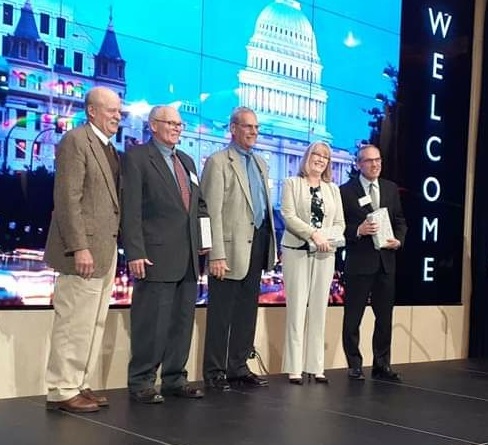
Thirty years ago, this group (pictured above) worked together on what would become the bestselling study Bible of all time (I discussed the process here.) We didn’t know then that God would use our prayerful labors to sell 20 million copies so far of the Life Application Study Bible. I am humbled to have worked with this group and appreciate the honors we received on the evening of October 16 as the pioneers on the project, now also celebrating those who completed work on the third edition of this Bible that has been updated for a new generation. We so enjoyed hearing from special speakers Ed Stetzer (director of the Billy Graham Center in Wheaton) and Dr. Barry Black (chaplain of the US Senate). It was a wonderful evening of celebration of the power of God’s Word.
Finally, in November, Tom and I drove to Nashville to attend the meeting of the Evangelical Christian Publishers Association. I recently became a member of this group, knowing that in my teaching about publishing, I need to stay on the cutting edge of the industry. Was fun to see a former student, Amy Green, publicist at Bethany House, who helped to plan the Christy awards celebration.
Enjoyed hearing from musician and author Andrew Peterson. His book, Adorning the Dark, will be a text in my senior capstone class this January.
Now I’m prepping for final exams and papers and decidedly NOT decorating for Christmas. But we’ll get in the spirit. I’m looking forward to sharing how I’m working on that. Stay tuned!
How was fall for you? What are you doing to get into the holiday spirit?
After we completed several versions of the Life Application Study Bibles (as I’ve mentioned in the last couple of posts, here and here), someone came up with the idea of creating actual commentaries—one for each book of the New Testament. Seventeen red volumes—some including two or three of the smaller books in one volume.
Several more years of intense work. Our study notes for the Life Application Study Bible had been necessarily limited by word counts and physical space on Bible pages, so we couldn’t include much of the material that we had gathered in the course of writing the notes. And, in the process of writing the notes and working our way through the piles of commentaries in the middle of our conference room table, we learned that most commentaries are extremely difficult to read and, while they offer information, they lacked that vital “so what?” element that had become our mantra.
Our team set out on another five years of work, making our way through a verse-by-verse commentary of every verse in the New Testament. I was still at home, working as a freelancer. My job was to create the skeleton of a note for every verse. I would start with what we did on that verse in the LASB (if, indeed, we addressed it there). If not, I worked as we had in our meetings—checking every commentary, reading what it said, condensing it to something readable, tying it to the context, making it interesting, applying it to today. With my home office desk piled high with commentaries, I began the process of doing, on my own, what we had done in a group. Bible chapter by Bible chapter, my rough material would go to the same guys to do their own edits and additions.
Some have asked me in the past how I could possibly work on the Bible this way, actually writing commentaries. “You’re not trained. You’ve not been to seminary. I don’t see how they could let you loose on something this important.”
I took this to heart and at first was really frustrated. Working with the Bible is a huge responsibility. It has to be right. And some passages have many interpretations by sincere believers. Why were they trusting me with this?
Then it struck me. Part of my work had to do with the fact that I knew our process. We had honed it in those hundreds of hours working together in the conference room writing the notes for the Bible. And my part? I had to be able to read and understand, and then I had to be able to rewrite in a readable way.
That was it. And I was by no means the final voice. What I wrote as a rough draft was read by our team of pastors and M.Divs. and Bible scholars for their revisions and edits—piles of pages coming back to me with my skeleton often intact but lots of red markings.
I realized that I didn’t have to be a Bible scholar to do what I was doing. Of course, all of the reading was giving me a vast education—I might as well have been in seminary. But in the end, it came down to being able to write well. To take a tough topic and condense it down for an unscholarly audience (like me) to be able to understand it. Simplifying scholarly material for an unscholarly audience seemed to come naturally to me.
It’s the same with anything I edit. I don’t have to be an expert in the topic of the book I’m editing—indeed, there would be no way to do so. I just need to read each manuscript with fresh eyes (as a reader would) and make sure that I as reader am following, getting what I need, understanding, not getting lost.