5 ways to stay sane on social media

We all probably have a love/hate relationship with social media. In these difficult times, how can we stay sane (and Christian) on social media?

I have talked often about the Social Media Strategy class I teach each semester at Taylor U. This summer, I wanted to rethink the class to make sure I am staying on the cutting edge of what’s happening in the social media world. I read (and highly recommend to you) two books:

Following Jesus in a Digital Age by Jason Thacker (Downers Grove, IL: InterVarsity Press, 2022)
Posting Peace by Douglas S. Bursch (Downers Grove, IL: InterVarsity Press, 2021)

I’d like to share with you a few takeaways that I also shared with my students, sourcing some quotes from these books as I go.

One key thing to realize right from the start: Technology is shaping our lives and our expectations.

We are so used to getting anything we want quickly. Amazon delivers in a couple of days. Have a question? Google it and have the answer in a matter of seconds. Click a button; get what we want.

The problem with this is that what’s real in life doesn’t work that way. Spiritual growth is a long, slow process that takes us a lifetime. There isn’t an app that will make us spiritual. Relationships — whether marriage or family or friends — take time and must weather ups and downs. How easy it is to decide something is too hard or taking too long, so we shut it down, let it go, turn away.

Technology has made us incredibly impatient. It has changed our expectations for how life should work. And not for the better.

So from these two books, I came away with 5 key points regarding our use of technology and social media that I shared with my class and I’d like to share with you. These are the things we need to keep in mind:

1. Keep in mind how social media is shaping us.

Wondering why social media can be such a toxic place (my goodness, especially now in a very divided country staring down a very divisive election)? Here’s what Bursch writes:

“Social media is more than just a medium for communication. The internet does more than magnify or amplify our expressions. Social media fundamentally changes what we say, when we say it, where we say it, why we say it, and how we say it. Most importantly, social media modifies who we are and what we are becoming. … [It is] revising our foundational understandings of moral decency, truth, and humanity.”  (Posting Peace, 25)

What can we do? We can slow down and process our thoughts. Not everything we think needs to be shared. It can be easy to hide behind a screen. We would be far better to chat with people in real life. It’s so simple to share posts without taking the time to actually educate ourselves, look for sources, find the facts. And, the capital T of God’s Truth should guide our every post and interaction.

Also realize that technology is monitoring everything we do and where we go online. If you’re more of a political liberal or a political conservative, you probably read certain sites and follow certain blogs. The algorithms are watching that and so sending you more of the same. What this does is entrench us into our divisions because we often don’t even see anything that disagrees with what we think.

2. Keep in mind how social media is causing us to lose our ability to build relationships.

Again from Bursch:

“Many individuals lack deep connections or the ability to form deep relational connection because they no longer have to maintain strong ties to function well in our online society. …Online communication ‘provides just enough connection to keep us from pursuing real intimacy. In a virtual community, our contacts involve little real risk and demand even less of us personally.’” (Posting Peace, 38, 39)

What can we do? We can realize that anything of value takes time to build, and what matters are those real people who are in our lives. Yes, we may have 900+ “friends” or “followers,” but, at the end of the day, who is going to be there for us? Are we taking the time and putting in the effort to strengthen our real relationships — the ones we have today, the new friends we could find tomorrow?

3. Keep in mind how social media affects our ability to handle conflict.

And life is full of conflict. But when we are impatient and don’t want to do the hard work, when we have not learned the basic skills for conflict management, we end up divided in our own camps, with no one able or willing to work on a compromise. We hunker down into our own little groups who agree with us and treat anyone who believes differently like an enemy. Bursch writes:

“In-person communication includes various verbal, facial, and environmental cues lost in online communication. … Because we’re not fully present online, capable of using all our senses, we don’t use our full brains to solve the relational complexities we face. When conflicts arise, we have fewer mental conflict processing tools at our disposal, which frequently leads to argumentative, depersonalized, detached, non-empathetic interactions.” (Posting Peace, 48)

What can we do? Think about how differently people deal with conflict online vs. conflict in person. People say things online they might never say to someone’s face. And rarely do those online conflicts lead to any kind of mutual respect and understanding. Real life discussions — even with differences of opinion or outright conflict — can do both. Let’s try to have more of those.

4. Keep in mind how we as believers must engage wisely.

Unfortunately, our world is filled with lies, manipulation, and gaslighting. We are at a point where we don’t know who is telling the truth; we don’t know who to believe. We as believers, writes Thacker,

“ . . . must engage any manipulation of truth in our world with eyes wide open. … We seek to understand the issues at stake and seek to apply God’s unchanging truths to our post-truth society. … We look bad news square in the eye (and learn more about it so that we might respond in a godly way) because our current hope and future security are in Christ, not in the culture around us.” (Following Jesus, 61-62)

What can we do? We need to be willing to do the work of seeking out the truth for ourselves, not simply believing and reposting every tweet or every Facebook post. We need to be people who focus back on the Truth, who can cut through the noise to the issues that are really at stake, and stand strong for what we believe.

5. Keep in mind how we as believers must honor the image of God in others.

Jesus must be our guide and model even as we engage in a world vastly different from 30 A.D. He taught us how to love others, and this must carry over into our online lives. Thacker writes:

“As Christians, our job is to testify to the reality of who God is and how he has made us to reflect him. The people we interact with online are not simply avatars. They are divine image bearers, just like you and me (Gen. 1:26-28). This means we must engage others online with grace and humility.” (Following Jesus, 66-67)

What can we do? Turn that social media time into prayer. Remember that behind that faceless X handle is a human being, and that human being has beliefs and opinions shaped by a plethora of experiences in his/her life. That’s why in-person conversations are so important, because that person becomes flesh and blood and you can get at what’s going on, why the person believes as he/she does. You can ask questions, follow up, share your own thoughts, reach an understanding or agree to disagree while still respecting each other’s place in God’s world. Absent the ability to chat in real life, let your social media feed become your prayer list instead of a place to argue (you’re not going to change anyone’s mind anyway). Everyone can use prayer.

We need to be careful today more than ever. What advice do you have for how you engage technology as a believer?

When the year begins hard

I’ve never been one of those people who takes the turning of the calendar to a new year too seriously. I don’t make lots of resolutions or feel that I can somehow start over, but I admit to at least thinking positively about some fun things coming this year. From watching my newest granddaughter explore her world to my new book coming out to a great lineup for our writers conference to some fun class plans, I was feeling enthusiastic.

That is, until January 4. After chatting with my 89-year-old dad and several of our family members together on Jan 1, to then dad suddenly needing to go to the ER with difficulty breathing on the 2nd, to thinking we lost him, to having him rally for a couple days, to then die in an ICU in Pittsburgh, PA, on January 4.

The sheer shock and suddenness threw us all for a complete loop. I had arrived on Dec 29 to help family with moving him to a new apartment in his complex to end up staying to plan his funeral … well, let’s just say the roller-coaster of emotions is not something I want to experience again anytime soon.

I’ve talked about my dad before. I am incredibly proud of him as a Colonel in the United States Air Force, honorably serving his country for 24 years. If you’re interested, here’s his obituary. He was truly one of the good ones. He was my hero.

Not to be morose, but all of this along with losing my mom, my mother-in-law, my brother-in-law, some of my husband’s aunts, another of my aunts and then, just yesterday, an uncle. This all in the past 15 months.

It’s dumb and not really true, but I just always figured my parents would never die. Everyone else’s would, but not mine. I knew I couldn’t handle it, so they’d just have to stick around. They certainly tried, both dying in their late 80s.

I know all of us have lost loved ones. Death is the part of life that comes whether we’re ready to face it or not. The loss is numbing. I’ve been surprised how this has shaken me.

Yet, I do not grieve as those who have no hope. While faith in Christ has in many ways fallen by the wayside in our current culture, looked at as either merely quaint or downright anathema, I remain grateful for parents who instilled that faith in me at a young age and encouraged my growth in it.

I know absolutely beyond a shadow of a doubt that one day I will be reunited with those I love in heaven. I can’t explain it (if I could, well, then where would faith be needed?). Paul wrote in 1 Thessalonians 4:16-18,

For the Lord himself will come down from heaven, with a loud command, with the voice of the archangel and with the trumpet call of God, and the dead in Christ will rise first. After that, we who are still alive and are left will be caught up together with them in the clouds to meet the Lord in the air. And so we will be with the Lord forever. Therefore encourage one another with these words.

People can believe what they will about those of us who hold to these promises, but that doesn’t change the promises. Over my 64 years of life, I’ve watched God at work in my life and the lives of others. I’ve watched new years come and go with new joys and new sorrows. I’ve watched the world spin around me. I’ve felt the ground move beneath my feet. But no matter what, I’ve always always had that solid foundation below me — the foundation that says I am loved by almighty God beyond anything I can imagine and that I was created for a purpose.

So in this new year, as I move forward from grief, I go in peace and deep abiding joy. “I know whom I have believed, and am convinced that he is able to guard what I have entrusted to him until that day” (2 Timothy 1:12 NIV).

Is your 2023 starting off hard? Feel free to comment below or message me so I can pray for you.

Guidelines for Quoting Bible Material: Part 2

As noted in Part 1 of this topic, quoting material from the Bible (and indeed any source) can be tricky. Editors need to be sticklers when it comes to sacred texts (and indeed, with any quoted material).

I offered 5 guidelines in Part 1. Here are 6 more guidelines when quoting (and then copyediting) material from the Bible.

(6) Watch your punctuation.

In addition to the quotation marks noted in Part 1, watch for other types of punctuation. The style for typing a verse within the text of a manuscript is generally quotation followed by punctuation. Notice in the following example that there is no punctuation at the end of the verse itself; instead, the period follows the close parenthesis of the reference.

“In the beginning the Word already existed” (John 1:1 NLT).

If your verse ends in a question mark or exclamation point, put that inside the close quote and put a period after the close parenthesis.

“Who has a claim against me that I must pay?” (Job 41:11 NIV).

“And Abraham said to God, ‘If only Ishmael might live under your blessing!’” (Genesis 17:18 NIV).

Notice in the Genesis verse that I had to add the open and close quotation marks around the entire verse, which means I had to put single quotations marks around Abraham’s words. The exclamation point stays, and the period is placed after the close parenthesis.

However, note that when you have a text in a block, the punctuation closes out the block with the reference without punctuation following.

You saw me before I was born. Every day of my life was recorded in your book. Every moment was laid out before a single day had passed. How precious are your thoughts about me, O God. They cannot be numbered! I can’t even count them; they outnumber the grains of sand! And when I wake up, you are still with me! (Psalm 139:16–18 NLT)

(7) Watch how you use ellipses.

Most publishers are fine with quoting a portion of a verse without ellipses at the beginning or the end. That is, if you’re talking about Jesus and what he said, and you want to drop off the “Jesus said” at the beginning of the verse and just quote what he said, you don’t need to include ellipses to indicate that you dropped the words “Jesus said.” The same often goes if you’re quoting just the first part and not the end; you don’t necessarily have to include the ellipses trailing at the end. Of course, you must use ellipses if you’re dropping material from the middle of the verse, or dropping a verse from a series of verses, to indicate that material is missing.

However, I would advise you to make these kind of changes carefully. Always remember that you’re working with God’s Word. Be respectful of it for its own sake and for the sake of your readers. Be careful not to cause contextual problems with ellipses. Make sure that you are letting the verse say what it says, without causing confusion by dropping out parts of it.

(8) Follow consistency in references.

While it’s important to know what to do with the Bible book name throughout your references, you will need to make several other consistency decisions as well—or you might ask your publisher how they want you to do it by requesting their style guide. (You can also get advice from The Christian Writer’s Manual of Style.) This attention to consistency may seem like overkill, but trust me, if you make these decisions early on and are consistent, your manuscript will make so much more sense to an editor and ultimately to your readers. For instance, in the Christian Writer’s Manual of Style, you’ll find an alphabetized text that includes extensive word lists of Christian terms and suggested spellings and capitalizations, along with every other question you might have and want to look up (for example, “Clerical titles and clerical positions” and how to use them is in the section for the letter C).

If you’re going to be quoting several verses from the same chapter (say, you’re discussing the story of Daniel in the lions’ den and your readers know you’re in Daniel 6, but throughout the coming pages you’re working your way through different verses), decide how to handle each reference. It might look awkward to put the full book name or even the abbreviated book name and chapter in each reference after each quote. Maybe opt for saying (verse 6) and (verse 7) and (verses 8–9), or maybe even (v. 6) and (v. 7) and (vv. 8–9). Or maybe keep just the chapter without the book name (6:6), (6:7), (6:8–9). The most important consideration is clarity for your readers.

(9) Let readers know if you are using emphasis.

Perhaps you want to emphasize a portion of a verse you’re quoting. Do that by putting it in italics, but let your readers know that the emphasis is yours. (This rule is true for quoting from anything anywhere, not just Scripture.) After the reference, say something like “italics mine” or “emphasis mine.” If you want to focus on the word patience in these verses about the fruit of the Spirit, do this: “But the Holy Spirit produces this kind of fruit in our lives: love, joy, peace, patience, kindness, goodness, faithfulness, gentleness, and self-control” (Galatians 5:22–23 NLT, emphasis mine).

(10) Use brackets to indicate added material.

As we’ve established, quoting from anywhere is sacrosanct. Leave the quote exactly as it is rendered—and this rule is obviously extremely important in Scripture. But sometimes, you’re quoting and must give your readers some context. Indicate that you are editing the direct quote by putting the edited material in brackets.

For example, quoting Genesis 45:25, “So they went up out of Egypt and came to their father Jacob in the land of Canaan” (NIV). You might need to explain who “they” refers to. Revise the verse to explain who “they” is by replacing the word and putting the referent in brackets, as follows: “So [Joseph’s brothers] went up out of Egypt and came to their father Jacob in the land of Canaan.”

Don’t use parentheses, because parentheses could be part of the quote. The brackets make it clear that you have added the material.

(11) Stay true to the Bible version.

Take care to always use the place and people names as rendered in the version you’re using. For example: Is that son of Saul named Ishbosheth or Ish-bosheth or Ish-Bosheth or Ish Bosheth? It’s actually all of them, depending on the Bible version. Some versions have John the Baptist’s mother spelled with a z “Elizabeth,” some with an s “Elisabeth”; some have his father as Zechariah and some as Zacharias. In some, Esther is married to King Ahasuerus; in others, King Xerxes.

Did the Israelites wander for 40 years in the “desert” or in the “wilderness”? Depends. In some Bible versions, place names are rendered as two words, others hyphenate, others just run them together, and capitalizations vary: Baal Peor, Baalpeor, Baal-peor, or even Baal of Peor.

This is not an issue of error; it’s an issue of translation and sources and Greek and Hebrew—and I suppose, whatever the translation committee eventually agreed upon.

And then, of course, some versions include upper-case deity pronouns (such as the NKJV) and some do not. So in some cases God is Him, His, Himself; in others, him, his, himself.

Even if a publisher’s style guide says not to capitalize deity pronouns, if in that same book you quote from a Bible text that does capitalize those pronouns, then always quote the Bible text as it is.

I know it seems like a lot, but, as with anything, the more you do it the easier it will become.

When quoting anything from printed material, always be exact, always give the source, always double check yourself.

After all, if someone quotes you, you would want it to be your exact words.

Guidelines for Quoting Bible Material: Part 1

Because I worked in Christian publishing for many years, I have learned a thing or two about copyediting and proofreading quotations of Scripture.

Authors have a tendency — no matter how careful they are — to inadvertently misquote the words of a verse, miss punctuation, or (often) give the wrong reference.

That’s where careful copyediting and proofreading comes in. (This post will focus on the technical details; it goes without saying that you as copy editor will want to make sure that your author is quoting the verse in context and correctly handling the word of truth, as noted in 2 Timothy 2:15.)

Some authors decide that they will quote just from one version of Scripture throughout their self-help book or devotional; others want to use a variety of versions. All versions read differently, and these authors may want to change up and quote different versions just because of the way it renders a passage. If you’re an author, please always tell your editor what version of the Bible you’re quoting.

If your author has quoted from only one version throughout the manuscript, there is no need to give the Bible version after all of the references. The line on the copyright page stating that “All Scripture quotations are taken from …” is sufficient. However, if the author at one point decided to quote from another version—even just one verse—at that verse reference the author will need to note the version, and then you as copy editor need to make sure that the correct copyright clause for that Bible version has been added to the copyright page.

Some publishers follow the Bible quoting and sourcing guidelines in the Chicago Manual of Style, others follow The Christian Writer’s Manual of Style.  In addition, all Christian publishers have their own style guides for how to abbreviate Bible book names (Deut., or Deu., or Dt.), how to write references (hyphen, comma or en-dash between verse spans), and the capitalizations of various scriptural words (temple or Temple; rapture or Rapture). Some publishers use the lowercase letters a or b to indicate in the reference that the author is using the first or second part of a verse (Psalm 139:14a); others don’t do that. If you are editing for a particular publisher, ask for their style guide. If not, make your decisions at this point and note them on your style sheet so that you’ll be consistent.

Over the years, I’ve gathered up a list of items important to remember when quoting from or otherwise using Scripture in writing. Following are the first five of ten key rules for quoting and sourcing Scripture (the other five will be in the next blog post).

(1) Know what version(s) you’re using—and quote it correctly.

“Be careful, for writing books is endless” (Ecclesiastes 12:12, NLT).

“Of making many books there is no end” (Ecclesiastes 12:12, NIV).

“There’s no end to the publishing of books” (Ecclesiastes 12:12 MSG).

Follow the various style guides or the style guide from the publisher for the details; barring that, be consistent. Use your style sheet to make note of how you write the references (1:3, 4 or 1:3-4 or 1:3–4) and whether you’re writing Bible book names out in full or abbreviating them (and how you abbreviate them). The moral of the story is, be consistent.

By far the most important key to quoting Scripture is to quote it accurately. I can’t stress enough: Read the verses carefully, word by word. If I had a nickel for every time I’ve seen typos in quoted verses … well, I’d have a lot of nickels. And if the author has copied verses from Bible Gateway or some other electronic Bible, still double check it. Do a comparison read, a phrase at a time—read aloud and read the punctuation as well. If you’re working with an electronic Bible, minimize both screens so that you can see the document and see the electronic page at the same time. That makes it much easier than trying to flip back and forth between screens.

(2) Be sure that “Lord” or “God” is small caps where appropriate.

Throughout the Old Testament (and in the New Testament when it’s quoting the Old), the word Lord will be rendered as LORD, with the “ORD” as small caps and, in a few cases, GOD is that way as well. (Note that my WordPress program isn’t allowing me to make those small caps, but take a look in your Old Testament and you’ll see what I mean.) When you see Lord in small caps, you’re seeing the translators using this special formatting to show that the word is the Hebrew word for the name of God, YHWH or Yahweh, as opposed to other names of God (Elohim or Adonai, for example). It is important that when you quote Bible verses that have small caps, you include those small caps.

If you’re not seeing a verse quoted with the small caps and it should be, you can quickly create small capitals by highlighting the “ord” (make sure that you start with the letters in lower case) and then pressing Control + Shift + K. You can also highlight the three letters, navigate to the Home ribbon and Font tab with the dropdown to open up the Font menu, and then click on the box for “Small caps.” Mac users, do Command + Shift + K.

(3) Don’t worry about italics.

Some Old Testament texts italicize words that have been added for readability in English but are not technically in their source texts. You may not see these on the electronic Bibles, but if you’re copying from your Bible, you may see various words italicized. Unless the words are italicized for other purposes (for example, in the New Testament where Jesus speaking in Aramaic), then don’t worry about copying the italics. Most publisher style guides specify not to do that.

For example, Genesis 1:10 in the King James Version reads, “And God called the dry land Earth; and the gathering together of the waters called the Seas: and God saw that it was good.” Notice the italics on “land” and “it was.” When you copy this verse into your manuscript, you don’t need to italicize those words. (However, note that you do need to maintain the capital letters beginning Earth and Seas.)

However, if you’re quoting Jesus as here in Matthew 27:46 in the New International Version (2011): “About three in the afternoon Jesus cried out in a loud voice, ‘Eli, Eli, lema sabachthani?‘ (which means ‘My God, my God, why have you forsaken me?’),” then preserve the italics because this verse is following the rule of putting foreign language words in italics.

(4) Use quotation marks accurately.

Generally, when you’re going to quote a verse, you will put it in quotation marks, as here, “But God showed his great love for us by sending Christ to die for us while we were still sinners” (Romans 5:8 NLT). However, if you’re quoting a passage with more than five lines, generally you’ll put that in a block, so then you will not use open and close quotes (this line-count rule applies to quoting any kind of block text—not only Scripture). For example:

We can rejoice, too, when we run into problems and trials, for we know that they help us develop endurance. And endurance develops strength of character, and character strengthens our confident hope of salvation. And this hope will not lead to disappointment. For we know how dearly God loves us, because he has given us the Holy Spirit to fill our hearts with his love. When we were utterly helpless, Christ came at just the right time and died for us sinners. (Romans 5:3–6 NLT)

If you’re running a quoted Scripture verse into your text that has a quote within it, you will need to change the double quotes to single quotes, such as, “Jesus told him, ‘I am the way, the truth, and the life’” (John 14:6 NLT). Notice that since I had to enclose the quote in quotation marks to quote it here in this paragraph, I needed to change the original double quotation marks around Jesus’ words to single quotation marks. Also, if you need to capitalize a letter at the beginning or lower case a letter because you’re folding the quote into a sentence you wrote, do so.

The exception is when you do a block (as above). Since there are no open or close quotes around a block of text, any internal quotation marks will remain as in the original.

(5) Don’t include verse numbers.

When you’re quoting more than one verse, either running into your text or in a block quote, you don’t need to include the verse numbers at each verse. These verse numbers may carry over from electronic Bible software if you copy a block of material, so be sure to remove them.

“Versification” refers to those Bibles where each verse starts in a new paragraph; that is, the verses are not run together to create paragraphs. When you’re copying from such Bibles, you do not need to keep the verses separate. That is simply a stylistic decision made by the Bible publisher. For your purposes when quoting, run the material together into one paragraph.

The same rule applies to quoting poetry in Scripture. You can preserve the poetic lines or type the poetry into paragraph form. Also note that when presenting poetry together into paragraph lines, you may need to lowercase some letters. The text may have capital letters at the beginning of each new line or verse, but when run together, these would be incorrect. Fix the capitalization to match sentence case.

I know! There’s a lot to keep track of!

So that gets us started! We need to be very careful as we work with material that quotes Scripture. Watch for rules 6-10 in an upcoming post.

In Love with God’s Word: Because It’s a Love Letter

I’m guessing that the Bible is probably one of the world’s most misunderstood books. It’s also one of the most owned but unread books. How many people sitting in the pews of our churches, or claiming the Christian faith, or attending Christian universities have read through the entire Bible, let alone taken time to truly study it? How many read it daily as the source of guidance and inspiration it is? How many truly see it as God’s words spoken to us?

Too many in our “enlightened” world look upon this ancient book as nothing more than that — an ancient book for a time and a place long before we all came along and now know better how to live our lives (*sarcasm*).

This book — this singular book — holds the key to a life well lived and a secure eternity (as I noted in this post). Yet so many sit idly on bookshelves gathering dust as we spend our hours scrolling through the latest Facebook argument or watching movies on our phones. Yet life’s answers are nowhere else. Indeed, media and social media most often leave us empty and confused, even angry. Maybe a warm-hearted video of baby elephants will lighten the mood momentarily, but it will not bring answers to the dilemmas of life.

The Bible can and will. But it must be read, read carefully, studied and understood with guidance from Christian scholars who also believe in its truth (and not merely the latest blogger with the biggest fan base), and then respected as sacred Scripture — God’s Word speaking to the individual through the power of the Holy Spirit. God’s love letter to the human race.

Yes, perhaps that all sounds a little mystical, and in actuality, it is. It’s spiritual power, beyond our comprehension, something we can’t rein in and explain. It’s faith. 

The Bible is losing ground in many places (see Barna research from 2013), being seen as nothing more than a book written by men and having no bearing on life today.

quote scripture

Other bloggers tell me that to see God’s Word as speaking to me is nothing more than “Western narcissism.”

It’s not narcissistic for me to daily go to God’s Word in prayer and seek what He’s saying to me. It’s what He wants me to do. The Word of God, written by people and compiled by people was not a people-driven enterprise. If I truly believe in the all-powerful God, then I also believe that Scripture came together exactly as He planned and that it is still “living and active” in our world and in my world. (And wow, is this becoming an increasingly unpopular opinion!)

It is a complex book with a simple message: God’s great love for us all. When we can grasp that unfathomable kind of love, when we have faith that is “the substance of things hoped for and the conviction of things not seen,” when we get out of our own way, when we come with faith as children, we discover Truth with a capital T that helps us begin to make sense of a complex world.

God speaks, and He speaks through His Word given to us. We would do well to blow any dust off that sacred book and dig in.

I did that several months ago. I had managed to let my own Bible gather dust or go missing from Sunday to Sunday (there’s something very convicting about not being able to locate your Bible before church on a Sunday morning). Now, I’m back in. Reading a little a day. Whether I’m in a glorious psalm or the depths of Leviticus, I’m sitting with God and His sacred love story to me.

It helps me refocus, regain my perspective, and rest in Him. No matter what happens in my world, I am called to bring His love and peace and joy to every situation. I am called to be His hands and feet. I am called on this particular pilgrim’s path, called to do what I’m specifically made for.

And so are you, fellow pilgrim.

That journey of simple steps, of daily service to Him, adds up to a life that will glorify Him and only Him.

I simply want to one day hear Him say, “Well done.”

 
Meme courtesy of memegenerator.net.

In Love with God’s Word: Bible Reading Plans

The Bible is a funny book. Imagine if publishers today were trying to consider various books of the Bible on their own terms and whether or not to publish them:

Gospel of John: “Really too much like three other books already on the market. And a bit too esoteric compared to the biographical and chronological approaches of the others.”

Hosea: “While we like the titillating back story of the wife turned prostitute, the author simply doesn’t finish the plot arc and tie up her story. And the female character’s name is ‘Gomer.’ We can’t take that seriously.”

Revelation: “The style of writing in this book fits well into our spec fic line, but the author is insistent that this is not fiction. We feel that he has spent way too much time alone on that island and thus takes his writing too seriously. Could publish if he’s willing to put it in our fiction line.”

Speaking of the book of Revelation:

I am enjoying my experiment with the Scripture engagement plan of journaling Scripture, as I described in my last post. I used the Christmas story in Luke 2, and then moved on the Matthew 1 to read about Joseph and the magi and Herod (who subsequently sent soldiers to kill the little ones in Bethlehem–a horror story if there ever was one).

I’m going to spend the next couple of days in Revelation 12, which tells the same story.  The woman (nation) giving birth to the male child (Messiah), the dragon (Satan) waiting to destroy the male child (as Satan used Herod), chasing the child and the nation attempting to destroy both (all of history bears this out).

Fascinating. I wonder what God has for me as I journal these passages . . .

But then, what’s next? I’m still stuck with the same problem of “what to read now.” And I’ve been-there-done-that with the through-the-Bible-in-a-year plans. But now I’ve found something new. Again at Bible Gateway, you can choose any of several reading plans. This time, I want to do a Bible reading plan that takes me through the Bible chronologically.

bible-reading-plans-new-year

I signed up for a free account at Bible Gateway so I can have the daily reading delivered to my email box. The “what to read” question is answered with the added highlight of studying God’s Word in a different way. I can spend time journaling through these passages. I’m excited to pair my Cultural Backgrounds Bible with reading Scripture chronologically.

And as I read, I can check off my reading and the program will keep up with me. Perhaps I want to take a couple of days on a passage. Perhaps I miss some days (and I will). All is not lost . . . I can just pick it up the next time and finish when I finish. Start when I want (as in now) and finish when I want (as in, whenever–maybe a year, probably not).

So what about you? With the new year approaching, many of us have plans to “be more consistent” or “try to do better.” What will you be doing to stay in God’s Word (and stay in love with God’s Word)?

And while you’re at it, what might be a current publisher response to a book of the Bible?


In Love with God’s Word: Scripture Engagement & Journaling

I have a strange problem. As much as I love God’s Word and as important as I know it is for me in my daily life (and as much as I talk and write about that), I have struggled with my daily quiet time with God.

Here’s the thing. I’ve been deep in the Bible for almost thirty years, daily editing notes or articles or devotionals for various types of study and devotional Bibles. I have read it in its entirety over and over and over. So when I want to have a quiet time, I don’t know where to start without feeling like I’m on the clock and editing. When I try various devotional books thinking I’ll get some new insights, I’m frankly bored by them.

Maybe you’ve been a Christian for a long time. Maybe you, like me, are trying to find a way to come to Scripture with fresh eyes and open heart without feeling the same-old same-old that too often blinds us.

Then I have a treat for you, something I just discovered that I want to share.

It’s called “Scripture Engagement,” and it’s over at the BibleGateway website in a section created by the Christian Educational Ministries faculty and students at Taylor University.

page-turning-book-animation-21

As I learned more about these many types of Scripture engagement, I discovered some new ways to “engage” with God’s Word. The link for Scripture Engagement gives an overview of 14 types of Scripture engagement techniques, and then sublinks guide you to various helps and videos that show you how to incorporate that new kind of Scripture engagement into your own quiet time. Many of them are good for individual study; some will work with group study.

I am starting with the Scripture engagement practice of “Journaling Scripture.” I watched the accompanying video, taking notes in my new notebook where I want to capture my thoughts as I experiment with these various types of engagement. I read all the tips and helps; I wrote down the questions and thoughts where I should focus. Basically, Journaling Scripture means to read a passage and begin by asking God, “What do you have for me today?” Then write:

  • verses that stand out
  • questions that arise
  • truths to hold onto
  • personal action steps
  • praises, prayers, confession

It’s a time to listen to God speak to me through His Word and a time for me to write what I sense God is saying to me.

I’m a student at heart, and so I really want to study the passage for a bit more depth. So when I read the passage for the day, I also read the study notes in both my Life Application Study Bible and my brand-new Cultural Backgrounds Study Bible. Reading these helps me keep that “wow” factor alive as I learn something new or relearn something I forgot. Then I begin the process of journaling, sitting quietly, and seeking God. As the pages in my journal slowly fill with my handwritten thoughts, I get a sense of God and I engaging together.

journaling

To get into the Christmas spirit in our decidedly un-Christmasy situation, I read Luke 2 and Matthew 1. I studied about Bethlehem (where Rachel is buried, Gen. 35:19; the story in the book of Ruth takes place; David was anointed, 1 Sam. 16; Micah prophesied as Jesus’ birthplace, Micah 5:2). I read the notes. I thought about Mary and Joseph basically putting their reputations on the line for their entire lives by their willingness to obey God’s call. I imagined the long trip to Bethlehem. I asked God,

  • “Why do you seem to do everything the hard way?”
  • “Why does obedience so often lead to difficulty?”

And those questions led me to much introspection about God’s working in my own life. Several pages’ worth, actually.

I encourage you to try Journaling as a method of Scripture engagement. And stay with me as I experiment with this and a few others in the weeks to come.

Like me, you might find a brand new way to listen to God.


Catching Up …

From the fire at the end of August to our now sadly undecorated and still unfinished restoration that will not happen before Christmas (we’re living in two rooms and a kitchen), life has managed to be an adventure.

Another school semester has passed.

At the end of September, I had the privilege of teaching at the Maranatha Christian Writers’ Conference and taking seven of my Professional Writing students along. It’s a joy to watch them network, meet authors they admire (like Travis Thrasher and Steven James), bond together as a group, and learn how to navigate a writers’ conference.

71137674_763585470740288_6358786557326917632_n
Enjoying Lake Michigan!

71687310_763585400740295_7387786100686716928_n
Meeting author Travis Thrasher (above) and Steven James (below).


October found my husband and me visiting Washington D.C. Highlights included the Library of Congress, seeing the Gutenburg Bible, all the wonderful monuments, and meeting up with several dear high school friends I haven’t seen in over 40 years.


But the main reason for visiting was to attend a celebration at the Museum of the Bible honoring the release of the third edition of the Life Application Study Bible. (Read more about the event here.)

museum

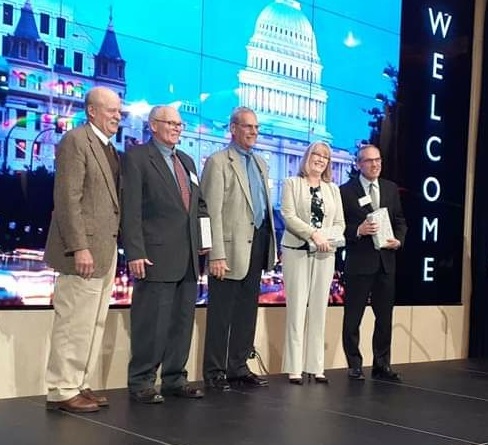
Thirty years ago, this group (pictured above) worked together on what would become the bestselling study Bible of all time (I discussed the process here.) We didn’t know then that God would use our prayerful labors to sell 20 million copies so far of the Life Application Study Bible. I am humbled to have worked with this group and appreciate the honors we received on the evening of October 16 as the pioneers on the project, now also celebrating those who completed work on the third edition of this Bible that has been updated for a new generation. We so enjoyed hearing from special speakers Ed Stetzer (director of the Billy Graham Center in Wheaton) and Dr. Barry Black (chaplain of the US Senate). It was a wonderful evening of celebration of the power of God’s Word.

Finally, in November, Tom and I drove to Nashville to attend the meeting of the Evangelical Christian Publishers Association. I recently became a member of this group, knowing that in my teaching about publishing, I need to stay on the cutting edge of the industry. Was fun to see a former student, Amy Green, publicist at Bethany House, who helped to plan the Christy awards celebration.

ECPA
Enjoyed hearing from musician and author Andrew Peterson. His book, Adorning the Dark, will be a text in my senior capstone class this January.

Now I’m prepping for final exams and papers and decidedly NOT decorating for Christmas. But we’ll get in the spirit. I’m looking forward to sharing how I’m working on that. Stay tuned!

How was fall for you? What are you doing to get into the holiday spirit?

In love with God’s Word—even thru fiery trials

We sat in our typical living room spots, my husband and I, bingeing something on Netflix as we unwound that late August evening.

“Do you smell something?” he asked.

I did. A slight husky smell of smoke. He looked out the back door and noticed our neighbors’ bonfire.

“It’s next door.” He shrugged and added, “Let’s go get the mail.”

We live in a tiny town, so tiny that we only have a P.O. box and need to go there to get our mail. It takes about seven minutes to walk the few blocks to the post office. We chatted as we walked through the cool end-of-summer evening. It was still light, 6:30ish.

The post office is next door to the local fire house. As we passed, the big doors were opening and our local volunteers were loading into trucks and pulling out.

We waved cheerily.

We collected our mail and ambled down the side streets heading home. The volunteer fire fighters were squealing into town, the blue lights on their varied pickup trucks flashing.

“Wow! Wonder where they’re headed?” we asked each other.

Two minutes later and around the corner onto our street we discovered that the fire was – US! Our garage was burning.

Long story short, the small blaze had started on the outside of our garage, perhaps from a stray ember. The fire traveled up across the garage ceiling and then into the great room ceiling. I located a kind neighbor who rescued our terrified Shih Tzu (those big men in yellow suits with oxygen masks tromping into her domain!). Then I could do nothing more than hold her and sit helplessly in the back yard swing  watching smoke pour from our new roof, firemen bashing their axes through the great room ceiling, smoke ascending, water descending.

What does all of this have to do with God’s Word, you ask?

Well, for several days we waited for the restoration company to do their work and for the freedom to make our way into the destroyed great room. The overturned furniture bulged from under wet smelly insulation and soaked drywall. The computer I’d been working on was soaked. Books, papers, everything lost.

My Bible had been on a ledge under the coffee table.

This is the Bible that carried me through marriage and child-raising. The Bible that has pages stained with tears. It has underlinings, comments, thoughts, prayers, and dates when a particular verse resonated with a particular situation. It’s the past 30-plus years between blue leather covers. I purchased this Bible right after we had completed the Life Application Study Bible in the NIV.

I expected the poor book to be soaked—a congealed mess of thin, Bible-paper pages.

Only it wasn’t. It survived. Its place under the table must have protected it from the worst of the cascading water from the firemen’s powerful hoses.

It has a slight smoky smell and its cover shows a few new dents. But the moment I saw it, I was overjoyed. Don’t get me wrong; I have other Bibles. I can buy more. But THIS one, this one holds much of my life between its covers, and it holds the promises that have helped me live that life to the best of my ability to honor God.

I’m not claiming anything miraculous; I’m just very thankful.

Even through fiery trials.

In Love with God’s Word: The LASB Commentaries

After we completed several versions of the Life Application Study Bibles (as I’ve mentioned in the last couple of posts, here and here), someone came up with the idea of creating actual commentaries—one for each book of the New Testament. Seventeen red volumes—some including two or three of the smaller books in one volume.

Several more years of intense work. Our study notes for the Life Application Study Bible had been necessarily limited by word counts and physical space on Bible pages, so we couldn’t include much of the material that we had gathered in the course of writing the notes. And, in the process of writing the notes and working our way through the piles of commentaries in the middle of our conference room table, we learned that most commentaries are extremely difficult to read and, while they offer information, they lacked that vital “so what?” element that had become our mantra.

LASB commentaries

Our team set out on another five years of work, making our way through a verse-by-verse commentary of every verse in the New Testament. I was still at home, working as a freelancer. My job was to create the skeleton of a note for every verse. I would start with what we did on that verse in the LASB (if, indeed, we addressed it there). If not, I worked as we had in our meetings—checking every commentary, reading what it said, condensing it to something readable, tying it to the context, making it interesting, applying it to today. With my home office desk piled high with commentaries, I began the process of doing, on my own, what we had done in a group. Bible chapter by Bible chapter, my rough material would go to the same guys to do their own edits and additions.

Some have asked me in the past how I could possibly work on the Bible this way, actually writing commentaries. “You’re not trained. You’ve not been to seminary. I don’t see how they could let you loose on something this important.”

I took this to heart and at first was really frustrated. Working with the Bible is a huge responsibility. It has to be right. And some passages have many interpretations by sincere believers. Why were they trusting me with this?

Then it struck me. Part of my work had to do with the fact that I knew our process. We had honed it in those hundreds of hours working together in the conference room writing the notes for the Bible. And my part? I had to be able to read and understand, and then I had to be able to rewrite in a readable way.

That was it. And I was by no means the final voice. What I wrote as a rough draft was read by our team of pastors and M.Divs. and Bible scholars for their revisions and edits—piles of pages coming back to me with my skeleton often intact but lots of red markings.

I realized that I didn’t have to be a Bible scholar to do what I was doing. Of course, all of the reading was giving me a vast education—I might as well have been in seminary. But in the end, it came down to being able to write well. To take a tough topic and condense it down for an unscholarly audience (like me) to be able to understand it. Simplifying scholarly material for an unscholarly audience seemed to come naturally to me.

It’s the same with anything I edit. I don’t have to be an expert in the topic of the book I’m editing—indeed, there would be no way to do so. I just need to read each manuscript with fresh eyes (as a reader would) and make sure that I as reader am following, getting what I need, understanding, not getting lost.

That’s the key to being a good editor.