Midwest Writers Workshop–Day 2

It’s the middle of day two of the Midwest Writers Workshop here in beautiful Muncie, Indiana.

Writers are scurrying from pitching an agent to a social media tutoring appointment to their next session from one of our amazing faculty to a manuscript makeover appointment to finding a bathroom to grabbing a snack to checking out the book table to heading to yet another session.

And that’s what it’s all about. Learning more about the craft that we all love.

We’re all here supporting one another as writers. Some with published books. Some with dreams of publishing. All with a passion for words.

That’s why I love it.

This place reeks with people who love words and writing. We’re all geeks sort of geeking out over words and how to put them together. This place reeks of geeks.

And it’s awesome.

There are lots of writers conferences, and I’m a strong proponent of all writers attending a conference for the continued training, support, and encouragement from other writers. I’m new on the planning committee for the Midwest Writers Workshop (we’re celebrating 40 years with this conference), and I’m amazed at how this team pulls together to make a great conference happen.

This year, Cathy Day and I worked together with some savvy Ball State students. Several of the students are acting as assistants for the five agents who are taking pitches, and the others are working in the social media lab giving one-on-one tutoring advice in the art of social media (websites, Twitter, Facebook pages, etc., etc.). Here’s a photo of our social media lab:

The social media lab with one-on-one tutoring about social media for writers

I’m sitting in the social media lab listening to the students talk about how great the attendees are, how they feel like they’ve both been able to teach something to their clients as well as learn something from them, and how they’re enjoying connecting with other writers. We’ve built in time for the students to attend a couple of workshop sessions as well.

We’re all in this writing life together.

And we’re having a perfectly awesome time.

You ought to think about attending next year!

Words Matter (and So Do Fish)

Thought you’d like to see a glimpse of my fan club.

My fishy fan club.
My fishy fan club.

Seriously, these little guys totally love me. They’re like groupies (not group-ers, group-ies). Whenever I walk outside my back door into the garden, they all come as one and follow me as I walk by. They dog-paddle (fish-paddle?) at the edge of the pond and watch my every move.

They totally love me.

Or, more likely, they totally think I’m going to feed them.

But still . . .

I like the fact that they notice me. I think it’s funny how they come as an entire group with their little mouths up out of the water looking at me so longingly.

When we moved into this house a few years ago, the little pond was already there with all of these fish (a neighbor recently ‘fessed up that she had taken some of the overflow from her pond and dumped them here during the year that the house was vacant). We had moved in at the end of October and didn’t have a clue what to do to winterize a pond. We figured that the house had sat vacant the winter before and no one had done anything, so we’d just let it go and see what would happen. Sure enough, the little pond froze over and got covered with a layer of snow. We figured we’d have to skim out the dead fish and start over come spring.

Then, as the water thawed, so, apparently, did the fish. By the time the Indiana air turned warm, the fish were back to their usual selves.

The moment I drop some fish food in the pond, I’ve got myself a fan club.

Wouldn’t the writing life be nice if we just dropped a few of our choice words into the world’s pond and we suddenly had such loyal fans? Fans who waited on our every word? Fans who knew we posted on our blog every week and sat by their computer, eyes wide, mouth agape, waiting for us to toss the morsels their way?

Eh, maybe not. fishies2

I just reach into the bag of fish food and toss the same morsels to those fishies every day. And they love me for it.

I can’t do that with my writing. I’m not looking to recycle a formula or take the easy route. In my blog post a couple weeks ago, I talked about the hard work of writing. Our words matter. That’s why even though only a few people may read something we write, we still agonize over what we want to say. We want to represent ourselves well, say what we mean, write something that will be enjoyable or helpful or compelling or inspiring to those folks who take a few minutes of their day to read our musings.

We do that because our writing matters so much to us.

We do that because we instinctively know that the words we put out there can have a life of their own.

Back before everyone was blogging, before Facebook and Twitter, I had a couple little books published. They’re long out of print, so imagine my surprise when a couple of years ago I found one of those books at a garage sale. (You know you’ve arrived when you find your book at a garage sale.) Then, a few years after that, when everyone was blogging and Facebooking and Tweeting, my son sent me a link to a YouTube video a woman had done to recommend another of my books.

Our words live on.

So I guess that’s my encouragement to my writing friends. You never know when a piece of your writing will rise again. Even if a book you wrote years ago went out of print causing you untold despair, it still lives on.

I tell students in Writing classes that they never know how or when a piece of writing will inspire someone. That’s why it matters so much. That’s why we do that hard work of writing. We put ourselves out there because we have something to share and we want to join our friends in digital conversation.

I’ll never know the paths my words have taken. I only know that they’re still out there with little lives of their own.

Our words matter. They live on.

Just like my fishy fan club.

The Hard Work of Writing

“Do what you love and you’ll never work a day in your life.” I’ve been guilty of saying just that to students in my Editing class. And while it’s true that I get to do what I love (and that, in itself, is a blessing), it’s not true that I’ve never worked. Many many days have been “head-down-plod-through-get-it-done-keep-going-don’t-give-up-the-manuscript-is-soon-ending” kind of days.

Editing is hard work.

And so is writing.

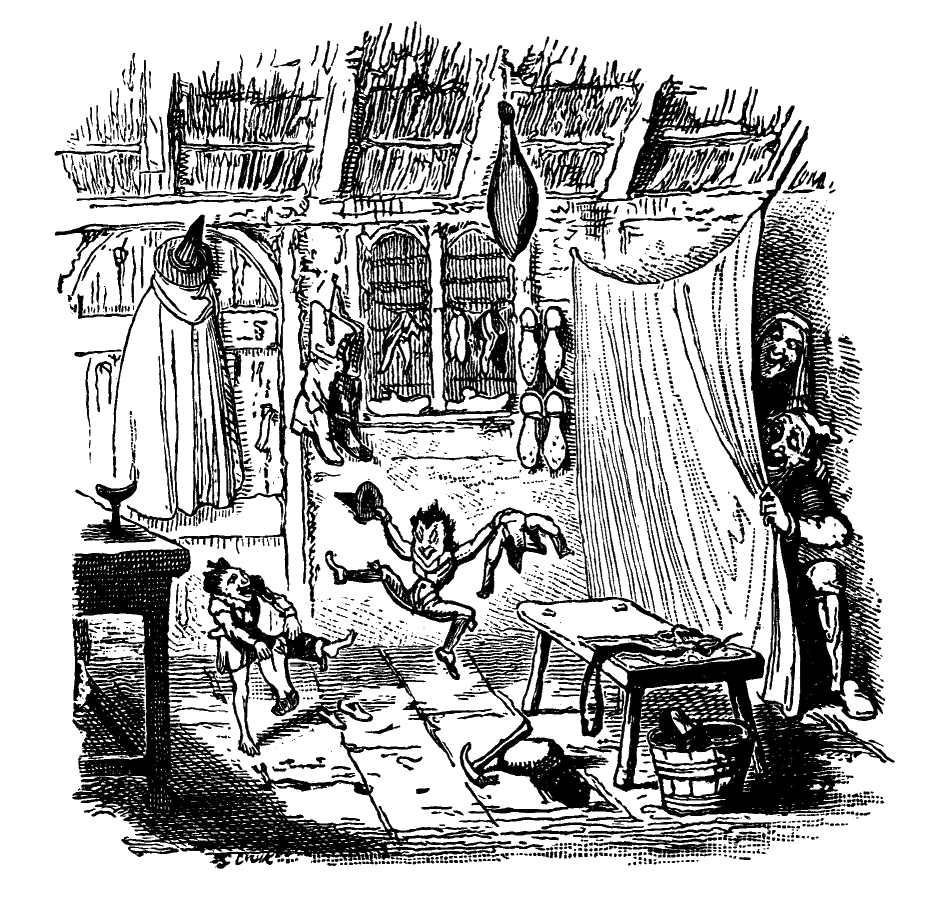
So my friend Kameron McBride (a BSU student and Midwest Writers social media intern) writes in his blog and makes the point that, indeed, writing doesn’t just happen like the cobbler going to sleep while the elves make the shoes. It’s sweaty, difficult, and painstaking work. We don’t (ever) wake up to a manuscript magically completed.

An illustration for the Brother's Grimm story "The Elves and the Shoemaker"
An illustration for the Brother’s Grimm story “The Elves and the Shoemaker”

So it’s a good thing we love it!

To be good at writing takes constant practice. Another BSU student and MWW social media intern John Carter discusses the importance of trying to create a schedule to keep him writing regularly over the summer. Then, of course, once “real life” is in place and summer vacation is a thing of the past (at least if you aren’t in academia), then that schedule and routine will be invaluable.

My friend L. Marie has been posting lots of writing process interviews. We writers must juggle life and overcome fear and discouragement. I love her post about this. (And, if you want more, read her whole lineup–especially if you’re into YA.)

Yep, this writing life is hard work–discouraging at times, frustrating, often unrewarded (except when we’re outstanding in our own minds).

And, like any skill, we need to work to improve. Sure, maybe some of us were born with an innate ability to put words together, but that doesn’t mean we shouldn’t continue to learn or to hone our craft. As Barbara Shoup (director of Indiana Writers Center and, incidentally MWW faculty this year) points out in this blog post, the craft can be learned if you’re patient and willing to work at it.

Work at it.

Here’s what my friend and mentor Cathy Day says about it:

Convincing yourself each day to keep going, this means that you are a writer. The world will be sure to declare, “You matter, but you don’t. Wow, your work is exciting, but yours is old fashioned and dull.” What do you do when someone says, “Eh, you’re okay, I guess.” Do you stop? Or do you keep going? That’s the moment when you know whether or not you’re a writer.

Cathy says, “You must do it simply because you want to.”

Kind of like what Mo Smith (yet another MWW social media intern) describes here.

And it’s hard work.

But therein lies the glory. We want to do it so much that we’re willing to work at it. To stare at the screen on the tough days. To get up early and write when that’s the only time available. To keep on plugging when it fights against us.

That’s the hard part for so many. I hate to sound like an old fuddy-duddy (even if I am one), but in a culture where crimes are solved in a TV hour and purchases are made immediately online and we get upset if someone doesn’t answer our text within 60 seconds–well, have we lost what it means to work at something tirelessly?

We each have to answer that for ourselves.

“May” I Say Good-bye to Short Story Month?

May, Short Story Month, is almost over.

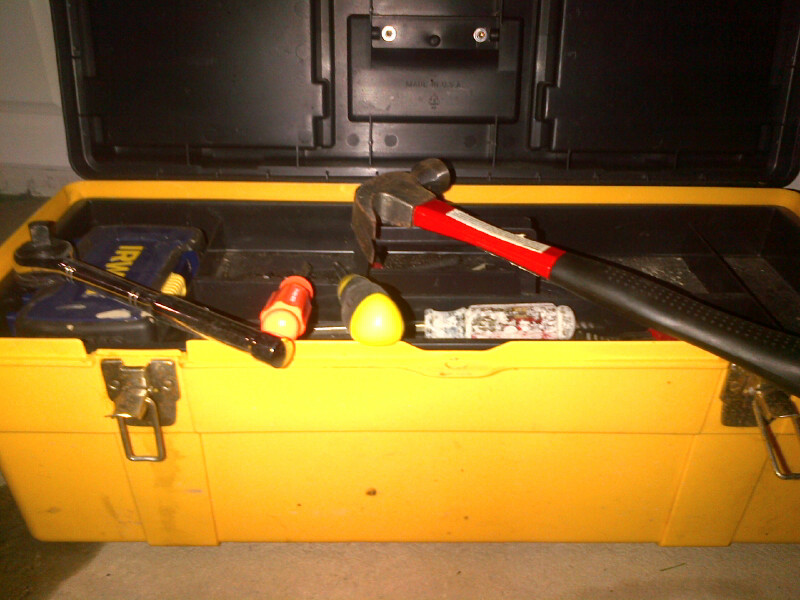
A couple of weeks ago, I mentioned in my blog about my love for the short story and my personal aesthetic that constantly leads me that direction. I asked for some ideas from readers about favorite short story writers and got some great advice (thank you!). L. Marie (my great friend who writes YA Fantasy) mentioned Flannery O’Connor, Poe (I’m reading him right now in my Romantics class), and the Grimms (and not the guy on the TV show). Cathy Day directed me to a post on her blog titled “Toolbox Stories” where she rounds up a terrific list of the stories she has in her writing toolbox.

toolbox

We all should have such a toolbox–those go-to stories that just do it for us. Maybe they inspire. Maybe they give us a new way to handle our plot line. Or maybe, as Cathy uses them, a specific story will help a writing student understand how to make his or her own story work better.

I’m working on my toolbox.

Some of my favorites? Ernest Hemingway (“Hills Like White Elephants”), Guy de Maupassant (“The String” is included in the anthology noted here, but my favorite will always be “The Necklace”), James Joyce (“Eveline”), William Falkner (“A Rose for Emily”), John Updike (“A&P”), John Steinbeck (“The Chrysanthemums”), and indeed Tobias Wolff’s amazing “Bullet in the Brain” . . . all included in On Writing Short Stories (Tom Bailey, editor). short stories

So as a roundup this week, I want to also thank The Missouri Review lit magazine which, this past month, has celebrated Short Story Month by writing a daily blog post about their favorite short stories. (If you want to start at May 1 and work your way through the posts, start here.) I’m intrigued by Angela Carter (Day 5), T. Corahessen Boyle (Day 9), Alice Munro (Day 22), and, of course, James Baldwin (Day 23).

There is so much to read, so much to learn. Some of my other favorite literary magazines have great short stories and essays that deserve further attention.

I’ll do my best to bring my favorites to you, some interviews, and even some advice as I learn as well. I’m working on filling my toolbox.

Short story month may be over, but my work is just beginning. I have a lot of learning–and writing–to do.

What about you? How’s your writing coming this summer?

Thoreau and the #2 Pencil–Who Knew?

Okay, so I learned something new yesterday–well, I learn something new practically every day. But what I learned so totally amazed me that I immediately thought, I need to share this on my blog.

Did you know that the reason we have #2 pencils is thanks to Henry David Thoreau?

Seriously . . . tell me you didn’t know that.

Of course, one problem with doing this is the realization that perhaps I am the only person on the planet who didn’t know this. Maybe you did.

But since this blog is about writing and this little tidbit is about pencils, well, you can see where I’m going with this.

Credit iStockphoto
Credit iStockphoto

According to this article on Mental Floss, millions of SAT takers can thank Thoreau for those #2 pencils. It seems that Henry’s dad and brother-in-law built a pencil factory after graphite was discovered in New Hampshire during the 1820s. Thoreau worked at the family factory and perfected a way of taking the New Hampshire graphite (that didn’t make very good pencils), combine it with clay, and create decent pencils. “By the middle of the 19th century, the Thoreaus were selling pencils with varying graphite hardness, which they numbered 1 through 4.” Oh, and he also did his “Civil Disobedience” and went to Walden Pond.

Don’t believe me? Let Harvard University weigh in with this photo of a box of Thoreau and Co. pencils.

Surely Thoreau’s writing neighbors in Concord, Massachusetts (who included Ralph Waldo Emerson, Nathanael Hawthorne, and the Alcott family), appreciated his contribution! (Tell me you didn’t know they all lived within a few blocks of one another.) All of this info, including a Powerpoint walking tour of Concord, was given to this amazed student yesterday in class courtesy of Dr. Robert Habich who has written about the Romantics and Transcendentalists. Thanks Doc!

I’m thinkin’ that little town of Concord went through a LOT of pencils . . .

Wordsworth, Rockwell, and Leaping Hearts

I admit to falling in love again . . . I have rediscovered William Wordsworth. I love this poem titled “My heart leaps up when I behold“:

My heart leaps up when I behold
A rainbow in the sky:
So was it when my life began,
So is it now I am a man,
So be it when I shall grow old
Or let me die!
The child is father of the man:
And I could wish my days to be
Bound each to each by natural piety.

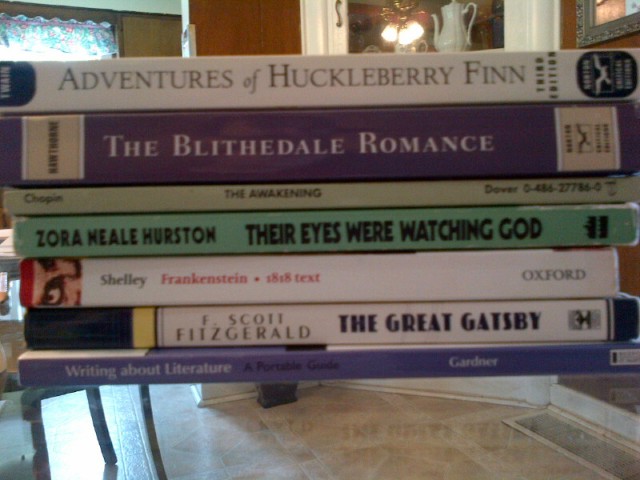
I’m currently taking a summer intensive course on the Romantic writers (the last three classes in my English program are literature! Yay!). Here are just the books for the next four weeks (not to mention numerous links to other writing such as my dear Wordsworth above):

bedside books

It’s been many years since I read these books, several decades since my English major. It almost makes me want to cry with joy to be “forced” to reread some of the greatest literature of all time. I’m scribbling notes of books I simply must read again, books any self-respecting English Lit major should know (or at least remember). Add Moby Dick to the above pile. It’s been too long, Captain Ahab! We must meet again!

But I digress . . .

What I love about the poem by Wordsworth is that it correctly assesses how I feel about my writing. Asked in a class last semester to determine my personal “aesthetic,” I thought long and hard. What do I want to write about? Who am I as a writer? I’ve been an editor for so many years that my writing got neglected. When I came back to it, I had to rediscover myself.

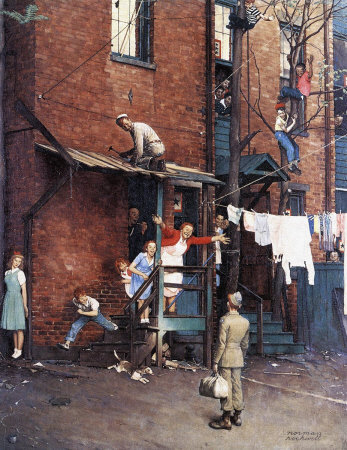
I honestly don’t recall “who influenced me” beyond what I’m sure was just the love of words and books. I can’t remember specifics. One thing I do recall, however, is staring for hours at the paintings by Norman Rockwell in a big coffee table book my parents had. I loved his realism. I loved how he captured a story in a painting so realistic that it almost looked like a snapshot. Having a dad in the military, this is probably one of my favorites:

"The Homecoming" by Norman Rockwell (1945)
“The Homecoming” by Norman Rockwell (1945)

The young boy dashing down the stairs to meet the returning soldier might well have been my ten-year-old self greeting my dad on his return from Vietnam.

What I love is realism. Take a moment. Capture it. Paint it for the reader.

Like Wordsworth, I want to notice things, to always have my heart leap up when I encounter nature in its beauty or a moment in time that must be captured in writing.

I like the short form. Sarah Hollowell set me on to Short Story Month (May, if you didn’t know) and Cathy Day commented on that blog, describing a friend who used 750words.com to write 750-word stories. So that’s my challenge . . . to start using that site (where I’m already a hit-or-miss member) and capture the moments.

So what short story writers do you admire most–past or current? I want to add them to my list!

5 Pledges of Literary Citizenship

In the grand tradition of “last lectures,” Cathy Day posted a note to her students on the Literary Citizenship blog at the end of her class this semester. It’s not really a final lecture since the class will be taught again for another group of fortunate students; the post is more of a wrap-up of everyone’s accomplishments.

And for me who got to sit in on the class this semester, it was a way to think about who I am in this literary world.

istockphoto
istockphoto

I took the challenge and revised my blog to focus on my literary life, and I invited you to join us on the journey as I learned what it meant to be a good literary citizen. Bottom line:

Be interested in what others are doing.

I was doing that, but not in a visible way. Now I “like” and comment on blogs. Now I follow Facebook pages of literary magazines and authors. Now I link to other people’s blogs. Now I’m finding people on Twitter who are as passionate about editing and proofreading and good grammar as I am. Now I write notes to authors I appreciate and thank them for inspiring me.

I learned to write about my passions. I decided to focus on areas of editing and grammar, with nods to all kinds of other topics (it is my blog after all). It was great to stake out a territory and then look around for folks already there and join them.

I learned some technical things like how to tag and categorize posts (yes, I CAN talk about things other than grammar) and how to better use Twitter. I learned about book reviewing.

And I’m finding my tribe.

As any great teacher will, Cathy challenges her students not to stop now that the class is over. This is about building a literary life, after all. At the end of her post on the Lit Cit blog, she challenged us with a few questions. I encourage you to think about them for yourself, but here are my pledges of citizenship in the literary world:

I pledge to continue to blog on a regular basis and to share with my readers great books, bloggers, articles, and ideas (yes, and even great grammar!). At times, I’ll write about what I’m doing, but that’s not the focus. It’s not all about me (that’s just true on so many levels. Wow . . . wouldn’t our world be a better place if we all adopted that mantra?).

I pledge to write a personal note to someone at least once a week to thank that person for his or her contribution to the literary world.

I pledge to keep finding, following, and connecting with folks in my tribe. And then I’ll talk about them so more people can know them.

I pledge to be continually interested in what other people are doing.

I pledge to talk about literary citizenship whenever and wherever I can. It’s that important.

Have you pledged citizenship?

How Not to be a Twitter Twit

I’ll never admit to being ahead of the curve. It usually takes me awhile to catch up with everyone else. When I finally joined Facebook, I felt like I’d arrived late to a party that was already in full swing. Then someone told me to get onto Twitter. I resisted, finally opened an account, didn’t get it, got exhausted trying to keep up with it, and closed it.

Then I finally decided–late–that I really had to be there. That happened when the indomitable Cathy Day (who else?) introduced me to hashtags and Tweetdeck, and suddenly I could make some sense of Twitter. (HootSuite is another option that works like TweetDeck to organize tweets via hashtags.) You can find me @LindaEdits if you’re so inclined.

credit: iStockphoto
credit: iStockphoto

I found some folks to follow (agents, other authors, publishers). Then, I went to this site, 44 Essential Hashtags Every Author Should Know, and found some hashtags that I want to follow. By creating TweetDeck columns for some of these hashtags, I have a constant feed, often with links to great blogs and articles, about the topics that matter to me. These blogs and articles give me great information for my classes, my research, and my teaching.

I follow people who interest me, I get followed, but I’m not trying to break any records. In fact, another indomitable force, Jane Friedman, explains why chasing after huge numbers of Twitter followers can just be a waste of time. Like any other tool of the trade, we just need to use Twitter wisely and well.

Since I’ve jumped back in and found so many interesting links and articles, I also realized the possibility of connections for jobs. Not only do my students need to understand Twitter, they should be there making connections as well as gaining experience in using it. Sure enough, many of the job postings they’re finding want people who understand and know how to use social media–and use it wisely. So this past week, my students in my Writing for Business class had an in-class exercise to create Twitter accounts. We talked about hashtags, and I gave them the link noted above that lists hashtags for writers. I created a hashtag for the class and everyone created a post and used the hashtag. With TweetDeck projected on the screen, their postings immediately appeared as they tweeted.

But I have to admit that it can be a little overwhelming. There is so much information out there that it’s nearly impossible to keep up. TweetDeck does help me by sorting tweets into categories where people are talking about writing or books or publishing or proofreading (my hot buttons).

How do you use Twitter? Has anyone done live tweeting as part of class? How can I make the most of my tweets? What do you find most helpful in your Twitter feed?

Avoid the Bog: Save Revision for Later

I spent this past weekend being an academic.

While I’ve presented at plenty of writers conferences, this past weekend I gave a paper (oooo, that sounds so academic) at the SUNY Council on Writing held in Buffalo, New York.

At the conference, I heard professors share teaching strategies to help their students engage better in a research paper and how to navigate different rhetorical situations required by different pieces of writing. One professor described working with students from one semester to the next to improve in areas where they need improvement. Another spoke during lunch about how he encourages his students to use all the technological resources at their disposal so that a paper is no longer just a Microsoft Word document but something full of visuals and hyperlinks.

The world is indeed changing, but some things are still the same.

That final product needs to be clean, perfect, polished.

My presentation was about the value of proofreading (big surprise). After decades in publishing, it’s been difficult for me to let go of the “perfection” level and understand that students need to be given freedom during the writing process. Two particular researchers in the field (for anyone who cares, it’s David Bartholomae in “Inventing the University” and Mike Rose in “The Language of Exclusion: Writing Instruction at the University”) helped me get my head around how to help writers and yet deal with my own requirement of final polish on papers. They explain that students new to academia are learning to write in a whole new way. They have to try on the language of academia. They have to take on the role of “authority” in their papers even though they’re writing to profs who are authorities. They have to think critically and not reach for the easy answer. They have to put together a coherent paper. And I would add that after writing it, they need to revise, copyedit, and proofread.

That’s a lot to ask. In a publishing house, different people do all those roles. And we’re asking students to do it all. Other research has shown that if students try to revise as they write, they end up bogging down in their own process, getting frustrated, and producing something maybe with fewer sentence-level errors but way less coherent.

“So Linda,” I said to myself, “let the proofreading go, would ya?”

“But I can’t,” I said back to myself, “because it’s important.”

And indeed it is. But it depends on what part of the process students are in and the rhetorical situation. I’ve learned that in initial drafts, I should work with students on the big picture. Let them get their thoughts together. Let the paper be full of comma errors and run-on sentences because this is still in process.

I should know this, for that’s just what an editor in a publishing house does. The big picture is what matters at that point.

From there, students can be helped to copyedit and then to proofread. I have for too long jumped right in with my red pen which focuses on the wrong thing too early. In reality, a student may have a lot of errors but also the beginnings of a well-reasoned argument or an amazing creative story. How much better to offer encouragement and queries at that level and leave the rest for later in the process.

Yet we still owe it to students to help them understand how to polish their papers. After all that work, we should help them deliver a piece that is indeed free of glaring errors (and that was the point of my presentation at the conference). And in a rhetorical situation like a resume or cover letter (which my Writing for Business students are doing this week), they have to understand how to create something that is indeed error free.

So what that means for us writers is that, during the process of writing, we need to just write. Get it down. Write as fast as we need to in order to keep up with our characters or our thoughts. Don’t stop to revise, at least not until the day’s writing is finished. Don’t get bogged down in the details during that first creative part of the process.

If you’re on a deadline, be sure to schedule in time for revision so you don’t feel rushed. Gone are the days of pulling all-nighters and turning in our assignment–our reputations are on the line, maybe even a paycheck.

To do it well, we need the time to revise and proofread (or have others help us–who also need to have time). But when we don’t get bogged down in the creative part of the process, we’ll feel much better about that final product.

Your Most Important Writing

My friend L. Marie posted a thought-provoking blog about what qualifies as success for us writers, so I wanted to repost it here and add a few thoughts.

Like her, I’ve spent much of my life working behind the scenes as an editor. You won’t find my name on too many book covers (maybe a couple, but long out of print); instead, I might appear on a copyright page (“Project staff includes”) or in the Acknowledgements (“Thanks to my editor”) or maybe neither of the above no matter how much work I may have done.

And you know what? That’s okay by me.

Sure. I’d love to land a six-figure book contract. I’d love to go on a book tour. I’d love fame and fortune and the new shoes all that money could buy (not to mention helping my kids pay off their college loans).

Sure.

Who among us wouldn’t want that?

But I tell my students that being published ought not be their standard of success. Trust me, plenty of books get published and simply don’t sell. Yes, it’s an important pursuit and I hope all of my writing friends are able to see their name in print. So keep trying. Keep writing articles and essays and stories and books, keep blogging, keep sending out those query letters and proposals, and above all, keep writing. L. Marie compares it to a marathon–actually running it is a success story in itself.

But here’s the thing. Don’t think less of the other writing you do. The unpublished stuff.

That note to a dear friend who’s going through a tough time.

That long-past-due letter to your grandmother to let her know how much she means to you.

That note of encouragement to a fellow writer.

That manuscript gathering dust in your drawer. You had to write it to pull yourself out of the depths of some despairing situation, or to get your head around some pain, or to write your way to an understanding and a peacefulness with your world. Yes, that manuscript. The one they have to bury with you because it simply can’t ever see the light of day.

And that’s okay, too.

The gift you have of writing–the ability to put words together in a special way–is valuable in all kinds of places, in all kinds of situations. And it may very well be that the most important writing you do will never be published for the world to see.

But it may make a difference in someone else’s life . . . or it may just have helped you continue on your journey in a better state of mind.

And when it comes to writing, what more could a writer want?