Editors Are People, Too (Just So You Know)

As a writer myself, I totally understand the frustration of trying to read an editor’s mind and understand the why behind lengthy edits or outright rejections. What’s going on?

I’ve been encouraging my professional writing students to be aware of and submit to literary magazines as an outlet for their creative writing. Some of them were only aware of a few such locations to send their writing, others didn’t know about lit mags at all, others knew only about contests and didn’t enter often because of the submission fee. But with the thousands of literary magazines out there (I just discovered Duotrope and used it to help me locate lit mags that publish in my genre), anyone can build a list of locations for future submissions. Literary magazines don’t generally pay (although a few do), but the by-line and exposure are invaluable. So this semester, each of my students will be researching lit mags and building lists.

As with any publishing house, however, the writing needs to pass muster for any number of reasons in order to get published.

That’s why I love this article by Savannah Thorne over at one of my favorite websites for following the world of literary magazines, “The Review Review” (and thanks to Becky Tuch for creating it!). Savannah was accepted for publication in a literary magazine called Conclave: A Journal of Character, only to find that the magazine was possibly going to close down. So she took the amazing step of taking it on as managing editor and turning it around.

Her article, “What the Editor Sees (That the Writer Does Not)offers wonderful insight from a writer turned editor into the world of editing a literary magazine. She describes for writers what happens after you’ve hit “submit.” And why it takes so long to hear back. And what you should do when you get a rejection. And why you should keep trying. And, yes, why it takes so long to hear back.

I’ll wait while you click on the link above and read her article . . . [pause for a refill on whatever I’m currently drinking]

What’s the takeaway? Do your research, write well, keep on writing, keep on submitting. Editors have any number of reasons for accepting some pieces and rejecting others–and often it’s just a gut feeling about a particular piece.

As I said in this post about how editors really aren’t “failed writers” with, as Martin Eden would say, nothing but failure in their past causing their desire to make life miserable for writers who are still trying. Instead, editors are slogging through piles of submissions, many of which are probably great, looking for the excellent, something that sings to them, something that they want to publish in the magazine about which they care so much.

No, you can’t know what that is necessarily. But write your best. Get critiqued. Keep writing. Keep submitting. If someone rejects it, try somewhere else.

Don’t give up, my friend. Keep writing what is truly you. As Herman Melville once wrote, “It is better to fail in originality, than to succeed in imitation. He who has never failed somewhere, that man cannot be great.”
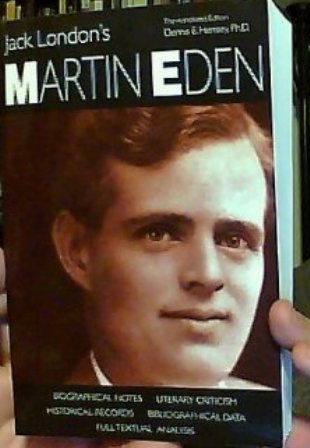
What Martin Eden (aka Jack London) Teaches about Writing and Editing

As I continue to write about editors and editing, I came across some very interesting insights in Jack London‘s masterful work, Martin Eden. Written as a thinly veiled autobiography, the story follows a low-class man and his desire for self-improvement in order to impress a high-class woman with whom he has fallen in love. He reads voraciously; learns language, grammar, and syntax; and teaches himself manners, politics, and philosophy. Eventually, he decides to become a writer–after all, he has many stories to tell from his travels around the world as a sailor.

Alas, every story he sends in is rejected and returned in what we would call the SASE (self-addressed stamped envelope). For years, he toils. He goes back and rereads the magazines to which he’s submitting to discover the “secret formula” for getting accepted. He spends hours and hours working at his craft, steadfastly refusing to bow to pressure from the woman he loves (and everyone else in his world) to just “get a job.”

He knows he’s a writer. He can feel it in his bones. He knows he has stories to tell, and he knows his stories are better than anything he’s reading in the magazines.

His money runs out. He barely survives. And the rejections keep coming. Martin begins to wonder:

He began to doubt that editors were real men. They seemed cogs in a machine. That was what it was, a machine. He poured his soul into stories, articles, and poems, and entrusted them to the machine. . . . There was no human editor at the other end, but a mere cunning arrangement of cogs that change the manuscript from one envelope to another and stuck on the stamps. (160-61)martin eden

The chief qualification of ninety-nine percent of all editors is failure. They have failed as writers. Don’t think they prefer the drudgery of the desk and the slavery to their circulation and to the business manager to the joy of writing. They have tried to write, and they have failed. And right there is the cursed paradox of it. Every portal to success in literature is guarded by those watch-dogs, the failures in literature. The editors, sub-editors, associate editors, most of them, and the manuscript-readers for the magazines and book-publishers, most of them, nearly all of them, are men who wanted to write and who have failed. And yet they, of all creatures under the sun the most unfit, are the very creatures who decide what shall and what shall not find its way into print–they, who have proved themselves not original, who have demonstrated that they lack the divine fire, sit in judgment upon originality and genius. (322-23)

Ever felt that way as a writer? Ever felt like the editors either don’t exist or are simply cogs in machines that send out nothing but rejections?

As an editor, I do have to take a bit of offense that Martin sees me as “unfit.” But as a writer, yes, I have at times wondered if anyone with any taste receives–and rejects–my queries, my articles, my blood-and-guts pieces of creative nonfiction.

I’m sure many writers feel the same.

But let me put in a little bit of a plug on behalf of myself and my editor friends.

  • We truly do want the very best writing. But, you need to understand how subjective that is. It’s a gut reaction to a piece of writing. And if you get rejected one place and you really believe in your piece, keep trying.
  • Everything needs to be edited–everything. Trust us. We will work with you to make your writing the best it can be.
  • Editors are human, and each one of us is different. No two editors will edit a piece the same way. Take the advice, but also understand that we are in a conversation with you when we edit.
  • We are busy. Sure, no one wants to wait months for a response, but we’re reading hundreds (sometimes thousands) of pieces. Hence, the form letters that get returned in your SASE. We simply don’t have time to give personal responses to everything. (That said, if you get any kind of response–such as a quick hand-written note on that rejection letter–take that as a huge compliment and keep on trying with that editor.)
  • And generally we aren’t failed writers who defaulted to editing. Many of us write on the side (and get the same treatment from fellow editors). There’s no club. Our work has to stand on its own, just as with everyone else. Many of us have no desire to write at all–editing is our calling and we’re committed to that.
  • Rejection doesn’t mean failure. A piece can be rejected for any number of reasons. It may be that your writing isn’t good–but if you’re in a critique group and you’re taking advice, that probably isn’t the case. It could be things you have no way of knowing–maybe a story like yours has already been accepted and now yours isn’t needed. It could be that gut thing I wrote of above.
  • We really do care about the submission guidelines, the formatting advice we give you, etc. Read these guidelines and follow them. Because we receive hundreds of manuscripts, if it’s apparent you can’t follow the simplest guidelines, then we won’t take the time to read what you sent.

Eventually, Martin Eden does find the success he so long sought, but it comes at a price. He discovers the down side of fame and some of the hypocrisy in publishing, which begins his undoing.

Bottom line, Martin Eden teaches us that it takes persistence, faith in yourself, and hard hard hard work to be a writer.

Don’t give up. Don’t let the editors get you down. Realize that they aren’t “rejection machines.”

Nothing’s perfect, but work with us. Your great writing will find its home.

Quotations taken from Jack London’s Martin Eden: The Annotated Edition by Dennis E. Hensley, Ph.D. Upland, IN: Taylor University Press, 2006. This edition is pictured above.

6 Quick Proofreading Tips

AND . . . . today is National Proofreading Day. I will celebrate by . . . proofreading! Today I am also reposting a blog I wrote last year on March 8.

What a busy week! We had National Grammar Day on March 4, and today, March 8, is National Proofreading Day. For someone like me who lives this stuff on a daily basis, it’s downright exciting!

The day is devoted to “mistake-free writing” and projecting “a professional image with well-written documents that are 100 percent accurate.” Started by Judy Beaver at The Office Pro, this day is designated because it was her mother’s birthday—and her mother loved to correct errors.

As I noted earlier this week in my post about National Grammar Day, I’m not a total grammar geek but I do care about the correct usage of our language, and I’ve made a living for many years honing this skill. Lots of times I still CMShave to look things up in a dictionary or my Chicago Manual of Style (the style manual for much of the book publishing industry). All manuscripts go through several phases of editing, and I’ve done them all. Generally, if I do one phase on a particular manuscript, I make sure that other people do the other two phases–there’s a different focus that has to take place at each phase.

Editing—I call this the 10,000-foot view. I look at the big picture. I’m reading the fiction story and checking the plot, the pacing and flow, the characterization. In a non-fiction manuscript, I’m seeing if the organization works and makes sense. Any changes I suggest at this point are on the macro level—moving chapter 3 to become chapter 1, for instance. Or looking for that loose end in the mystery that the writer forgot to tie up (“What happened to so-and-so?”). The author makes changes (or not) based on my suggestions, and then the manuscript goes to a copyeditor.

Copyediting—This is more like the 1,000-foot view. Now that the editor has put the manuscript in good shape, if I’m in this role, I’m reading closely for sentence construction—dangling modifiers, run-ons, and inconsistencies. I fact check. I query if something doesn’t make sense, if a transition is needed, if a character’s way of speaking doesn’t sound real based on how he or she has been described by the author (“Would he really say this in this way?”).

Proofreading—This is the 10-foot view. If I’m in this role, sometimes I’m working on a manuscript, but often at this phase I’m looking at a pdf of typeset pages—which means I have to check the table of contents to make sure the titles and page numbers are correct, I check all the folios and running heads, I check the look of each page—marking widows and orphans (those random one or two words at the top of a page, or the lone line at the bottom—these just look awkward). Then I read every word. Even a clean manuscript can have random errors show up when the document is flowed into the typesetting program (a hidden tab in a Word document can suddenly rear its ugly head and space words far apart when typeset).

I love it.

Proofreading is probably my favorite. It’s that red pen mentality. I’m looking for errors only because I want the book, the author, and the publisher to put their best foot (feet?) forward.

The three types of editing take different skills. In my Editing class, I give my students practice in all of these areas, telling them that they will probably find an affinity for one and not like the others so much. But I also tell those who want to become editors that they should hone their grammar and punctuation knowledge anyway, because the copyediting and proofreading jobs are often the entry level positions in publishing companies. From there, they can move up, since often editors and acquisitions editors are hired from within, from people who have been with the company and understand the ethos there.

As I noted in my post earlier this week, proofreading skills are vitally important, especially on the job market. To have a clean paper, I suggest the following:

(1) Don’t trust the spell check program on your computer. (Judy has some tips on her blog about this.)

(2) If you’re not absolutely sure of the spelling of a word, don’t guess. Look it up. Dictionary.com is your best friend.

(3) Go back and read your letter, paper, email, memo, whatever, aloud slowly to yourself. This will help you notice if words are missing or if a sentence runs on and on. (It’s best to do this on hard copy. Trust me, you’ll see things differently than on screen. A friend of one of my students writes about that on his blog.)

(4) Then, read it again starting from the bottom paragraph backward, a paragraph at a time. This helps you get outside your own flow and see errors you might skip over otherwise.

(5) Electronically, go back and do a search for an open parenthesis (to make sure that you always have a matching close parenthesis), an open quotation mark (to make sure you always have the appropriate closing quotation mark and to make sure any inner quotation marks are single and that they are both there). And get rid of those double spaces between sentences!

(6) Be aware of your own weaknesses. If you know you tend to write run-on sentences, watch for that in particular. If you know that possessives always mess you up, do a search for apostrophes and check each one for correct usage.

This will clear up a good number of your errors. It never hurts, however, to have someone else look over an especially important document—like a cover letter or resume or manuscript submission.

Let’s put our best foot forward—both of them!

It’s National Grammar Day!

In honor of National Grammar Day, I am reposting my blog on this date from last year. Why? Because I’m busy grading papers for correct grammar–that’s why!

Today, March 4, is National Grammar Day.

Are you celebrating? Well, are you?

I am celebrating by finding other celebrants–people I want to add to my tribe because they care about this stuff as much as I do.

I have to confess to being a bit of a grammar geek–although not nearly at the level of Mignon Fogarty aka Grammar Girl. I know some things, but I may not know why I know them or the rule behind them. That comes from thirty years of proofreading, following publisher style sheets, painstakingly reading typeset pages and marking pdfs until my eyes blur.

I love my red pen.

You see, I value perfection. (Oh my, I sure hope there aren’t any errors in this post when I’m finished . . . ). I’ve started grad school to learn more about teaching writing and discovered in my theory classes, much to my chagrin, that teaching grammar works against creativity and that college instructors try to steer clear in favor of the big picture, the creativity, the thought processes. I believe all of that is vital, of course. What’s the point of writing if you can’t make a clear argument or create a document that flows? But I also believe that the best argument in the world will get ignored if the writing is fraught with errors. Why do I want to take the time to read your article and consider your opinion if you can’t take the time to make sure to spell correctly and use proper punctuation?

It matters.

So I love National Grammar Day. (It’s on March 4th because apparently that’s the only date that forms a sentence, “March forth.”) I love when I find others in my tribe who care as much as I do about grammar and punctuation and a well-written sentence (they won’t be dangling any modifers in front of me, no sir!).

For one of my classes, I did a little research project. I hypothesized that writing instructors need to teach their students to proofread. We help them a lot at the contextual and sentence level in their writing, but we probably say, “And be sure to proofread your paper before turning it in,” without explaining what proofreading really involves. I think we do them a disservice. There is indeed a place for focusing on perfection. (More about this on Friday, March 8, National Proofreading Day . . . oh my, busy week!)

Take, for example, business writing. I start filling in for the instructor of a Writing for Business class this week for the rest of the semester (the regular instructor is out for shoulder surgery and rehab). I’m reading the textbooks and finding constant statements about the importance of perfection. In fact, one book quotes a website that keeps a collection of “cover letters from hell“–cringe-worthy letters sent to them by folks hoping for a job, like the person who wrote that he/she was an English major good at grammar–and then misspelled it as “grammer.” The website then states,

Elements of Style

A word to the wise: An error-free letter is now so freakin’ rare that the minimal care required to send a letter with zero defects, combined with a few crisply written simple declarative sentences, will, alone, guarantee a respectful reading of a resume. Maybe even secure an interview. Doesn’t anybody read Strunk and White in school any more? If you haven’t, get a copy of The Elements of Style, so you can follow it all your days.

Exactly.

Now all those theorists have a point. Do your writing and don’t worry a bit about your grammar. Get your ideas down. Tell your story. Make your point. Do the best writing you can do.

But before you send the query letter, turn in that article, or send in that manuscript, do me a favor.

Make sure it’s perfect.

Now realize that if you have your own little stylistic “tics” (you want to Capitalize Certain Words for Emphasis, or do random italics), then just let your proofreader know. You can be “incorrect” if it’s part of your style. Create a style sheet that tells your proofreader this is how you want it–then he/she will make sure that you’re consistent, along with looking for any errors you may have missed.

As citizens of the literary world, let’s protect our craft, always doing our best to deliver the best quality.

And if you feel that your proofreading skills leave something to be desired, hire a professional proofreader (or get someone you trust who really knows the craft) to go over everything before you submit the story or mail the letter. Believe it or not, there are people who thrive on helping your writing be perfect. In fact, even if you are good at it, it’s difficult to proofread your own work. It’s that whole “seeing the forest for the trees” thing.

(One little additional note: I’m talking at the professional level here. Please don’t refuse to drop me a note for fear of making errors. I truly do want to keep my friends. My point is that when we’re doing professional writing, we need to be professionals. The rest of the time, my red pen is safely in the drawer.)

So celebrate National Grammar Day with me! Grammar is the toolbox of our trade. Let’s keep those tools sharp!

The Melody of Our Manuscripts

He always arrived in a rumpled brown suit and a wide, striped 1970s-style tie. He would bustle in the door of our apartment in Germany, run his stubby fingers through his mop of gray hair, say “guten Abend,” and sit down in the chair beside the piano bench.

And I duly took my place beside him on the bench.

We opened the book.

I had one piano book when I studied under Herr Mueller. Not a book for scales or a separate book to write in and draw the little notes on the staff and practice making the G-clef. I was way more advanced than that. I’d been taking piano since I could remember.

My piano book
My piano book

So when we arrived in Bonn, Germany, in my freshman year of high school, my parents set about finding a piano teacher.

And they found Herr Mueller.

I wish I knew his whole story. He had been the pianist for the some big orchestra in the United States. Thus, in his younger days, he had played in large concert halls to crowds of appreciative symphony goers. I’m sure he’d worn a tux and, when he approached the piano bench, had deftly tossed the tails behind him. He had been applauded.

And now, he sat beside a high school girl who didn’t appreciate that she was learning piano from a genius.

I ache to think of it.

We practiced from this one book–a big red book filled with music from the great composers. The cover and spine and title page are all missing, so I can’t even give the title. But when I sit down at the piano thirty years later and open the book to page 44, I can still play Beethoven’s “Adagio ‘Moonlight’ Sonata.” I can still play parts of “Fur Elise” (page 48) from memory.

When we opened to a new song that came from an opera, Herr Muller told me the story and where, in the opera, this song appeared. He told me how to play Edward Grieg’s, “Anitra’s Dance” (from Peer Gynt) based on the action at that point in the story, and he could hum every melody from the entire opera.

I think of those days now. I remember how I’d hold my breath when he leaned in close to scribble on the piano page and his bad breath floated into my nostrils. I remember how his stubby fingers flew across the keys. I remember how he loved, loved, loved the piano.

Herr Mueller's fingering notes on my piano page
Herr Mueller’s fingering notes on my piano page

If I could just take lessons from him now. These thirty years later I would cherish every word. I’d have a notebook beside me where I would write down the context of every melody he assigned just as he told it to me.

And I’d just offer him a breath mint and be done with it.

I worked hard for him. I practiced hard. I loved the piano too, for a time, even accompanying my high school chorus for a few programs.

Herr Mueller, I wish I could thank you. I’m sure you’re long gone from this world, but I thank you for your love of the piano and great music. I’m sure that some of my love for great literature comes from hearing Herr Muller tell me the great stories of the operas with unmatched passion. And the fact that I could accompany my high school chorus as they sang Bob Dylan’s, “The Times They Are A-Changin’,” was because I had pounded away at Bach and Verdi and Grieg and Tschaikowsky and Wagner.

The same is true for writers. We’re readers first for good reason. We read great literature (past and present) because it helps us with our craft. We read because we love love love the words on the pages–and we’re amazed when, like the music notes floating on the staffs, the words come together in a way that gives us goosebumps. We want to learn to make that happen in our own writing.

We’re creating a melody in our manuscripts.

I wish I had appreciated the privilege of studying under Herr Mueller. Likewise, I wish I had appreciated the time I spent reading the classics in my literature classes both in high school and college (this summer I’m rereading many of those classics that any self-respecting English major should be conversant about!).

Because now, I understand. Now I appreciate them.

Thank you, Herr Mueller.

Me at the piano with appreciative baby sister as my audience (ca. 1970).

“May” I Say Good-bye to Short Story Month?

May, Short Story Month, is almost over.

A couple of weeks ago, I mentioned in my blog about my love for the short story and my personal aesthetic that constantly leads me that direction. I asked for some ideas from readers about favorite short story writers and got some great advice (thank you!). L. Marie (my great friend who writes YA Fantasy) mentioned Flannery O’Connor, Poe (I’m reading him right now in my Romantics class), and the Grimms (and not the guy on the TV show). Cathy Day directed me to a post on her blog titled “Toolbox Stories” where she rounds up a terrific list of the stories she has in her writing toolbox.

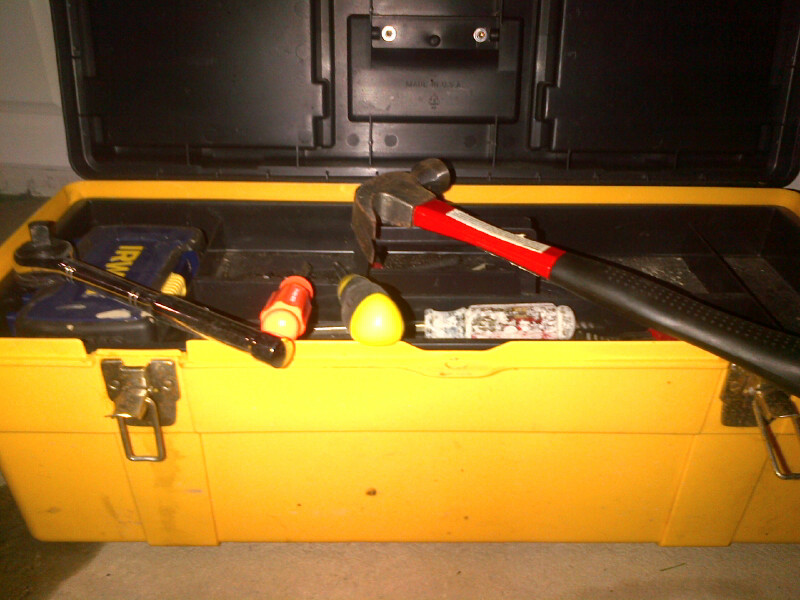
toolbox

We all should have such a toolbox–those go-to stories that just do it for us. Maybe they inspire. Maybe they give us a new way to handle our plot line. Or maybe, as Cathy uses them, a specific story will help a writing student understand how to make his or her own story work better.

I’m working on my toolbox.

Some of my favorites? Ernest Hemingway (“Hills Like White Elephants”), Guy de Maupassant (“The String” is included in the anthology noted here, but my favorite will always be “The Necklace”), James Joyce (“Eveline”), William Falkner (“A Rose for Emily”), John Updike (“A&P”), John Steinbeck (“The Chrysanthemums”), and indeed Tobias Wolff’s amazing “Bullet in the Brain” . . . all included in On Writing Short Stories (Tom Bailey, editor). short stories

So as a roundup this week, I want to also thank The Missouri Review lit magazine which, this past month, has celebrated Short Story Month by writing a daily blog post about their favorite short stories. (If you want to start at May 1 and work your way through the posts, start here.) I’m intrigued by Angela Carter (Day 5), T. Corahessen Boyle (Day 9), Alice Munro (Day 22), and, of course, James Baldwin (Day 23).

There is so much to read, so much to learn. Some of my other favorite literary magazines have great short stories and essays that deserve further attention.

I’ll do my best to bring my favorites to you, some interviews, and even some advice as I learn as well. I’m working on filling my toolbox.

Short story month may be over, but my work is just beginning. I have a lot of learning–and writing–to do.

What about you? How’s your writing coming this summer?

Wordsworth, Rockwell, and Leaping Hearts

I admit to falling in love again . . . I have rediscovered William Wordsworth. I love this poem titled “My heart leaps up when I behold“:

My heart leaps up when I behold
A rainbow in the sky:
So was it when my life began,
So is it now I am a man,
So be it when I shall grow old
Or let me die!
The child is father of the man:
And I could wish my days to be
Bound each to each by natural piety.

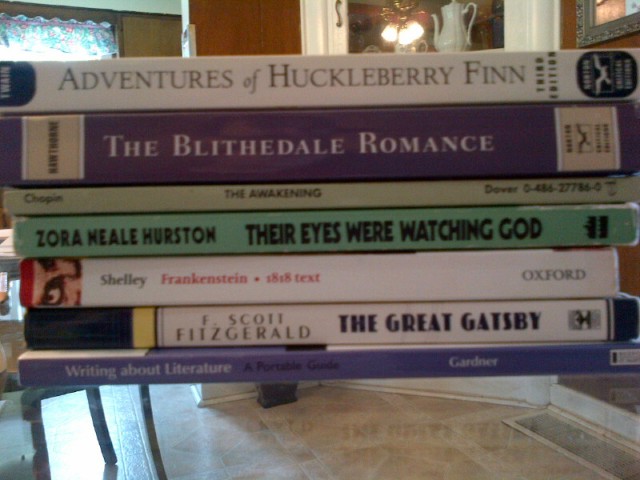
I’m currently taking a summer intensive course on the Romantic writers (the last three classes in my English program are literature! Yay!). Here are just the books for the next four weeks (not to mention numerous links to other writing such as my dear Wordsworth above):

bedside books

It’s been many years since I read these books, several decades since my English major. It almost makes me want to cry with joy to be “forced” to reread some of the greatest literature of all time. I’m scribbling notes of books I simply must read again, books any self-respecting English Lit major should know (or at least remember). Add Moby Dick to the above pile. It’s been too long, Captain Ahab! We must meet again!

But I digress . . .

What I love about the poem by Wordsworth is that it correctly assesses how I feel about my writing. Asked in a class last semester to determine my personal “aesthetic,” I thought long and hard. What do I want to write about? Who am I as a writer? I’ve been an editor for so many years that my writing got neglected. When I came back to it, I had to rediscover myself.

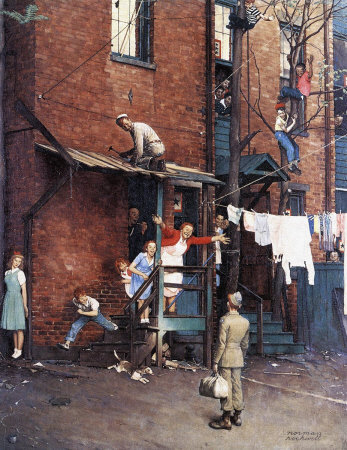
I honestly don’t recall “who influenced me” beyond what I’m sure was just the love of words and books. I can’t remember specifics. One thing I do recall, however, is staring for hours at the paintings by Norman Rockwell in a big coffee table book my parents had. I loved his realism. I loved how he captured a story in a painting so realistic that it almost looked like a snapshot. Having a dad in the military, this is probably one of my favorites:

"The Homecoming" by Norman Rockwell (1945)
“The Homecoming” by Norman Rockwell (1945)

The young boy dashing down the stairs to meet the returning soldier might well have been my ten-year-old self greeting my dad on his return from Vietnam.

What I love is realism. Take a moment. Capture it. Paint it for the reader.

Like Wordsworth, I want to notice things, to always have my heart leap up when I encounter nature in its beauty or a moment in time that must be captured in writing.

I like the short form. Sarah Hollowell set me on to Short Story Month (May, if you didn’t know) and Cathy Day commented on that blog, describing a friend who used 750words.com to write 750-word stories. So that’s my challenge . . . to start using that site (where I’m already a hit-or-miss member) and capture the moments.

So what short story writers do you admire most–past or current? I want to add them to my list!

6 Quick Proofreading Tips

What a busy week! We had National Grammar Day on Monday, and today, March 8, is National Proofreading Day. For someone like me who lives this stuff on a daily basis, it’s downright exciting!

The day is devoted to “mistake-free writing” and projecting “a professional image with well-written documents that are 100 percent accurate.” Started by Judy Beaver at The Office Pro, this day is designated because it was her mother’s birthday—and her mother loved to correct errors.

As I noted on Monday, I’m not a total grammar geek but I do care about the correct usage of our language, and I’ve made a living for many years honing this skill. Lots of times I still CMShave to look things up in a dictionary or my Chicago Manual of Style (the style manual for much of the book publishing industry). All manuscripts go through several phases of editing, and I’ve done them all. Generally, if I do one phase on a particular manuscript, I make sure that other people do the other two phases–there’s a different focus that has to take place at each phase.

Editing—I call this the 10,000-foot view. I look at the big picture. I’m reading the fiction story and checking the plot, the pacing and flow, the characterization. In a non-fiction manuscript, I’m seeing if the organization works and makes sense. Any changes I suggest at this point are on the macro level—moving chapter 3 to become chapter 1, for instance. Or looking for that loose end in the mystery that the writer forgot to tie up (“What happened to so-and-so?”). The author makes changes (or not) based on my suggestions, and then the manuscript goes to a copyeditor.

Copyediting—This is more like the 1,000-foot view. Now that the editor has put the manuscript in good shape, if I’m in this role, I’m reading closely for sentence construction—dangling modifiers, run-ons, and inconsistencies. I fact check. I query if something doesn’t make sense, if a transition is needed, if a character’s way of speaking doesn’t sound real based on how he or she has been described by the author (“Would he really say this in this way?”).

Proofreading—This is the 10-foot view. If I’m in this role, sometimes I’m working on a manuscript, but often at this phase I’m looking at a pdf of typeset pages—which means I have to check the table of contents to make sure the titles and page numbers are correct, I check all the folios and running heads, I check the look of each page—marking widows and orphans (those random one or two words at the top of a page, or the lone line at the bottom—these just look awkward). Then I read every word. Even a clean manuscript can have random errors show up when the document is flowed into the typesetting program (a hidden tab in a Word document can suddenly rear its ugly head and space words far apart when typeset).

I love it.

Proofreading is probably my favorite. It’s that red pen mentality. I’m looking for errors only because I want the book, the author, and the publisher to put their best foot (feet?) forward.

The three types of editing take different skills. In my Editing class, I give my students practice in all of these areas, telling them that they will probably find an affinity for one and not like the others so much. But I also tell those who want to become editors that they should hone their grammar and punctuation knowledge anyway, because the copyediting and proofreading jobs are often the entry level positions in publishing companies. From there, they can move up, since often editors and acquisitions editors are hired from within, from people who have been with the company and understand the ethos there.

As I noted in my post earlier this week, proofreading skills are vitally important, especially on the job market. To have a clean paper, I suggest the following:

(1) Don’t trust the spell check program on your computer. (Judy has some tips on her blog about this.)

(2) If you’re not absolutely sure of the spelling of a word, don’t guess. Look it up. Dictionary.com is your best friend.

(3) Go back and read your letter, paper, email, memo, whatever, aloud slowly to yourself. This will help you notice if words are missing or if a sentence runs on and on. (It’s best to do this on hard copy. Trust me, you’ll see things differently than on screen. A friend of one of my students writes about that on his blog.)

(4) Then, read it again starting from the bottom paragraph backward, a paragraph at a time. This helps you get outside your own flow and see errors you might skip over otherwise.

(5) Electronically, go back and do a search for an open parenthesis (to make sure that you always have a matching close parenthesis), an open quotation mark (to make sure you always have a the appropriate closing quotation mark and to make sure any inner quotation marks are single and that they are both there). And get rid of those double spaces between sentences!

(6) Be aware of your own weaknesses. If you know you tend to write run-on sentences, watch for that in particular. If you know that possessives always mess you up, do a search for apostrophes and check each one for correct usage.

This will clear up a good number of your errors. It never hurts, however, to have someone else look over an especially important document—like a cover letter or resume or manuscript submission.

Let’s put our best foot forward—both of them!

It’s National Grammar Day!

Today, March 4, is National Grammar Day.

Are you celebrating? Well, are you?

I am celebrating by finding other celebrants–people I want to add to my tribe because they care about this stuff as much as I do.

I have to confess to being a bit of a grammar geek–although not nearly at the level of Mignon Fogarty aka Grammar Girl. I know some things, but I may not know why I know them or the rule behind them. That comes from thirty years of proofreading, following publisher style sheets, painstakingly reading typeset pages and marking pdfs until my eyes blur.

I love my red pen.

You see, I value perfection. (Oh my, I sure hope there aren’t any errors in this post when I’m finished . . . ). I’ve started grad school to learn more about teaching writing and discovered in my theory classes, much to my chagrin, that teaching grammar works against creativity and that college instructors try to steer clear in favor of the big picture, the creativity, the thought processes. I believe all of that is vital, of course. What’s the point of writing if you can’t make a clear argument or create a document that flows? But I also believe that the best argument in the world will get ignored if the writing is fraught with errors. Why do I want to take the time to read your article and consider your opinion if you can’t take the time to make sure to spell correctly and use proper punctuation?

It matters.

So I love National Grammar Day. (It’s on March 4th because apparently that’s the only date that forms a sentence, “March forth.”) I love when I find others in my tribe who care as much as I do about grammar and punctuation and a well-written sentence (they won’t be dangling any modifers in front of me, no sir!).

For one of my classes, I did a little research project. I hypothesized that writing instructors need to teach their students to proofread. We help them a lot at the contextual and sentence level in their writing, but we probably say, “And be sure to proofread your paper before turning it in,” without explaining what proofreading really involves. I think we do them a disservice. There is indeed a place for focusing on perfection. (More about this on Friday, March 8, National Proofreading Day . . . oh my, busy week!)

Take, for example, business writing. I start filling in for the instructor of a Writing for Business class this week for the rest of the semester (the regular instructor is out for shoulder surgery and rehab). I’m reading the textbooks and finding constant statements about the importance of perfection. In fact, one book quotes a website that keeps a collection of “cover letters from hell“–cringe-worthy letters sent to them by folks hoping for a job, like the person who wrote that he/she was an English major good at grammar–and then misspelled it as “grammer.” The website then states,

Elements of Style

A word to the wise: An error-free letter is now so freakin’ rare that the minimal care required to send a letter with zero defects, combined with a few crisply written simple declarative sentences, will, alone, guarantee a respectful reading of a resume. Maybe even secure an interview. Doesn’t anybody read Strunk and White in school any more? If you haven’t, get a copy of The Elements of Style, so you can follow it all your days.

Exactly.

Now all those theorists have a point. Do your writing and don’t worry a bit about your grammar. Get your ideas down. Tell your story. Make your point. Do the best writing you can do.

But before you send the query letter, turn in that article, or send in that manuscript, do me a favor.

Make sure it’s perfect.

Now realize that if you have your own little stylistic “tics” (you want to Capitalize Certain Words for Emphasis, or do random italics), then just let your proofreader know. You can be “incorrect” if it’s part of your style. Create a style sheet that tells your proofreader this is how you want it–then he/she will make sure that you’re consistent, along with looking for any errors you may have missed.

As citizens of the literary world, let’s protect our craft, always doing our best to deliver the best quality.

And if you feel that your proofreading skills leave something to be desired, hire a professional proofreader (or get someone you trust who really knows the craft) to go over everything before you submit the story or mail the letter. Believe it or not, there are people who thrive on helping your writing be perfect. In fact, even if you are good at it, it’s difficult to proofread your own work. It’s that whole “seeing the forest for the trees” thing.

(One little additional note: I’m talking at the professional level here. Please don’t refuse to drop me a note for fear of making errors. I truly do want to keep my friends. My point is that when we’re doing professional writing, we need to be professionals. The rest of the time, my red pen is safely in the drawer.)

So celebrate National Grammar Day with me! Grammar is the toolbox of our trade. Let’s keep those tools sharp!

Writers Write, Right?

So as writers, we’re supposed to write, right? I have to admit that I need to think of writing as my job; I need to schedule time to do it. Some days it’s difficult; often it’s just plain hard work. Sometimes it’s rewarding; other times I melt into a puddle of frustration at my inability to say what I want to say.

Ever been there?

What do you do to stay disciplined and keep writing–even when it’s tough?

I’ve been an editor for a long time and have done my share of helping other people’s work sound better. Then I started graduate school at Ball State University, a full thirty years after finishing my undergrad at Houghton College and after a long career in publishing. The writing classes took what felt like dried-up creativity and infused it with new life. I could write again–for myself. I could read some of the best writers, study their techniques, and try them out. I could listen to peer reviews and learn how to make my writing better.

It’s been stupendous.

And I realized that I needed to go about the business of being a writer–which means writing.

Right?

Yes indeedy.

In my class with Dr. Deborah Mix, we discussed how to keep writing. She gave us five key points:

(1) Decide on a writing commitment and post it where you can see it.

(2) Set a word goal.

(3) Set aside time every day to write.

(4) Be creative in how you motivate and reward yourself.

(5) When that distracted feeling comes, realize that at that very moment your brain is working hard. If you don’t yield to the distraction, you may experience a breakthrough.

So I jumped into the proverbial pool. I’ve taken on my job of writing with renewed energy and enthusiasm. One of my favorite sites is 750words.com–a simple site that gives me a nice blank page and counts my words for me, congratulating me when I get to the magic 750. It sends me a reminder by email every day, “You should write your 750 words” and it gives me a little hashtag on a calendar to track my monthly progress.

In any case, set a goal and then keep track of your progress.

Need writing prompts? Check out these rolling prompts at Writers Digest when you need some inspiration.

Need help with not being distracted? Download this program called Freedom. It blocks your access to the Internet for a set amount of time. You will literally be unable to check email or Facebook or the latest news during the time you’ve set aside to write.

Great idea, eh? What will they think of next?

As citizens of the literary world, we should join our fellow writers in our commitment to write, write, write because, well, it’s what we do.

How to Write a LotNeed more motivation? Pick up this little book, How to Write a Lot, by Dr. Paul J. Silvia (American Psychological Association, 2007). He encourages us not to find the time to write but to allot the time to write, treating our writing time as sacred. And, as a busy professional, he understands that writing can involve more than just writing. Perhaps you have to do some research, or review page proofs, or read the book you’re reviewing. Do it during your writing time because “writing is more than typing words. Any action that is instrumental in completing a writing project counts as writing” (19). He especially takes to task those writers who don’t write because they’re waiting for inspiration. “Serious writers write, inspired or not. Over time they discover that routine is a better friend to them than inspiration” (27). His help with setting goals and charting progress is invaluable.

It’s an odd task we’ve set ourselves, this thing called writing. We do it because we love it. We do it because we take joy in the look of words on the page and the sounds of words as they bump up against one another. We love to see what happens to the characters in our story.

So what keeps you writing?