Thoreau and the #2 Pencil–Who Knew?

Okay, so I learned something new yesterday–well, I learn something new practically every day. But what I learned so totally amazed me that I immediately thought, I need to share this on my blog.

Did you know that the reason we have #2 pencils is thanks to Henry David Thoreau?

Seriously . . . tell me you didn’t know that.

Of course, one problem with doing this is the realization that perhaps I am the only person on the planet who didn’t know this. Maybe you did.

But since this blog is about writing and this little tidbit is about pencils, well, you can see where I’m going with this.

Credit iStockphoto
Credit iStockphoto

According to this article on Mental Floss, millions of SAT takers can thank Thoreau for those #2 pencils. It seems that Henry’s dad and brother-in-law built a pencil factory after graphite was discovered in New Hampshire during the 1820s. Thoreau worked at the family factory and perfected a way of taking the New Hampshire graphite (that didn’t make very good pencils), combine it with clay, and create decent pencils. “By the middle of the 19th century, the Thoreaus were selling pencils with varying graphite hardness, which they numbered 1 through 4.” Oh, and he also did his “Civil Disobedience” and went to Walden Pond.

Don’t believe me? Let Harvard University weigh in with this photo of a box of Thoreau and Co. pencils.

Surely Thoreau’s writing neighbors in Concord, Massachusetts (who included Ralph Waldo Emerson, Nathanael Hawthorne, and the Alcott family), appreciated his contribution! (Tell me you didn’t know they all lived within a few blocks of one another.) All of this info, including a Powerpoint walking tour of Concord, was given to this amazed student yesterday in class courtesy of Dr. Robert Habich who has written about the Romantics and Transcendentalists. Thanks Doc!

I’m thinkin’ that little town of Concord went through a LOT of pencils . . .

Wordsworth, Rockwell, and Leaping Hearts

I admit to falling in love again . . . I have rediscovered William Wordsworth. I love this poem titled “My heart leaps up when I behold“:

My heart leaps up when I behold
A rainbow in the sky:
So was it when my life began,
So is it now I am a man,
So be it when I shall grow old
Or let me die!
The child is father of the man:
And I could wish my days to be
Bound each to each by natural piety.

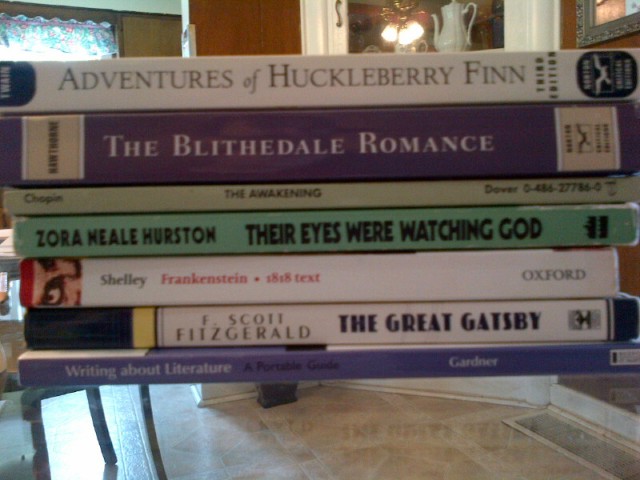
I’m currently taking a summer intensive course on the Romantic writers (the last three classes in my English program are literature! Yay!). Here are just the books for the next four weeks (not to mention numerous links to other writing such as my dear Wordsworth above):

bedside books

It’s been many years since I read these books, several decades since my English major. It almost makes me want to cry with joy to be “forced” to reread some of the greatest literature of all time. I’m scribbling notes of books I simply must read again, books any self-respecting English Lit major should know (or at least remember). Add Moby Dick to the above pile. It’s been too long, Captain Ahab! We must meet again!

But I digress . . .

What I love about the poem by Wordsworth is that it correctly assesses how I feel about my writing. Asked in a class last semester to determine my personal “aesthetic,” I thought long and hard. What do I want to write about? Who am I as a writer? I’ve been an editor for so many years that my writing got neglected. When I came back to it, I had to rediscover myself.

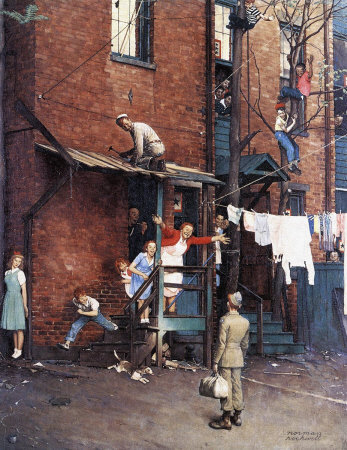
I honestly don’t recall “who influenced me” beyond what I’m sure was just the love of words and books. I can’t remember specifics. One thing I do recall, however, is staring for hours at the paintings by Norman Rockwell in a big coffee table book my parents had. I loved his realism. I loved how he captured a story in a painting so realistic that it almost looked like a snapshot. Having a dad in the military, this is probably one of my favorites:

"The Homecoming" by Norman Rockwell (1945)
“The Homecoming” by Norman Rockwell (1945)

The young boy dashing down the stairs to meet the returning soldier might well have been my ten-year-old self greeting my dad on his return from Vietnam.

What I love is realism. Take a moment. Capture it. Paint it for the reader.

Like Wordsworth, I want to notice things, to always have my heart leap up when I encounter nature in its beauty or a moment in time that must be captured in writing.

I like the short form. Sarah Hollowell set me on to Short Story Month (May, if you didn’t know) and Cathy Day commented on that blog, describing a friend who used 750words.com to write 750-word stories. So that’s my challenge . . . to start using that site (where I’m already a hit-or-miss member) and capture the moments.

So what short story writers do you admire most–past or current? I want to add them to my list!

5 Pledges of Literary Citizenship

In the grand tradition of “last lectures,” Cathy Day posted a note to her students on the Literary Citizenship blog at the end of her class this semester. It’s not really a final lecture since the class will be taught again for another group of fortunate students; the post is more of a wrap-up of everyone’s accomplishments.

And for me who got to sit in on the class this semester, it was a way to think about who I am in this literary world.

istockphoto
istockphoto

I took the challenge and revised my blog to focus on my literary life, and I invited you to join us on the journey as I learned what it meant to be a good literary citizen. Bottom line:

Be interested in what others are doing.

I was doing that, but not in a visible way. Now I “like” and comment on blogs. Now I follow Facebook pages of literary magazines and authors. Now I link to other people’s blogs. Now I’m finding people on Twitter who are as passionate about editing and proofreading and good grammar as I am. Now I write notes to authors I appreciate and thank them for inspiring me.

I learned to write about my passions. I decided to focus on areas of editing and grammar, with nods to all kinds of other topics (it is my blog after all). It was great to stake out a territory and then look around for folks already there and join them.

I learned some technical things like how to tag and categorize posts (yes, I CAN talk about things other than grammar) and how to better use Twitter. I learned about book reviewing.

And I’m finding my tribe.

As any great teacher will, Cathy challenges her students not to stop now that the class is over. This is about building a literary life, after all. At the end of her post on the Lit Cit blog, she challenged us with a few questions. I encourage you to think about them for yourself, but here are my pledges of citizenship in the literary world:

I pledge to continue to blog on a regular basis and to share with my readers great books, bloggers, articles, and ideas (yes, and even great grammar!). At times, I’ll write about what I’m doing, but that’s not the focus. It’s not all about me (that’s just true on so many levels. Wow . . . wouldn’t our world be a better place if we all adopted that mantra?).

I pledge to write a personal note to someone at least once a week to thank that person for his or her contribution to the literary world.

I pledge to keep finding, following, and connecting with folks in my tribe. And then I’ll talk about them so more people can know them.

I pledge to be continually interested in what other people are doing.

I pledge to talk about literary citizenship whenever and wherever I can. It’s that important.

Have you pledged citizenship?

How Not to be a Twitter Twit

I’ll never admit to being ahead of the curve. It usually takes me awhile to catch up with everyone else. When I finally joined Facebook, I felt like I’d arrived late to a party that was already in full swing. Then someone told me to get onto Twitter. I resisted, finally opened an account, didn’t get it, got exhausted trying to keep up with it, and closed it.

Then I finally decided–late–that I really had to be there. That happened when the indomitable Cathy Day (who else?) introduced me to hashtags and Tweetdeck, and suddenly I could make some sense of Twitter. (HootSuite is another option that works like TweetDeck to organize tweets via hashtags.) You can find me @LindaEdits if you’re so inclined.

credit: iStockphoto
credit: iStockphoto

I found some folks to follow (agents, other authors, publishers). Then, I went to this site, 44 Essential Hashtags Every Author Should Know, and found some hashtags that I want to follow. By creating TweetDeck columns for some of these hashtags, I have a constant feed, often with links to great blogs and articles, about the topics that matter to me. These blogs and articles give me great information for my classes, my research, and my teaching.

I follow people who interest me, I get followed, but I’m not trying to break any records. In fact, another indomitable force, Jane Friedman, explains why chasing after huge numbers of Twitter followers can just be a waste of time. Like any other tool of the trade, we just need to use Twitter wisely and well.

Since I’ve jumped back in and found so many interesting links and articles, I also realized the possibility of connections for jobs. Not only do my students need to understand Twitter, they should be there making connections as well as gaining experience in using it. Sure enough, many of the job postings they’re finding want people who understand and know how to use social media–and use it wisely. So this past week, my students in my Writing for Business class had an in-class exercise to create Twitter accounts. We talked about hashtags, and I gave them the link noted above that lists hashtags for writers. I created a hashtag for the class and everyone created a post and used the hashtag. With TweetDeck projected on the screen, their postings immediately appeared as they tweeted.

But I have to admit that it can be a little overwhelming. There is so much information out there that it’s nearly impossible to keep up. TweetDeck does help me by sorting tweets into categories where people are talking about writing or books or publishing or proofreading (my hot buttons).

How do you use Twitter? Has anyone done live tweeting as part of class? How can I make the most of my tweets? What do you find most helpful in your Twitter feed?

Avoid the Bog: Save Revision for Later

I spent this past weekend being an academic.

While I’ve presented at plenty of writers conferences, this past weekend I gave a paper (oooo, that sounds so academic) at the SUNY Council on Writing held in Buffalo, New York.

At the conference, I heard professors share teaching strategies to help their students engage better in a research paper and how to navigate different rhetorical situations required by different pieces of writing. One professor described working with students from one semester to the next to improve in areas where they need improvement. Another spoke during lunch about how he encourages his students to use all the technological resources at their disposal so that a paper is no longer just a Microsoft Word document but something full of visuals and hyperlinks.

The world is indeed changing, but some things are still the same.

That final product needs to be clean, perfect, polished.

My presentation was about the value of proofreading (big surprise). After decades in publishing, it’s been difficult for me to let go of the “perfection” level and understand that students need to be given freedom during the writing process. Two particular researchers in the field (for anyone who cares, it’s David Bartholomae in “Inventing the University” and Mike Rose in “The Language of Exclusion: Writing Instruction at the University”) helped me get my head around how to help writers and yet deal with my own requirement of final polish on papers. They explain that students new to academia are learning to write in a whole new way. They have to try on the language of academia. They have to take on the role of “authority” in their papers even though they’re writing to profs who are authorities. They have to think critically and not reach for the easy answer. They have to put together a coherent paper. And I would add that after writing it, they need to revise, copyedit, and proofread.

That’s a lot to ask. In a publishing house, different people do all those roles. And we’re asking students to do it all. Other research has shown that if students try to revise as they write, they end up bogging down in their own process, getting frustrated, and producing something maybe with fewer sentence-level errors but way less coherent.

“So Linda,” I said to myself, “let the proofreading go, would ya?”

“But I can’t,” I said back to myself, “because it’s important.”

And indeed it is. But it depends on what part of the process students are in and the rhetorical situation. I’ve learned that in initial drafts, I should work with students on the big picture. Let them get their thoughts together. Let the paper be full of comma errors and run-on sentences because this is still in process.

I should know this, for that’s just what an editor in a publishing house does. The big picture is what matters at that point.

From there, students can be helped to copyedit and then to proofread. I have for too long jumped right in with my red pen which focuses on the wrong thing too early. In reality, a student may have a lot of errors but also the beginnings of a well-reasoned argument or an amazing creative story. How much better to offer encouragement and queries at that level and leave the rest for later in the process.

Yet we still owe it to students to help them understand how to polish their papers. After all that work, we should help them deliver a piece that is indeed free of glaring errors (and that was the point of my presentation at the conference). And in a rhetorical situation like a resume or cover letter (which my Writing for Business students are doing this week), they have to understand how to create something that is indeed error free.

So what that means for us writers is that, during the process of writing, we need to just write. Get it down. Write as fast as we need to in order to keep up with our characters or our thoughts. Don’t stop to revise, at least not until the day’s writing is finished. Don’t get bogged down in the details during that first creative part of the process.

If you’re on a deadline, be sure to schedule in time for revision so you don’t feel rushed. Gone are the days of pulling all-nighters and turning in our assignment–our reputations are on the line, maybe even a paycheck.

To do it well, we need the time to revise and proofread (or have others help us–who also need to have time). But when we don’t get bogged down in the creative part of the process, we’ll feel much better about that final product.

Your Most Important Writing

My friend L. Marie posted a thought-provoking blog about what qualifies as success for us writers, so I wanted to repost it here and add a few thoughts.

Like her, I’ve spent much of my life working behind the scenes as an editor. You won’t find my name on too many book covers (maybe a couple, but long out of print); instead, I might appear on a copyright page (“Project staff includes”) or in the Acknowledgements (“Thanks to my editor”) or maybe neither of the above no matter how much work I may have done.

And you know what? That’s okay by me.

Sure. I’d love to land a six-figure book contract. I’d love to go on a book tour. I’d love fame and fortune and the new shoes all that money could buy (not to mention helping my kids pay off their college loans).

Sure.

Who among us wouldn’t want that?

But I tell my students that being published ought not be their standard of success. Trust me, plenty of books get published and simply don’t sell. Yes, it’s an important pursuit and I hope all of my writing friends are able to see their name in print. So keep trying. Keep writing articles and essays and stories and books, keep blogging, keep sending out those query letters and proposals, and above all, keep writing. L. Marie compares it to a marathon–actually running it is a success story in itself.

But here’s the thing. Don’t think less of the other writing you do. The unpublished stuff.

That note to a dear friend who’s going through a tough time.

That long-past-due letter to your grandmother to let her know how much she means to you.

That note of encouragement to a fellow writer.

That manuscript gathering dust in your drawer. You had to write it to pull yourself out of the depths of some despairing situation, or to get your head around some pain, or to write your way to an understanding and a peacefulness with your world. Yes, that manuscript. The one they have to bury with you because it simply can’t ever see the light of day.

And that’s okay, too.

The gift you have of writing–the ability to put words together in a special way–is valuable in all kinds of places, in all kinds of situations. And it may very well be that the most important writing you do will never be published for the world to see.

But it may make a difference in someone else’s life . . . or it may just have helped you continue on your journey in a better state of mind.

And when it comes to writing, what more could a writer want?

6 Quick Proofreading Tips

What a busy week! We had National Grammar Day on Monday, and today, March 8, is National Proofreading Day. For someone like me who lives this stuff on a daily basis, it’s downright exciting!

The day is devoted to “mistake-free writing” and projecting “a professional image with well-written documents that are 100 percent accurate.” Started by Judy Beaver at The Office Pro, this day is designated because it was her mother’s birthday—and her mother loved to correct errors.

As I noted on Monday, I’m not a total grammar geek but I do care about the correct usage of our language, and I’ve made a living for many years honing this skill. Lots of times I still CMShave to look things up in a dictionary or my Chicago Manual of Style (the style manual for much of the book publishing industry). All manuscripts go through several phases of editing, and I’ve done them all. Generally, if I do one phase on a particular manuscript, I make sure that other people do the other two phases–there’s a different focus that has to take place at each phase.

Editing—I call this the 10,000-foot view. I look at the big picture. I’m reading the fiction story and checking the plot, the pacing and flow, the characterization. In a non-fiction manuscript, I’m seeing if the organization works and makes sense. Any changes I suggest at this point are on the macro level—moving chapter 3 to become chapter 1, for instance. Or looking for that loose end in the mystery that the writer forgot to tie up (“What happened to so-and-so?”). The author makes changes (or not) based on my suggestions, and then the manuscript goes to a copyeditor.

Copyediting—This is more like the 1,000-foot view. Now that the editor has put the manuscript in good shape, if I’m in this role, I’m reading closely for sentence construction—dangling modifiers, run-ons, and inconsistencies. I fact check. I query if something doesn’t make sense, if a transition is needed, if a character’s way of speaking doesn’t sound real based on how he or she has been described by the author (“Would he really say this in this way?”).

Proofreading—This is the 10-foot view. If I’m in this role, sometimes I’m working on a manuscript, but often at this phase I’m looking at a pdf of typeset pages—which means I have to check the table of contents to make sure the titles and page numbers are correct, I check all the folios and running heads, I check the look of each page—marking widows and orphans (those random one or two words at the top of a page, or the lone line at the bottom—these just look awkward). Then I read every word. Even a clean manuscript can have random errors show up when the document is flowed into the typesetting program (a hidden tab in a Word document can suddenly rear its ugly head and space words far apart when typeset).

I love it.

Proofreading is probably my favorite. It’s that red pen mentality. I’m looking for errors only because I want the book, the author, and the publisher to put their best foot (feet?) forward.

The three types of editing take different skills. In my Editing class, I give my students practice in all of these areas, telling them that they will probably find an affinity for one and not like the others so much. But I also tell those who want to become editors that they should hone their grammar and punctuation knowledge anyway, because the copyediting and proofreading jobs are often the entry level positions in publishing companies. From there, they can move up, since often editors and acquisitions editors are hired from within, from people who have been with the company and understand the ethos there.

As I noted in my post earlier this week, proofreading skills are vitally important, especially on the job market. To have a clean paper, I suggest the following:

(1) Don’t trust the spell check program on your computer. (Judy has some tips on her blog about this.)

(2) If you’re not absolutely sure of the spelling of a word, don’t guess. Look it up. Dictionary.com is your best friend.

(3) Go back and read your letter, paper, email, memo, whatever, aloud slowly to yourself. This will help you notice if words are missing or if a sentence runs on and on. (It’s best to do this on hard copy. Trust me, you’ll see things differently than on screen. A friend of one of my students writes about that on his blog.)

(4) Then, read it again starting from the bottom paragraph backward, a paragraph at a time. This helps you get outside your own flow and see errors you might skip over otherwise.

(5) Electronically, go back and do a search for an open parenthesis (to make sure that you always have a matching close parenthesis), an open quotation mark (to make sure you always have a the appropriate closing quotation mark and to make sure any inner quotation marks are single and that they are both there). And get rid of those double spaces between sentences!

(6) Be aware of your own weaknesses. If you know you tend to write run-on sentences, watch for that in particular. If you know that possessives always mess you up, do a search for apostrophes and check each one for correct usage.

This will clear up a good number of your errors. It never hurts, however, to have someone else look over an especially important document—like a cover letter or resume or manuscript submission.

Let’s put our best foot forward—both of them!

It’s National Grammar Day!

Today, March 4, is National Grammar Day.

Are you celebrating? Well, are you?

I am celebrating by finding other celebrants–people I want to add to my tribe because they care about this stuff as much as I do.

I have to confess to being a bit of a grammar geek–although not nearly at the level of Mignon Fogarty aka Grammar Girl. I know some things, but I may not know why I know them or the rule behind them. That comes from thirty years of proofreading, following publisher style sheets, painstakingly reading typeset pages and marking pdfs until my eyes blur.

I love my red pen.

You see, I value perfection. (Oh my, I sure hope there aren’t any errors in this post when I’m finished . . . ). I’ve started grad school to learn more about teaching writing and discovered in my theory classes, much to my chagrin, that teaching grammar works against creativity and that college instructors try to steer clear in favor of the big picture, the creativity, the thought processes. I believe all of that is vital, of course. What’s the point of writing if you can’t make a clear argument or create a document that flows? But I also believe that the best argument in the world will get ignored if the writing is fraught with errors. Why do I want to take the time to read your article and consider your opinion if you can’t take the time to make sure to spell correctly and use proper punctuation?

It matters.

So I love National Grammar Day. (It’s on March 4th because apparently that’s the only date that forms a sentence, “March forth.”) I love when I find others in my tribe who care as much as I do about grammar and punctuation and a well-written sentence (they won’t be dangling any modifers in front of me, no sir!).

For one of my classes, I did a little research project. I hypothesized that writing instructors need to teach their students to proofread. We help them a lot at the contextual and sentence level in their writing, but we probably say, “And be sure to proofread your paper before turning it in,” without explaining what proofreading really involves. I think we do them a disservice. There is indeed a place for focusing on perfection. (More about this on Friday, March 8, National Proofreading Day . . . oh my, busy week!)

Take, for example, business writing. I start filling in for the instructor of a Writing for Business class this week for the rest of the semester (the regular instructor is out for shoulder surgery and rehab). I’m reading the textbooks and finding constant statements about the importance of perfection. In fact, one book quotes a website that keeps a collection of “cover letters from hell“–cringe-worthy letters sent to them by folks hoping for a job, like the person who wrote that he/she was an English major good at grammar–and then misspelled it as “grammer.” The website then states,

Elements of Style

A word to the wise: An error-free letter is now so freakin’ rare that the minimal care required to send a letter with zero defects, combined with a few crisply written simple declarative sentences, will, alone, guarantee a respectful reading of a resume. Maybe even secure an interview. Doesn’t anybody read Strunk and White in school any more? If you haven’t, get a copy of The Elements of Style, so you can follow it all your days.

Exactly.

Now all those theorists have a point. Do your writing and don’t worry a bit about your grammar. Get your ideas down. Tell your story. Make your point. Do the best writing you can do.

But before you send the query letter, turn in that article, or send in that manuscript, do me a favor.

Make sure it’s perfect.

Now realize that if you have your own little stylistic “tics” (you want to Capitalize Certain Words for Emphasis, or do random italics), then just let your proofreader know. You can be “incorrect” if it’s part of your style. Create a style sheet that tells your proofreader this is how you want it–then he/she will make sure that you’re consistent, along with looking for any errors you may have missed.

As citizens of the literary world, let’s protect our craft, always doing our best to deliver the best quality.

And if you feel that your proofreading skills leave something to be desired, hire a professional proofreader (or get someone you trust who really knows the craft) to go over everything before you submit the story or mail the letter. Believe it or not, there are people who thrive on helping your writing be perfect. In fact, even if you are good at it, it’s difficult to proofread your own work. It’s that whole “seeing the forest for the trees” thing.

(One little additional note: I’m talking at the professional level here. Please don’t refuse to drop me a note for fear of making errors. I truly do want to keep my friends. My point is that when we’re doing professional writing, we need to be professionals. The rest of the time, my red pen is safely in the drawer.)

So celebrate National Grammar Day with me! Grammar is the toolbox of our trade. Let’s keep those tools sharp!

Writers Write, Right?

So as writers, we’re supposed to write, right? I have to admit that I need to think of writing as my job; I need to schedule time to do it. Some days it’s difficult; often it’s just plain hard work. Sometimes it’s rewarding; other times I melt into a puddle of frustration at my inability to say what I want to say.

Ever been there?

What do you do to stay disciplined and keep writing–even when it’s tough?

I’ve been an editor for a long time and have done my share of helping other people’s work sound better. Then I started graduate school at Ball State University, a full thirty years after finishing my undergrad at Houghton College and after a long career in publishing. The writing classes took what felt like dried-up creativity and infused it with new life. I could write again–for myself. I could read some of the best writers, study their techniques, and try them out. I could listen to peer reviews and learn how to make my writing better.

It’s been stupendous.

And I realized that I needed to go about the business of being a writer–which means writing.

Right?

Yes indeedy.

In my class with Dr. Deborah Mix, we discussed how to keep writing. She gave us five key points:

(1) Decide on a writing commitment and post it where you can see it.

(2) Set a word goal.

(3) Set aside time every day to write.

(4) Be creative in how you motivate and reward yourself.

(5) When that distracted feeling comes, realize that at that very moment your brain is working hard. If you don’t yield to the distraction, you may experience a breakthrough.

So I jumped into the proverbial pool. I’ve taken on my job of writing with renewed energy and enthusiasm. One of my favorite sites is 750words.com–a simple site that gives me a nice blank page and counts my words for me, congratulating me when I get to the magic 750. It sends me a reminder by email every day, “You should write your 750 words” and it gives me a little hashtag on a calendar to track my monthly progress.

In any case, set a goal and then keep track of your progress.

Need writing prompts? Check out these rolling prompts at Writers Digest when you need some inspiration.

Need help with not being distracted? Download this program called Freedom. It blocks your access to the Internet for a set amount of time. You will literally be unable to check email or Facebook or the latest news during the time you’ve set aside to write.

Great idea, eh? What will they think of next?

As citizens of the literary world, we should join our fellow writers in our commitment to write, write, write because, well, it’s what we do.

How to Write a LotNeed more motivation? Pick up this little book, How to Write a Lot, by Dr. Paul J. Silvia (American Psychological Association, 2007). He encourages us not to find the time to write but to allot the time to write, treating our writing time as sacred. And, as a busy professional, he understands that writing can involve more than just writing. Perhaps you have to do some research, or review page proofs, or read the book you’re reviewing. Do it during your writing time because “writing is more than typing words. Any action that is instrumental in completing a writing project counts as writing” (19). He especially takes to task those writers who don’t write because they’re waiting for inspiration. “Serious writers write, inspired or not. Over time they discover that routine is a better friend to them than inspiration” (27). His help with setting goals and charting progress is invaluable.

It’s an odd task we’ve set ourselves, this thing called writing. We do it because we love it. We do it because we take joy in the look of words on the page and the sounds of words as they bump up against one another. We love to see what happens to the characters in our story.

So what keeps you writing?

The Art of the Book Review

I just got off the phone with my friend, L. Marie, who recently created a blog, “Thoughts about writing and life.” I’m thrilled that she’s blogging! We chatted about Literary Citizenship and how she needs this online presence in order to impress the agents where she’s currently shopping her young adult fantasy book. She has an MFA and is a terrific writer—but she realized that she needed to get online and join the literary world. I talked to her all about what we’re doing in our class; we talked through WordPress and how to add hyperlinks and tags. She’s on a roll now!

She’s also an avid reader, so I encouraged her to do reviews of books (her current blog is a movie review that ties into her writing). And wouldn’t you know it, our Lit Cit class is talking about that very topic this week. Book reviews are extremely important–especially book reviews by book lovers and writers who understand the craft.

That’s you.

Indeed, Robin Becker at Penn State has an entire class on book reviewing because “my own experience had led me to book reviewing. Years ago, just as my first book entered production, I asked a more experienced poet how to get my book reviewed. She replied, ‘Review other people’s work. That way, you participate in the conversation.'”

As citizens of the literary world, we should participate in the conversation about books by reviewing books and helping along other authors who are just getting started.

Sure, review the latest Stephen King if you want, but it will be a great help to another fledgling writer if you discover and love his or her book and write a well-crafted review. Post it on your blog, sell it to a magazine where it might fit, offer it to a newspaper in the town where the author will be doing a reading. Follow up with an interview and do the same thing.

But maybe, like me, you wonder how to craft a good book review. Well, here’s some help.

I’m new to this, so I come to the topic eager to learn. Our class website featured an interview with David Walton, author and prolific book reviewer, who offered his advice on writing book reviews. So I am passing along what I’m learning to you.

I love the pie chart included there; further detail about each category on that pie chart is here so that you understand what plot synopsis (35%), critical analysis (25%), showing off (20%), providing context (10%), and quoting from the text (10%) mean in the context of a book review.

I also discovered that there is a lot of conversation happening in the literary world regarding book reviews. I think I’ve stayed away because I thought: (a) I’m not high profile enough to write in the New York Times book review column, (b) I don’t know how to write a review, and (c) I don’t even want to comment on Amazon because isn’t that just people who either like or dislike the author or the topic and really write nothing about the quality of the book? (Charles Baxter calls this “Owl Criticism”: I don’t like owls; this book is about owls; I don’t like this book.) Indeed, many publishers are vetting their book reviewers to make sure they’re legit.

Well meanwhile, over at Amazon, there’s been plenty of conversation about fake reviews, with Amazon actually pulling down many suspect ones. (For help in writing one of those short Amazon reviews, check out this post.)

So what does that mean for those of us just getting started?

First, read the book.

Second, understand the craft and study the book well enough to be able to see what the writer is doing as a writer.

Charles Baxter’s “Owl Criticism” post puts it this way, “A reviewer is entitled to any opinion at all, but he or she earns that opinion based on a description and a judicious citation of evidence. . . . Is it too much to ask of a reviewer that he should know what he’s talking about?” He goes on:

The marks of a trustworthy review, therefore, have a kind of doubleness: the reviewer manages to assert somehow that the book under discussion is of some importance for one reason or another; and second, a good review provides a formal description of the book’s properties, so that you could reconstruct it from the reviewer’s sketch of it. This description is not the same as a plot summary, although a plot summary may figure into it. What a formal description does is to show what a book is about in relation to the form in which the subject matter has been shaped or located. In order to write such a review, let’s say of a novel, you have to have a basic idea of how novels are constructed; you have to have the technical knowledge that allows you to stand back from the book and to say how a book is put together. By these criteria, quite a few book reviews are worthless.

Los Angeles Times book critic, David Ulin, discusses the importance of well-crafted reviews:

Criticism matters — not because of how many people read it, or whether they agree or disagree with it, but because it is a way of engaging with literature. . . .

Books can stir this range of emotions also, which is why the act of criticism can be so hard. It’s not just about opinion but engagement, the sense of hope, of anticipation with which we come to a book, and the ideas, the feelings, with which we walk away from it, even, or especially, if they are not what we expect.

For me, this is how I know I’m doing my job: not by whether I like a book or don’t (whatever that means), but by what I learn. When I’m reading and writing well, books open up before me; often, they turn my preconceptions around. They make me think — not just about the flow of this text, but also about the flow of all texts: the different texts by this particular author, the different texts that I have read. I have, in other words, to confront myself, to figure out what I think, and then like all writers, to follow that line to its logical conclusion, for good or for ill.

For us writers, it’s a part of our craft to learn to write a good book review. It’s an art form. It keeps us reading. It allows us to learn from one another. It connects us in this literary world. It allows us to share good books with one another.

It helps us be good literary citizens.