My Own EdBoWriMo

I don’t know how you novel writers do it. First, I am always astounded by fiction writers–people who can weave a tale, build a plot and sustain it, create believable and likable characters, keep the suspense going, and then end with a conclusion that satisfies.

Seriously. I admire you more than you know.

So as the month of November approaches, and with it NaNoWriMo (National Novel Writing Month), I can hear weeping and gnashing of teeth from my Professional Writing students who are trying to decide if they can take on the beast that is NaNoWriMo.

If you don’t know, NaNoWriMo is when novel writers everywhere commit to writing 50,000 words of a novel during the month of November. To translate, there are about 250 words on a standard double-spaced typed page. So 50K words = 200 pages, divided by 30 days = roughly 6 or 7 pages a day. That’s a day. Anyone who is a writer will tell you how difficult it is to sustain that kind of momentum for very long. Not impossible, but tough. Especially when you have, you know, like, a life. Like classes to take and homework to do and food to eat and sleep to enjoy.

My student Chrysa discusses her past experience with NaNo in her blog post this week. And Jessie is trying to decide if the commitment is worth it:

If nothing else, the commitment of NaNo helps writers see what is possible. Whether they get to that magic 50K number or not, they have discovered that setting a goal and working steadily toward it have their own rewards. Basically you just do it and see if, well, if you can do it. There are no prizes, no awards dinners. Doing the task is reward unto itself.

Only writers understand that.

Which brings me to EdBoWriMo.

I don’t write novels. Never have. Never will. I am content to be astounded by my fellow writers who do. However, as I shared last week, I’m under contract to write a book about editing. So I decided to join my novel writing friends in making a commitment to myself to make this “Editing Book Writing Month.”

And since I know my abilities, I’m not shooting for 50K words; instead, I think I’m going for a more modest 22,500 words, which works out to 750 words (or about three pages) per day.

So what about you, my fellow writers? Do you have something you need to work on, but NaNoWriMo doesn’t quite fit? Then create your own! Let’s join with our fellow novel-writing friends and commit ourselves to a certain number of words per day (or per week if that’s better). Create your own acronym. Create your calendar.

And on November 1, let’s commit to seeing how far we can finally get on that project.

So tell me, what could you work on this November? What languishing project could you breathe new life into? What project could benefit from your sustained attention during the month of November? Tell me about it in the comments below.

Real-World Experience–My Students and Their Practicums

All of our majors in the Professional Writing department at Taylor University are required to do 160 hours of practicum experience. They do a variety of things, often based on a secondary interest–as long as they’re doing writing. One of my greatest privileges is to help them secure these practicums (sometimes they find their own; sometimes I mine my contacts to help them), to read their journal entries sent to me during the course of the practicum, and then to read their final reflection papers. If it’s possible, I try to visit them on site and talk to their supervisors.

Here are a few excerpts from this past spring and summer from a few of my students as they reflected on what they learned during the course of getting real-world experience. This young lady worked at a mission organization:

 In general, as I’ve been thinking about my internship experience so far, I think it’s been a pretty good fit. It’s allowed me to apply my skills as a writer and editor and refine them. I’ve been able to practice writing with an organization’s tone, and learning how to be creative within the confines of that tone. It’s given me opportunities to practice my interviewing skills, which I’m most excited about and have enjoyed best, I think. . . . I think will prove to be a good primer as I seek a job with a magazine or house within the next five years.

This person worked with a magazine:

I got to edit another article this week. One interesting thing that I learned when editing this is a little bit about the relationship between the writer and the editor. When I was sent this article to edit, [the publisher] told me that this writer was a really good writer, but she always turned her articles in late, too long, and with lots of mistakes. He said that he always spends the most time editing this author’s articles. I thought it was interesting, though, that he still really likes working with this author because she provides good content. So for this article I got some experience correcting many mistakes for formatting, grammar, and AP style. I also had to cut about 600 words. And since it was a scientific article, I had to make it easy enough for the common person to understand. It was a really fun challenge.

This young lady worked remotely for a publisher, reviewing, editing, and copyediting manuscripts:

Before starting this internship, copyediting was the only form of editing I felt really good at. However, in the past 10 weeks I’ve discovered I’m capable of evaluating, rewriting, proofreading, and more. My future editing career is by no means limited to just copyediting. Admittedly, after several weeks of doing everything but copyediting, it was great to go back to it. Copyediting is definitely the area I’m the most skilled at, as well as the area I most enjoy, which I’ve found is equally important.

On the last day of my internship, I sent my supervisor an email asking for advice about finding a job in publishing, skills I could improve on, etc. [She said], “Honestly, I think you have great editorial instincts. You’ve been well trained and you’re just a natural editor. One thing you could do is broaden your reading. Southern fiction, for example. I noticed there were  regional or generational things you didn’t know, which is normal because you’re young. You will learn about these things, but reading different types of literature and popular fiction will acquaint you with the ways that people from different regions, and countries, think and talk. But that’s about the only thing I can think of. I told Linda that you are among my two best interns ever. I hired the other one. I’m pretty sure you’ll get a job.”

And this young man worked at a local company doing more technical writing:

I spent my first full week at [company] reading and editing [their] training materials. The pace and dual nature of this work was a great fit for me, allowing me to work and learn simultaneously, and gather information for what would become the [company’s] Style. I became familiar with the software, terms, and procedures surrounding this product and made note of no fewer than 100 changes—from typos to phrasing—to the training material to make the brand more professional and consistent. . . .

Even though my title is Technical Writing Intern, I have actually done more editing than writing, which has honed my attention to detail. Through the different types of work I have completed so far, I have realized that I enjoy several aspects of editing fundamentally. Of the things editing requires of me, internalization and careful reading are two things I enjoy more than anything else.

I love it when my students get to hone the skills I’ve taught them and begin to find their callings!

From Manuscript to Book: As It Happened (Typesetting and Proofreading Phase)

One thing (among many) that I love about our Professional Writing program at Taylor University is that the students get such a thorough and well-rounded education in the world of publishing.

Here’s what I mean: After the students in my “Manuscript to Book: How It Happens” class finished their copyediting passes on their manuscripts (which included style tags, along with general language and punctuation cleanup), they then took those manuscripts to the layout and design lab.

As part of the Professional Writing major, students are required to take classes in “Digital IMG-20160426-00896Tools: Photoshop” and “Digital Tools: InDesign.” This makes them quadruple threats for any job in publishing because they know what it means to work with the words, but they also know what goes on in the design and typesetting phase where the books are created from the manuscript.
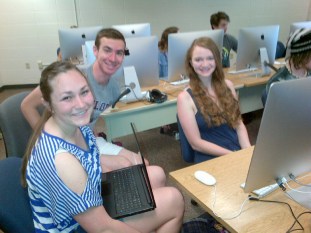
So each took one of the styled manuscripts, flowed it onto a template, and typeset a book. For three class periods we met in the layout and design lab and they worked on the manuscripts–deciding on fonts, chapter starts (recto only or recto/verso), leading, kerning, watching for widows and orphans (those random single words or lines at the top or bottom of a page), placing folios and running heads, and generally working to lay out a pleasing book within the page count target.

After they completed laying out the typeset pages, the teams chose one to turn into a PDF, and the PDF then moved on to the next team to do the proofreading pass.

In proofreading, the students work with the PDF tools to mark errors that either were IMG-20160426-00895missed in the copyediting phase or showed up in typesetting. They first do a visual check of all the pages — looking that the margins are even, that the folios and running heads are placed correctly, that everything looks right. Only then do they go back and begin to read every letter on every page.

After a few days of this proofreading practice, we met together, looked at the PDFs on the screen, and talked about what they had noted as errors.

Again, this is one of the phases that takes a different kind of skill. At this point, no one wants the proofreader’s opinion of the book or the arc of the story. And really the proofreader should not be revising sentences. Instead, he or she should really only fix true errors (which can, indeed, happen at the sentence level; for instance, if there’s a dangling modifier, the proofreader should fix it).

IMG-20160426-00898Proofreaders need to enjoy the hunt – searching for and correcting errors. It takes a special “eye” to do this, one that can be trained with practice. (I recall many years ago when I was doing freelance proofreading on galleys, the editor at the publishing house would often say, “I can’t believe you found those errors!” I took this as a compliment.)

As our “final exam,” the students went back to the styletagged manuscripts and learned how to create ebooks.

So there we have it. My students took manuscripts and turned them into books. Now they know how it happens! They felt that actually working through the steps as would happen in a real publishing house had been extremely valuable in the learning process.

I think so, too!


From Manuscript to Book: As It Happens (Copyediting Phase)

So here we go! Manuscripts have come back from our authors. A few of them worked on some of the suggested changes and sent us revised manuscripts. A couple of others are taking our revision suggestions to heart but going to hold off until they have more time to dig in and make the editorial changes. In either case, we’re moving on with unrevised or revised manuscripts, sending them to a new group to copyedit.

What exactly happens at this phase?

Generally the big questions have been answered, the big problems have been solved. Issues of plot arc or plot lines or characterization or dialog or setting have been queried and revised. The manuscript comes back to the editors for a final check and then moves on to this next phase. So right now, my intrepid editors need to put on their copyediting hats and think differently. They have received the manuscripts from the editing groups and have uploaded them to Google docs so they can copyedit as a team, making and seeing one another’s comments.

The copyeditors now dive in and read carefully. They move in closer, looking at paragraphs and sentences and words choices and punctuation. They look for general readability. They fact check where necessary. They look for consistency issues. They smooth out rough sentences.

They have a little over two weeks for this process, and this morning they did the math (yes, math!) to figure out how many hours this will take them (number of pages x how many minutes it takes to copyedit each page divided by sixty to give them the number of hours). They then also created some benchmark dates for working through the pages and meeting the deadline.

It’s a different level of work. Some people find that they like the big picture editing more than copyediting. Others find that they really like being able to dig in and work at the sentence and readability level. Some had difficulty keeping themselves from doing that in the editing phase! But we have to separate these out because the processes are different, ask different questions, and take different ways of looking at the manuscript at hand.

It’s a lot of reading, a lot of work. But they’re on it! And I couldn’t be prouder!

From Manuscript to Book: As It Happens

At the end of last month I posted about a class that I created here in our Professional Writing department called “From Manuscript to Book: How It Happens.” I explained that my hardy group of thirteen students would be working their way through five manuscripts — first as editors, then as copyeditors, finally as proofreaders.

So we’re about a month into the class and they are nearing their deadline for the content editing portion of the project. At the beginning of class, each group took their manuscripts, divided them up across the class periods, and figured out how much they needed to read before each class to be ready to discuss. They have a lot of steps to perform, but getting on schedule for reading and editing (and staying on schedule) is one of the first and most important parts of the process. Here’s how the entire flow looks for us for this semester:

We have deadlines throughout the semester to ensure that all five books make it through the entire process.

The second week of classes, the authors came to class and talked with their editors. It was very helpful for the editors to understand the background of the projects, what the author is trying to accomplish, and just to even put a face behind the writing.

The students come to class and, for the first half hour, talk about the next section of material they read. They’re looking at plot pacing and characterization and dialog and flow and asking questions of one another. I hear snippets such as, “Does anyone understand why the character did that?” “Yeah, I’m not sure that this makes sense.” “This character is supposed to act one way but seems to act another way in some spots. Is she supposed to be bipolar?” “This was so good I couldn’t stop reading! I had to force myself to put it down and do my other homework!”

And sometimes, they end up in laughing fits because, well, it’s difficult and tiring work and they need to relax. (I totally get that.)

Last week, a wonderful fiction editor from Tyndale House, Sarah Mason Rische, skyped with us about her process in fiction editing. The students were able to ask her questions about how to handle certain issues that they came across in their manuscripts. She was a great encouragement to them. So wonderful to hear from a true professional who lives this process every day.

Here are my students wrapping up the editing phase (and feeling darn proud of themselves, as I am of them!):

These guys had two separate manuscripts from separate authors, so they've had to change gears halfway through.
These guys had two separate manuscripts from separate authors, so they’ve had to change gears halfway through.


The group in front had a 500-page beast that they've been taming. The ladies in the back had two books by the same author.
The group in front had a 500-page beast that they’ve been taming. The ladies in the back had two books by the same author.


So here we are now preparing to write our letters to our authors with our editorial feedback. It’s a lot of work to condense the advice into a readable and encouraging letter while still helping the author clearly see areas that can make the manuscript stronger. The letters and manuscripts with comments will go back to our intrepid authors and we’ll give them a few weeks to make revisions.

In the meantime, the next phase is understanding book budgeting, how the numbers work, and what the publishing board needs to consider in order to make sure that the book can make money. We’ve got an Excel doc to run our numbers, and we’ve got a template of information to fill out. Each group is creating a presentation for their book (in the cases of where they have two books they’ve been editing, they’re choosing one) and will put together a proposal for the pub board with information about the project, the author, the budget, the competition, and the start of a marketing plan.

In preparing a document for the designers (the layout and design class is going to work with us on creating some book covers), they will need to give information such as the title, subtitle, tagline, author’s name, back cover copy, and author bio. Those are the words that need to go on the cover. Then the designer needs specs such as trim size and page count (so the spine can be the right size). Then, of course, beyond that, they need a synopsis of the story, the genre (a romance will have a different look than a fantasy than a thriller), the audience (a kids’ book will have a different look than an adult book), and they need to know the time period, the setting, and some idea of what the main character looks like in case they decide to put a person on the cover — needs to look like how the character is described.

The templates my students will use to create a pub board presentation and a book cover designer presentation.

So a big portion is nearing completion, but there’s still so much more to do! So many more steps. So much to learn! Of course, that’s why we have this class! I think these guys are getting a great understanding of what it really takes to make a book. It’s tough, it’s tiring. But it’s also rewarding.

From Manuscript to Book: How It Happens

I’ve been intensely creating syllabi for the last month. Spring semester begins February 1 and I have three classes to prep. (I never appreciated my class syllabi for my classes in college. But now that I’ve had to be creating them, wow. What a lot of work and planning!)

One class I’m particularly excited about is a new one I’m creating called “From Manuscript to Book: How It Happens.” I did a version of it during a May term at Houghton College back in 2009, but I’m refashioning it to fill a full semester. Five local authors have entrusted us with their complete manuscripts (all fiction), and my class will become a publishing company (name to be determined) that will walk these manuscripts through the entire publishing process.

My students will work in groups. Each group will receive a manuscript and they’ll first work as content editors. They’ll consider all the things fiction editors have to — pacing and characterization and plot and dialog. We’ll Skype with a fiction editor who will talk us through her process. At the end of the first few weeks, they’ll prepare a detailed letter back to their author with advice for the manuscript. In the meantime, class periods will include a behind-the-scenes look at how a publishing company works. We’ll create schedules and budgets and P&Ls and sales projections. From this information, they’ll also begin a title information sheet.

From the title sheet and their P&Ls, they’ll prepare a sales presentation for their book to bring to the publishing board (us) that will determine if we’ll publish these books (which, of course, we will). We’ll Skype with a fiction agent who will clue us in on the types of proposals that sell. This will give my students practice in understanding the how and why of decisions in a publishing house. We’ll hear from publishing professionals currently working in the field.

When the manuscripts come back from the authors, each will go to a new group who will become the copyeditors. They’ll put the manuscript on a template, create style tags, and add front matter. Then I’ll probably have them transfer the work to a Google doc to make the copyediting process easier for group work. They’ll copyedit the manuscript and create a style sheet before preparing the manuscript for typesetting.

We’ve got a plan to meet with a layout and design class. I’ve worked it out with the instructor to include an assignment for his class that involves creating book covers for our books. My students will fill out design acquisition forms and then present the stories of their manuscripts, audience, and other information to these designers so they have the information they need to create the covers.

They will then work as teams to typeset the books and prepare final pdfs. The pdfs will then come back to our class and move to the next group that will then proofread.

Final exam? We’ll learn how to take the manuscript and create an e-book.

Will it work? I don’t know — my class will need to offer me some grace as we move through the process. The bottom line is that I hope they learn about the book publishing process, start to finish.

I will keep you posted.

What’s in Your Wallet?

The things we carry tell a lot about us.

In my Writer’s Craft class, we studied the value of details in our stories — you know, those little words or tiny descriptions that can make a whole story turn and give a complete description without having to say much at all.

To illustrate how this can work, we read part of the first story of Tim O’Brien’s work, The Things They Carried. This essay collection details some of O’Brien’s experiences in the Vietnam War. Published in 1990, twenty years after O’Brien returned from the war, the story still resonates with its gritty realism. Such a story could only be written by someone who lived it.

The titular essay describes the various soldiers in the 23rd Infantry Division with vivid descriptions mostly of — you guessed it — what each soldier was carrying. From these lengthy paragraph descriptions, my students and I could detail on the board the job each soldier had within the unit, what he cared about, and even a bit about what he was like (the things carried could be something like “fear”). Here’s just a taste:

obrien

The things they carried were largely determined by necessity. Among the necessities or near-necessities were P-38 can openers, pocket knives, heat tabs, wristwatches, dog tags, mosquito repellent, chewing gum, candy, cigarettes, salt tablets, packets of Kool-Aid, lighters, matches, sewing kits, Military Payment Certificates, C rations, and two or three canteens of water. Together, these items weighed between 15 and 20 pounds, depending upon a man’s habits or rate of metabolism. Henry Dobbins, who was a big man, carried extra rations; he was especially fond of canned peaches in heavy syrup over pound cake. Dave Jensen, who practiced field hygiene, carried a toothbrush, dental floss, and several hotel-sized bars of soap he’d stolen on R&R in Sydney, Australia. Ted Lavender, who was scared, carried tranquilizers until he was shot in the head outside the village of Than Khe in mid-April.

This first essay gives a brilliant picture of this group of men, together by necessity, bound to one another, trying to do the tasks assigned and stay alive.

So my students did a writing exercise. I asked them to dig into their backpacks or purses or pockets or wallets and list everything they were carrying. Then they did some free writing. My challenge to them was to write a couple of paragraphs describing what the things they were carrying revealed about them.

There’s the girl who was lugging around in her backpack papers that she didn’t even need (and she couldn’t remember what class they were from). There’s the girl with the detailed calendar. There’s the guy with the extra pens and the other who probably needs to bum writing implements. Almost all of them were carrying books (one read Shakespeare constantly!). The students carried pictures or other items that brought back memories.

I looked in my purse. First, it’s way too big, but I like a big purse when I need to carry extra — you know — stuff. I have a big make-up bag with extras of all the basics after one day a couple years ago when I arrived at school and had forgotten to put on any make-up! I vowed that would never ever happen again! I have a notebook like what I tell my students to carry so that they can write down brilliant ideas when they strike. It’s pretty much bereft of brilliant ideas, although I do use it to jot down names of books I want to read.

In other words, I’m carrying things I hope not to need (extra make-up) and things I hope to need (a place to write down brilliant ideas).

I have a wallet and three sets of business cards and too many pens. I like to be prepared. I have my datebook because I don’t have nor want a smart phone. I like to have lists and organization and for that I need my datebook.

My bag tells me a lot about myself. My students learned a lot about themselves by looking at what they carried. We talked about using such details for the characters in their fiction–how can what the character carries be part of the description of him or her?

So, what’s in your wallet? What do the things you carry say about who you are and what you care about?


.

Building an Author Platform – One Board at a Time

The students in my “Building Your Author Platform” class have been busy. We spent the first couple weeks of this class figuring out who we are as writers and who we need to be out there online. They thought about what they write, their interests in both reading and writing, where they want to take their writing, and who they want to meet out there and add to their “tribes.” I have a couple of students who write psychological horror/thrillers, several who write fantasy/sci-fi, a Star Wars fanatic, some YA writers, a student who doesn’t want to write but wants to promote books (bless her!), a scientific writer (she even has a moth of the month you can learn about!), and a couple who are also just multi-talented and still figuring it all out.

They then built their websites to go along with the sort of “brand” they’re creating of themselves. Then, following principles of literary citizenship, we’ve talked about how the best way to “network” is not to “network” per se but to simply to be interested in what other people are doing. They’re writing charming notes each week to someone they admire. They’re following and commenting on one another’s blogs and blogs of writers they admire and want to add to their tribe. They’re tweeting (and tweeting and tweeting and tweeting . . .).

I love it when a student stops by my office to say, “My tweet just got ‘favorited’ by my favorite author!” and they begin to realize that reaching out simply means a tweet, a retweet, or a kind comment on a blog. I want them to understand that, once they leave this college cocoon where they’re surrounded by likeminded writers who understand them, they will be out in the bigger world where, chances are, fewer people “get” them as writers. They will need that online “tribe” that continues to discuss the various virtues of the new Star Wars trailer or the plot line of the latest Brandon Sanderson book or whether their own character in the latest story is speaking in a believable way (“Let me just read you this . . .”). The tribe is a place where they can continue to join the conversation about things that matter to them.

Your platform--where is it taking you? How's the view?
Your platform–where is it taking you? How’s the view?

I tell them that they will need to attend a writers conference — hopefully once a year — to get recharged and reinvigorated. They will need to continue to buy and read books (that doesn’t seem to be an issue with this group).

This past week we also listened to the pitches of those students who have books in the works. I wanted them to both practice writing proposals and pitching those proposals to agents. Half the class is in that position, so the other half acted as agents and I gave the authors five minutes to sit down in front of an agent, give their book’s synopsis, and be calm and professional all at the same time. It was great practice for that opportunity they will have sooner or later to actually pitch that finished book.

Platform building isn’t all about me, myself, and I — which I think is why many people are scared of it. No, platform building is about building a network of likeminded folks both in your physical world and online — caring about them, sharing their work and their words, joining the conversation, and rejoicing with the successes that happen in the group. Then, one day, when success comes knocking on my students’ doors (as I have no doubt it will), they have a group ready to celebrate with them.

One board at a time. Reach out to your favorite authors in your genre. Thank them for something. Comment on their blog posts. Share your work and your thoughts on your own blog. Take your time, because it will take time. But the time to start is now–even if you don’t have a book to sell. Just go out there and join the conversation. You have something important to say.

Word Power

I tried an experiment in one of my writing classes this past week. We’re talking about the power of words and learning to, as Francine Prose writes in her book Reading Like a Writer, “put every word on trial for its life.”

We looked at the words used (and not used) in Cynthia Ozick’s ‘The Shawl.” (They were amazed to realize that the word “Nazi” is nowhere in the story, even though that’s what it’s about and they knew that’s what it’s about, even without that word and many others one might expect.) We studied the descriptions of place and people in Guy de Maupassant’s, “The Piece of String.” We watched how Flannery O’Connor chose words and led us along in “A Good Man Is Hard to Find.”

Then I read them some quotes from one of my recent favorite books, Markus Zusak’s The Book Thief. Here are some of the beautiful, lyrical lines:

When the train pulled into the Bahnhof in Munich, the passengers slid out as if torn from a package.

All was dark-skied and hazy, and small chips of rain were starting to fall.

In Liesel’s mind, the moon was sewn into the sky that night. Clouds were stitched around it.book thief

That was when a great shiver arrived. It waltzed through the window with the draft. Perhaps it was the breeze of the Third Reich, gathering even greater strength. Or maybe it was just Europe again, breathing. Either way, it fell across them as their metallic eyes clashed like tin cans in the kitchen.

<a scene of the Nazis burning books> The orange flames waved at the crowd as paper and print dissolved inside them. Burning words were torn from their sentences.

The cold was climbing out of the ground.

Snow was shivering outside.

The window opened wide, a square cool mouth, with occasional gusty surges.

Pimples were gathered in peer groups on his face.

I love how Zusak uses words, putting them together in surprising ways to make descriptions that are exact and yet so unusual and unexpected. It’s that very unexpectedness that delights me.

So we did an exercise in class. I gave students four small pieces of paper. On each paper they were to write a word — two papers would have adjectives, two papers would have nouns. Any adjective, any noun. I gathered the papers into two piles, shuffled them, and then each student chose one adjective and one noun and had to find a way to use them together in a sentence.

We got “chilling sun” and “soft children” and “shiny dream.” And the students wrote amazing new sentences, allowing these unusual pairs to work together.

In a weekly journal post, one of my students wrote, “I liked the adjective and noun game. Combinations like chilling sun made me think about the ways I described things throughout the week. Instead of relying on easy, conventional descriptions, I searched for different, more unusual word pairings that still made sense.”

Couldn’t have said it better myself!

What are some of the most lyrical, surprising, and unexpected sentences you’re read — and where did you read them?

The Writer’s Craft–Learning from the Best

That’s it–The Writer’s Craft. That’s the name of a required class in our Professional Writing department at Taylor University–a required class that I will be teaching for the first time this fall. I’m so excited to teach this class because we’re going to read great writing, unpack it, understand what makes it great, and learn what we can use to improve our own writing.

ProseThe class has traditionally used Francine Prose’s book, Reading Like a Writer: A Guide for People Who Love Books and for Those Who Want to Write Them (New York: Harper Perennial, 2007).

I love this book because it gives examples of great writing in areas of words, sentences, paragraphs, narration, character, dialogue, details, and gesture. All of this is studied by way of what she calls “close reading,” taking the time to annotate a chosen text and study it carefully.

So I’m excited to bring to the students stories from John Steinbeck and Ernest Hemingway and Flannery O’Connor and John Updike and Tim O’Brien and Edgar Allan Poe and James Joyce and Anton Chekov, among others. I can’t wait to have my students do close reading of amazing writing, discuss it, learn from it, be inspired by it, use it.

I’m just a little thrilled to teach this class.

It is important that writers read “textbooks” about writing–and those textbooks are the great works that have stood the test of time. Prose (don’t you just love that the author’s name is “Prose”?) writes that these great works are “textbooks, private lessons in the art of fiction” (3). What is it about this piece of writing that makes it great? that has stood the test of time? that makes it classic? She continues, “A masterpiece can inspire us by showing us how a writer does something brilliantly” (11).

We’re not going to look at the big picture–the why of the writing. Instead, we’re going to focus on the mechanics, the how. What words does the writer use? How are those words making this piece sing? What about sentence structure? Paragraphing? How is this dialogue telling us the story without telling us the story? (For the last one we’ll read Hemingway’s “Hills Like White Elephants.”)

In his wonderful little book Steal Like An Artist, Austin Kleon talks about making sure we artists surround ourselves with other great artists (I talked about this book more in this post). He advises us to be collectors, collecting the things we love.

You’re only going to be as good as the stuff you surround yourself with. My mom used to say to me, “Garbage in, garbage out.” It used to drive me nuts. But now I know what she meant. Your job is to collect good ideas. The more good ideas you collect, the more you can choose from to be influenced by. (13-14)

Seeing yourself as part of a creative lineage will help you feel less alone as you start making your own stuff. I hang pictures of my favorite artists in my studio. They’re like friendly ghosts. I can almost feel them pushing me forward as I’m hunched over my desk.

The great thing about dead or remote masters is that they can’t refuse you as an apprentice. You can learn whatever you want from them. They left their lesson plans in their work. (17)

So we’ve got our readings, our lesson plans, our pens, and our desire to collect and learn from the greats.

Can’t wait!

What great writers or particular pieces of writing have inspired you?