The Challenge of Christian Writing and Publishing

It’s been an interesting challenge, this past school year, as I’ve taken on new classes (translate—learn what I need to teach and then figure out how to teach it) and gotten out of my comfort zone.

But it has forced me to do some deep thinking about what I’m doing, why I’m doing it, and what really matters.

Why do I teach writing and publishing?

What do I really want my students to know?

In the past few months, three things have become more clear to me. For the Christian writers who come through the Professional Writing major at Taylor University, I am committed to them graduating with the following understandings:

  1. as Christians, I want them stand strong on the foundations of their faith, understanding that Scripture and their faith impacts every aspect of their lives; I want them to fall in love with God’s Word and see its power for the rest of their lives;
  2. as writers, I want them to understand that their love for and ability with words is a calling and a gift from the Caller that they should and must continue to hone and improve;
  3. as Christian writers, I want them to comprehend the power of those words and their responsibility to God for how they use their giftedness with words, especially as they seek to publish those words into the world.

How can my faith intersect my discipline as I teach the Professional Writing curriculum? How can I—a Christian publishing professional, editor, writer, and faculty member—bring these fundamental truths into our program? How can I bookend my students’ learning from their 101 introductory class to their final capstone class with these truths that matter?

It feels like a very heavy load.

But down deep in my soul, I sense that this is vital. This is more important than anything else I can do.

It is incumbent on Christian publishing professionals—whether authors or editors or publishers or marketers or bloggers or social media experts or agents—to deliver material that is well written, winsome, true, biblical, and honors Jesus Christ.

In a recent discussion, one of these Christian publishing professionals told me, “Too much of Christian writing is either preachy or saccharine. We need to bring wisdom, winsome words, and truth from our foundation into our writing.”

But what does that even mean anymore? The world is so deeply divided. Even among Christians there is so much division we sometimes act like a circular firing squad. I wonder how we can impact our world for good. How can we disagree about living out our faith (our politics, our work lives, our theological beliefs) but do so in a winsome and respectful way? How can we engage the questions so important in our culture, even as we disagree, while still being able to help others find what we have discovered in the foundations of our faith? In the end, that foundational piece is going to be all that matters to us anyway.

How do I guide my students to these understandings—even as we learn good writing and style tagging and editing and platform building and how to do a book proposal?

How do I guide them—even as we look for truth in Scripture and perhaps disagree on many other areas?

How do I help us all “work out our own salvation with fear and trembling” and work out our writing and publishing lives in the same way?

There’s a lot to unpack here, and I invite you to join me both as I prayerfully seek God’s guidance and express my thoughts in the blog. I invite you to comment with your own thoughts and ideas as I think this is a big conversation worth having.

Writers have a lot of power with their words.

And the world needs our very best.


The Splendid Work of Writing

I’ve been reading the essays of author Andre Dubus, considered a master of the short form. In his book, Meditations from a Movable Chair (New York: Vintage, 1999), Dubus writes an essay called “First Books” and offers this encouragement to writers:

An older writer knows what a younger one has not yet learned. What is demanding and fulfilling is writing a single word, trying to write le mot juste, as Flaubert said; writing several of them, which become a sentence. When a writer does that, day after day, working alone with little encouragement, often with discouragement flowing in the writer’s blood, and with an occasional rush of excitement that empties oneself, so that the self is for minutes longer in harmony with eternal astonishments and visions of truth, right there on the page on the desk, and when a writer does this work steadily enough to complete a manuscript long enough to be a book, the treasure is on the desk. If the manuscript itself, mailed out to the world, where other truths prevail, is never published, the writer will suffer bitterness, sorrow, anger, and more dangerously despair, convinced that the work is not worthy, so not worth those days at the desk. But the writer who endures and keeps working will finally know that writing the book was something hard and glorious, for at the desk a writer must try to be free of prejudice, meanness of spirit, pettiness, and hatred; strive to be a better human being than the writer normally is, and to do this through concentration on a single word, and then another, and another, and another. This is splendid work, as worthy and demanding as any, and the will and resilience to do it are good for the writer’s soul. If the work is not published, or is published for little money and less public attention, it remains a spiritual, mental, and physical achievement; and if, in public, it is the widow’s mite, it is also, like the widow, more blessed. (162-63)

dubus

Writers, we must endure. We must keep working knowing that the words we write are worth it . . . it being the process, the “splendid” work, the worthy and demanding work.

No one said it would be easy. No one said it would be a sure path to fame and fortune. But as writers, we must be true to ourselves, to our giftedness and our calling. We must reach and try and write and rewrite and reach again because it matters.

If we’re true to our giftedness, then we will continue to write — no matter whether published or not, read or not. It is the “widow’s mite” that we offer up, and we are blessed.


Prepping for Life (Part 3)

The last two posts gave Part 1 and Part 2 of our Interterm capstone course for my Professional Writing seniors. The final piece of this three-week puzzle was a writing project (we are a Professional Writing major, after all).

I built this as a hybrid course where we met every Monday, Wednesday, Friday for 3-1/2 hours, and the Tuesday, Thursday days were set aside for them to do research and write their capstone papers. During the course of those days, Blackboard discussion questions kept the students on track and on task.

Here was the assignment:

You will write a paper of 2000 to 2500 words. You will choose the topic—something to study or learn that you want to know for the future. You have a couple of different directions you can go.

Craft—Perhaps you want to study an aspect of the craft of the type of writing you do: world-building, foreshadowing, creating twists in a plot, building a memoir, putting together a book of poetry, etc. The sky is the limit (pending my approval of your topic). The paper will include research from books on craft, from favorite books and writers who are doing it well, magazine articles, websites and blogs with information, even personal interviews if applicable. You will write the paper and source it with endnotes using CMS style and a bibliography of all sources consulted, also in CMS style.

Occupation—Perhaps you want to study a particular job such as editing (content editing, copyediting, proofreading, acquisitions; book, magazine, newspaper), agenting, publicity and social media, etc. The sky is the limit (pending my approval of your topic). The paper will include research from books on the topic, magazine articles, websites and blogs with information, even personal interviews if applicable. You will write the paper and source it with endnotes using CMS style and a bibliography of all sources consulted, also in CMS style.

The last two days were for final oral presentations, which called for them to

  1. Introduce themselves.
  2. Explain the project they chose to research, why they chose it, and how they felt it is important information that they want to carry into their post-Taylor life.
  3. Describe how the project fit into their “red thread” (as noted in Part 1) and how it provides a “cap” to the work they’ve done during their tenure at Taylor University.
  4. Give an overview of the entire paper in condensed form (like an “abstract”).
  5. Choose a section of about 600–750 words to read, something that will give those of us listening an idea of what was learned.
Jan 2019 grads
Seven of my seniors were January grads, finishing at the end of capstone. Talk about tearful goodbyes!

Want to know the topics covered? Here you go.

  • How to run a freelance writing business
  • A comparison of tragic and comic plays
  • How to write the middle of your novel so it doesn’t sag but keeps the plot moving
  • How American journalism has changed during the 20th century
  • Why businesses (and authors) need digital marketing and how to begin
  • What it takes to be a screenwriter
  • Inbound marketing–how it works and why it’s the best way to reach customers
  • The essential elements of suspense and how to use them in a novel
  • Content editing–the four relationships that interplay for the editor
  • Writing characters that live beyond the book
  • How to implement theme in fictional stories
  • Why poetry matters to individuals and to society
  • Archetypes in fiction
  • The beginner freelancer’s guide to money
  • The elements of a strong memoir
  • The art of the tragic character
  • The ethics of horror

amazing

The students were happy that they had the opportunity to research something they really wanted to know about (the woman who wrote about suspense said that her research gave her that “aha” moment she needed to understand what had been missing in her writing).

They were all so excited about one another’s papers that we had to find a way to make sure everyone had access to all of them and could download them for later reading.

One change I will make next year is to allow the paper to be longer — most of them felt they could barely scratch the surface of their topics. I wanted to take into account the limited amount of time they had to research and write (3 weeks), but these writers felt like they could do much more even in that limited time.

All in all, I think we had a successful time together.

Then, it was time to head into spring semester!

Prepping for Life (Part 2)

“Calling is the truth that God calls us to himself so decisively that everything we are, everything we do, and everything we have is invested with a special devotion, dynamism, and direction lived out as a response to his summons and service.”

–Os Guinness, The Call

In a previous post, I told you about how our Professional Writing capstone class was kicking off with my 17 seniors. That was Part 1.

For Part 2, my students worked on the Flower Diagram from What Color Is Your Parachute? (I used the 2017 version). If you don’t know, the Flower Diagram is a self-inventory that helps individuals work through their own personal preferences in working style, environment, coworkers, location, and even stretching to what each person wants to accomplish in life. The students overwhelmingly found this exercise (which took us two class days, so seven hours) to be helpful in capturing in one spot a lot of scattered information about themselves. (We even built a preliminary budget on Excel docs!)

For another class, we talked about how to network — which basically means learning how to be a good listener. I then had each student write a 30-second elevator pitch to answer the question, “So tell me about yourself” (much as an interviewer might). They then did a “speed dating” exercise where they moved from one person to the next, spending three minutes sharing their pitch, listening to the other person’s pitch, and then conversing before the bell rang and they moved on to the next person and did it again.

Having to say the pitch and hone it over eight times helped them be ready for . . .

. . . mock interviews.

I gave the students a list of the most-asked questions, and a link to a website that would help them understand what employers are looking for when they ask these questions. I required the students to use their journals to write answers to each question, or at least to take notes as to what they would need to do to prepare for those questions.

Six professionals gave of their time to interview six students each. The students went in groups of three; each was interviewed while one of the other two kept time and both observers wrote assessments. After each interview, they all had five minutes to talk together about the good and the areas that need improvement, and then the groups moved to another interviewer to try again and improve.

Sort of helped with the jitters and to make the interviewing process a tiny bit less intimidating.

I really wanted this to be a practical class so that they are ready — resume polished, LinkedIn profile and portfolios ready, answers to interview questions prepped, all with a feeling of certainty that they understand themselves and their goals just a bit better.

But lest you think it was all fun and forms, stay tuned for Part 3.


Prepping for Life (Part 1)

“Calling transforms life so that even the commonplace and menial are invested with the splendor of the ordinary.” (Os Guinness, The Call)

My seventeen Professional Writing seniors are closing in on the end of their careers at Taylor. I’m privileged to be teaching what our program calls the “capstone” class — three credit hours together to “cap” their time at Taylor U and their time in our major.

It’s a daunting class — and this was the first time I’ve taught it.

From the start, I knew the class needed to have a writing element, it needed some self-inventory, it needed some interview and job hunt practice and information, and it needed some “adulting” conversations. Three solid weeks, 3-1/2 hours per day. And I wanted all of it to feel practical and meaningful and purposeful.

And that’s what I’ve tried to do.

One day, we talked about our “callings,” considering the definition in Os Guinness’s classic book. How calling can be to many types of work, not just “Christian” work per se. How calling can be simply to finding splendor in the ordinary. How calling can change the world in small ways. How calling, with the acknowledgement of a Caller, gives meaning to life. That was the initial part of our self-inventory.

Then we did what one of my colleagues calls “the red thread.” Each student went through all of the classes taken at Taylor, noting what they liked and didn’t about each — trying to understand how they like to learn, how they learn best regarding type of class, type of instruction, type of content, etc. This traces a “thread” that serves to remind them of the many types of information and skills they’ve gained across these four years.

A highlight was a bus trip to Grand Rapids to visit Zondervan Publishing House, RBC (Our Daily Bread and Discovery House Publishers), and lunch with author Travis Thrasher. The students were encouraged that many of the folks in jobs they hope to have got there in convoluted ways while learning much about themselves along the way.


The Zondervan folks were incredibly welcoming, even offering us a panel discussion. They shared with my students about their pathways to their “dream job.”

taylor students

In the lobby at Zondervan. The mission statement applies to my students as well.

img_20190109_123846996-2624x1476

Travis Thrasher has gone from being an employee at a publisher to being a full-time writer. We enjoyed hearing about his fiction writing and ghostwriting.


img_20190109_142127780-2624x1476img_20190109_152705558-2624x1476

At RBC (Our Daily Bread and Discovery House), we learned about their incredible worldwide ministry, got to see their printing presses in action, and heard from two editors who told about their pathways to where they are today.

The takeaway? Be patient. Try on a lot of jobs. Learn what you can wherever you are. Network with people and let them know the kind of work you’re looking for.

And this was pretty much just week one. I’m excited to watch my students get excited about their possibilities for the future. They are well prepared to become publishing professionals.

Stay tuned for more adventures in Professional Writing capstone!


Just a Smell

It is just a smell.

Something in the air as I walk across campus. It strikes with subtle but unmistakable force. It makes me stop, sniff.

It isn’t Chick-Fil-A or the lunch aroma from the college dining commons.

In fact, I can’t pinpoint or describe the smell; it is simply in the air. Closing my eyes, the smell has transported me. I am at Houghton College, walking the sidewalk that encompassed the quad, a new freshman, terrified, lonely, missing my family, worried about being a failure, that I can’t cut this whole college thing.

Now, as I stand on the sidewalk surrounded by the buildings of Taylor University where I teach, I am not here — I am traveling in time. I am not a publishing professional and faculty member. I am an eighteen year old with no fashion sense and big glasses and low self-esteem. A girl who doesn’t know what she wants to major in or why she’s at college or who will be her new friends or if she’ll have friends at all.

Standing here in these passing moments, I open my eyes and see a a lone student slouching toward me, eyes downcast, heavy backpack, sad face. My heart goes out to him. I know, in that moment exactly how the young man is feeling. Exactly. I am right there with him. Overwhelmed with distress from four decades ago.

I want to grab him, to hug him, to tell him it’s all going to be okay. He’ll figure it out as each day goes by. Tell him that God will be faithful. Tell him to just take it a day at a time, a step at a time.

But of course, I don’t. I can’t. The young man walks by. I sniff again and return to the present. But I vow that any moment I can, I will tell these dear students with their wide eyes and their fears and worries that it will indeed be okay.

I can testify to it.

It is just a smell. But how powerful the memories it evokes. It gives me a mission, for it reminds me that four decades ago I, too, was slouching along a sidewalk, overwhelmed, deeply distressed, trying to figure out life. God walked with me each step of the way.

All it took was a smell.

My Experiment with Ekphrasis

Last post, I discussed my discovery of ekphrasis and how much I enjoyed using it in my classroom to help the students write the details. The practice helps them to notice and employ those details in whatever they write.

This is my ekphrastic piece about the photo below, a photo of me and my youngest son, taken in the early 1990s.

Sweet Sonme and sean

He snuggles into my lap—my sweet youngest boy, born a mere eighteen months after his brother and thirty months after his sister. His blue shirt and green shorts are most likely hand-me-downs from his siblings. The Velcro shoes revealing that he has not yet learned to work with laces.

Always moving, he is caught for a moment. Perhaps as he ran by me while I sat outside on our deck, I reached out and scooped him onto my lap as my dad snapped this photo. It’s summer, circa 1994, my parents still able and willing to make the eight-hour drive from their Pennsylvania home braving Chicago traffic to visit their 1-2-3 grandkids who had arrived in 1-2-3 fashion and then grew too quickly. These are their only grandkids at this point as my sister—eleven years younger—has only recently married.

Dad captures these moments on slides, his trusty and omnipresent camera yielding trays and trays of slides. He stores them upstairs in their home and, at every family gathering, is happy to haul down the screen and projector asking, “What years shall we revisit tonight?”

For Christmas one year, dad sorted his hundreds of slides representing a half-century, and downloaded them onto his computer. He then created a flash drive for each of his siblings and children with only the slides featuring them, creating a wonderful chronicle of them young, then with young families, then with grandchildren. My flash drive begins with me as a babe in arms, works its way through the hobby-horse days, every birthday and vacation, my awkward cat-eye glasses stage, all the way to me and my kids.

So the reason I have this particular photo is because I’m in it. I see my young mom self—newly out of the haze of caring for three toddlers in diapers and getting no sleep. At this point, finally everyone can pee and poop and sleep on their own.

Yet for me, the photo is all about my little boy. I have my arms around his sturdy body as he curls into me, his hands touching each other, mine cupping his shoulder. He smiles that mischievous smile that for a moment captures the fact that he is here now but mentally on to his next act. The large Band-Aid across his left knee attests to some misadventure.

He and I are close. His giggle could light up a room. He approached life in a lighthearted way, laughing at even those scrapes on the knee (after a few appropriate tears). A hug from mom or dad and he was soon on his way to what life offered next.

He will grow up to see what I don’t see—make films, create art, dive deeply into a realm that is beyond my sensibilities. He and I are able to snuggle this way for many years until slowly I begin to lose him to depression and, one day, an attempted suicide.

But he is back now. Stronger. Growing.

“You saved my life,” he says. “I am still here because of you.”

I wish I could still hold him this tightly. Protect him from the scrapes and sufferings and hurts that life inevitably gives. Let him know that it’s going to be all right.

Yet I do hold him just as tightly.

In my heart.

Every day.

Ekphrasis, My New Inspiration

I didn’t know what the word meant either.

I was first introduced to it in an MFA class with Dr. Root. And the minute we began to read examples and try it for ourselves, I was in love.

Wikipedia defines it this way: “Ekphrasis has been considered generally to be a rhetorical device in which one medium of art tries to relate to another medium by defining and describing its essence and form, and in doing so, relate more directly to the audience, through its illuminative liveliness.”

Basically, for me as a writer, it’s me using my words in as creative a way as possible to describe another form of art, such as a painting or a photograph (although it takes on many other forms).

For example, this painting titled “Landscape with the Fall of Icarus” has inspired many pieces of ekphrasis.

In Greek mythology, Icarus was the son of Daedalus who created the labyrinth. Daedalus and Icarus tried to escape Crete with wings made of feathers and wax. Daedalus warned Icarus not to fly too high and thus too close to the sun because the wax would melt. Icarus ignored his father, flew too close to the sun, his wax wings melted, and he fell into the sea. His pride destroyed him.

Now look at Brueghel’s painting:

Bruegel,_Pieter_de_Oude_-_De_val_van_icarus_-_hi_res
“Landscape with the Fall of Icarus,” Pieter Brueghel the Elder, circa 1558 [Public domain], via Wikimedia Commons
Ekphrastic writing about this painting draws us back to study it more closely, seeing what the writer saw in what the painter presented.

For example, William Carlos Williams (1883-1963) wrote a poem titled the same as the painting: “Landscape with the Fall of Icarus.” Read it here, and then come back and study the painting. Williams studies what the painter has done, showing us a regular world of common people plowing or sailing while the mythic event unfolded. (See the little legs of Icarus as he splashes into the water on the bottom right of the painting?)

W. H. Auden (1907-1973) also wrote an ekphrastic poem from this painting titled “Musee des Beaux Arts.” Notice Auden’s take on how life goes on even as tragedy unfolds.

One more: Michael Hamburger (1924-2007) wrote a poem “Lines on Brueghel’s ‘Icarus.'” He focuses on those foreground details while Icarus is “left to drown.”

The point for me is the value of noticing, of looking closely, of then writing in such a way as to illuminate the picture or painting, to draw us in and make us look again and see what the writer sees.

I find this exercise helpful because looking at a picture and writing about it seems to turn on the creative spigot and help me dig deep into myself.

I’ve tried the exercise with my Freelancing class, asking them to bring in a photograph (or they can choose a painting or movie poster or something similar) that means something to them. They then are challenged to describe the picture, tell us a story, and draw us in.

To say I was impressed is an understatement. We put the photographs on screen in the classroom and the students read their ekphrastic pieces. From the student who had a photo of her mother’s gravestone, to the family portraits, to the four guys on a road trip, to “us-sies” with family members or significant others, to interesting places they traveled, their writing drew us in, helped us study the details of the photographs, and gave us insight into their lives.

Next post, I’ll share with you my own experiment with ekphrasis.

Have you ever tried this kind of writing? How did it work for you?


From Manuscript to Book: As It Happens (Round 2)

“Okay, this next sentence just baffles me.”

“We need to stop here and talk about this.”

“Let’s delete the word somewhat.”

“I found another fake swear word. Add it to the list.”

“Wait, how did they get to the woods?”

“I’m gonna go ahead and remove this whole paragraph.”

“Can your face curl in anger?” (question asked of class) “How about contort?” (someone says) “Yes! That’s it.”

“I don’t know what’s going on here.”

“Wait . . . .!”

“This sounds like a Tim Burton movie.”

“I like that!”

“Wow. Good description.”

These are just a few statements I’m overhearing as I listen to my student editors work on the copyediting part of this project. (You can read about the content editing part here.)

IMG_20170411_101839209_HDR
It takes a village . . .

For this part, we revised the groups into three groups of four to focus on the three fiction manuscripts. The authors did what they could over the past month and sent us their full revised manuscripts. Now the new groups are diving into the copyediting phase. The manuscripts were moved onto Google docs where the groups can read together and comment along the way.

“This takes so long!”

Another comment.

They’re getting a real understanding of what’s involved at the copyediting level. It does take time to really consider every sentence, every word, every bit of punctuation. To make sure the facts are lining up, to make sure the reader won’t be confused, to make sure that the author is saying what s/he really means to say. (If my editors are confused, future readers will be confused. Now is the time to fix any concerns.)

IMG_20170411_103401247
“Copyediting is hard,” he complained. (Dramatic effect.)

There’s new appreciation brewing for how hard editors work and why they work so hard.

I think mission accomplished.

From Manuscript to Book: How It Happens (Round 2)

We’re at it again. Last year, I taught a class in our Professional Writing program that exposed our students to the entire publishing process, “from manuscript to book.” We read and edited real manuscripts written by real people; the students took them through the content editing phase, the copyediting phase, and the typesetting and proofreading phase. We also worked with the layout and design class, which created cover designs for us.

This semester, we again have five manuscripts and four authors.

img_20170223_095823373
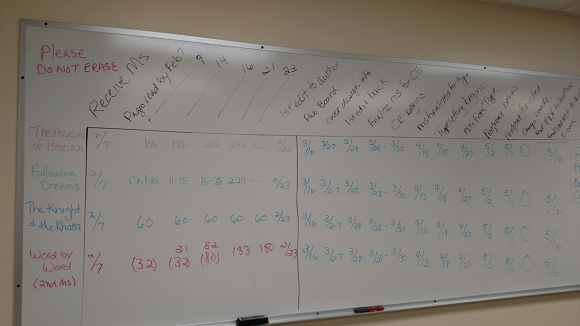
Here’s our semester schedule.

You can read about the actual process on last year’s manuscripts through the hyperlinks above. This time around, we have three fantasy manuscripts and two nonfiction.

I want to tell you about this experience from the viewpoint of an author. One group of this class gamely took on my MFA thesis and my new editing book for Bold Vision Books, titled Word by Word, coming out this summer

I had this group work on both of my manuscripts because the word count added up to roughly the same as the manuscripts in the other groups (about 100K), spreading the work evenly.

img_20170223_095623807
Fantasy manuscripts call for a lot of discussion . . . 
img_20170223_095615723
. . . as the editors figure out the setting and characters and plot lines and, in fantasy, often the magic system the author created.

Here’s what happened from my perspective as an author. I had sent in the first draft of my thesis for review in my program. My MFA mentor wrote back with some excellent advice and good questions. One thing had to do with the entire premise. My thesis is about my life as an editor — it is more memoir-ish with research and other nonfiction elements. At first, I had the title “Superhero Editor.” My mentor challenged that, sensing that the metaphor didn’t really work. The editor doesn’t swoop in and “save the day”; no, it’s much more collaborative and intimate than that. He challenged me to try another metaphor.

I thought and thought and thought, coming up dry. Then, when I decided to give the project to my students, I offered them the challenge. And they came through.

They thought that the friendship angle would work better. They gave me the title “Friends with Words.” Then I realized that for the last month I’ve been playing on my phone every night with my mom — the Scrabble game “Words with Friends” (and, by the way, she usually smokes me!). We moved their words around, and I titled the thesis “Words with Friends” and went back and recast the entire thing to reflect the new tone of that kind of relationship between editors and authors.

img_20170223_095800343_hdr
These editors made my manuscripts so much better!

I couldn’t have done it without my student editors!

After they finished my thesis, they gamely moved on to my contracted book, which is more of a textbook style (a book I will use in my editing classes moving forward). The full manuscript for this was due to the publisher on March 1, so I asked what I needed to do to improve this first draft.

I told them to put me through my paces and do what I’ve trained them to do . . . and they did. They pointed out my overuse of the word “So.” (When I checked it, Microsoft Word said, “There are too many instances to check. You use this word a lot!” Yikes!) They mentioned that I needed to watch for passive voice. They told me when I got long-winded (read: “boring”) and need to cut or revise some lengthy sections.

AND, they let me know what they liked, what was engaging, and what was helpful.

All the editing groups put together their editorial letters with suggestions and advice to their authors, who will do what they can with their manuscripts by our March 28 due date.

Stay tuned!

img_20170223_095640945
Hammering away at a manuscript.