It’s Hard to Say Good-bye: The Annual Heartache of a College Instructor

When I signed on to teach at the college level–first as an adjunct and now as a full-time instructor–no one told me that every year in May I was going to experience the heart-throbbing pain of good-byes.

Don’t get me wrong. I’ve said a lot of good-byes in my life. I grew up as a military kid and we moved a lot, so good-byes were pretty standard fare. I went to high school in Bonn, Germany, at what was then Bonn American High School (Go Crusaders!). After our class of fifty-some students moved the tassel in 1976, we scattered all over the globe (literally–and I am using literally correctly).
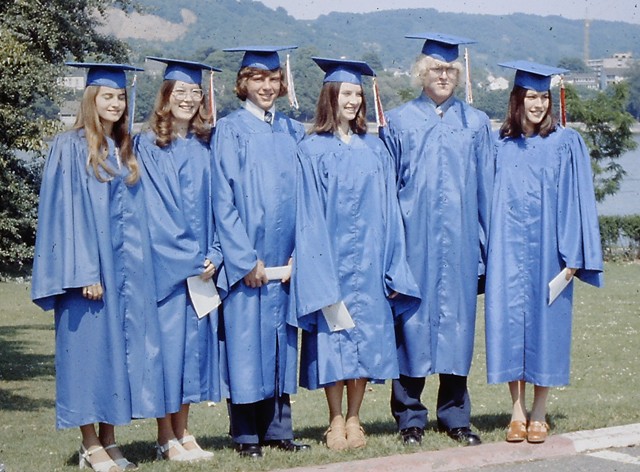
Some of my fellow graduates. BAHS 1976. That's me second from the left. Our tassels were red, white, and blue to commemorate America's 200th birthday.
Some of my fellow graduates. BAHS 1976. That’s me second from the left. Our tassels were red, white, and blue to commemorate America’s 200th birthday. By the way, that’s the Rhine River behind us.

Then, after college, I said good-bye again to dear people who had been my roommates, my suitemates, fellow residence staff, professors, and friends.

Good-byes are never easy.

So no one warned me that now every year I would have to say good-bye to an entire group of students that I had come to love–literally. Students I had watched grow into great writers. Students I had talked to about their future dreams and plans. Students I had prayed for and with, cried with, laughed with. Students who, each year, taught me a little more about myself.

This evening we had a dinner to honor our seniors. Yesterday one of them asked that each of the profs in the department provide a letter to all of them, a “last lecture” of sorts. We wrote those letters, and she put them into a packet for each senior.

I thought long and hard about my letter. Writing should be easy, right? I’m a writer, right? But what do I say? What words of advice can I possibly give to these young people moving the tassel and scattering to the winds?

I told them to expect bittersweet. Graduation has been in their sights for years–but when it comes, it also means good-bye. And that’s hard. It means for the first time in four years they may not know where they will be come August. That can be frightening.

I told them to expect loneliness and confusion. Even if life is mapped out, even if there’s a job or grad program waiting and a wedding in the works, there will be times when they will miss the craziness that is dorm life. They’ll wonder if they’re making the right decisions. If they’re still job hunting and spouse hunting, at times the loneliness can be overwhelming.

But lest you think I’m Negative Nellie (or maybe just Realistic Rachel), let me assure you, I am all about the positive. I just want them to not think they’re alone when those feelings hit.PWR10
I also told them to keep the faith. Follow their path and stay close to the God who brought them this far and has a plan.

I told them to live this crazy adventure called life to the fullest.

I told them to keep writing and to expect rejection (yes, Realistic Rachel, it happens all the time) but to keep writing anyway.

I told them to stay in touch with one another and to continue to encourage one another in life and in writing.

I told them to find their tribes “out there” and to go to writing conferences just to remember what it’s like to be around a writing community.

I told them that they have a gift–the gift of words. Open it, enjoy it, share it, use it.

Good-bye, dear seniors. Thanks for being part of my life.

The Tax Man Cometh . . . and He’s Here to Help

If you’re like me and you’re a word lover, the IRS tax forms with all their lines and numbers send you into a panic attack. I get it. No matter what political persuasion you are or whether taxes bring you joyous refunds or difficult fees, filling out the dang forms can be a stressful endeavor.

If only you could get help—good help, help who knows what they’re talking about. If only there was a website that would answer your questions about your life as a writer and whether or not all of those expenses count on your tax returns (even if that long-sought-after royalty check has yet to arrive . . . or be promised).

Today, my friends, “if only” is here. I offer a helper whose passion is Tax Solutions for Writers (which also happens to be the name of his website). Gary Hensley was an accountant for his entire life, an IRS agent and auditor for part of it, and one of the guys who answered the phone for TurboTax if someone needed help.

He knows whereof he speaks. [Update: Gary Hensley passed away in 2018.]

Every year, our Professional Writing department at Taylor University invites Gary to talk to our students about acting like writers and filing their taxes as such. (In addition, you can catch Gary every year at numerous locations, including Midwest Writers Workshop where he is always one of our most popular speakers.) Or you can go to his website that has every question you can think of, and many you probably haven’t.

Here are just a few things I have learned from Gary about handling my tax returns.

(1) You don’t need to be an official “business” to be in business as a writer and to file a Schedule C for deductions. If you are busy writing (sending out articles, researching that novel, attending conferences to improve your skills), you are a writer and should treat yourself as a professional on your tax return.

(2) Purchase a $5 planner that you can carry with you. In it, document every single activity that you do that shows your activity as a writer. Write down what you did at your desk (your home office area) each day. Track the time you spent writing and what you did. This separates you as an active writer (even if you’re not published) from someone who is sitting around thinking he’d like to write a book someday. You are actively writing. That makes you a writer.

(3) Then use those daily slots to document writer expenses. Maybe you subscribed to a particular magazine or website to help you with information for an article or book. Maybe you attended a conference. Maybe you purchased books about the topic you’re writing about or simply to improve your writing skills. Then, of course, find a place to keep those matching receipts.

(4) In that diary, also keep track of mileage for writerly activities (not just miles, but write in the actual odometer readings to and from anything that had to do with your work—and write next to it the business/writerly purpose for your trip). Perhaps you drove to the library to do research. Maybe you drove to interview someone and purchased lunch for you both. Track the mileage to that writers conference.

(5) Get a separate bank account for your business that has a debit card attached. Again, you don’t need to be an official DBA or LLC or Ltd. or anything. But this particular bank account holds only the money that you earn as a writer (yes, even that $35 for the column you wrote), and it tracks anything you purchase for your business (printer paper, stamps, books, conferences). Maybe you don’t have income, or nothing really worthy to call that. Doesn’t matter. Get in the habit of separating out your writer life from the rest of your life. I know, you may need to lend yourself money back and forth in order to cover a business expense (like a conference—the $35 article won’t cover that), and Gary explains how to do that on his website. The point is to keep your writerly income and out-go separate from the rest of your household.

All of this documentation will make it easier both when you go to fill out next year’s form and if you ever get audited. These expenses are deductible on the Schedule C, so you want to take advantage of them and you want them to be accurate.

I know. The forms are difficult, but it’s time to take hold of your writer self and claim your professional status. Check out Gary’s website for answers to other questions.

And go purchase that journal to track this year’s activities! (Oh, and write down the odometer reading before you go and when you get back!)

Editors Are People, Too (Just So You Know)

As a writer myself, I totally understand the frustration of trying to read an editor’s mind and understand the why behind lengthy edits or outright rejections. What’s going on?

I’ve been encouraging my professional writing students to be aware of and submit to literary magazines as an outlet for their creative writing. Some of them were only aware of a few such locations to send their writing, others didn’t know about lit mags at all, others knew only about contests and didn’t enter often because of the submission fee. But with the thousands of literary magazines out there (I just discovered Duotrope and used it to help me locate lit mags that publish in my genre), anyone can build a list of locations for future submissions. Literary magazines don’t generally pay (although a few do), but the by-line and exposure are invaluable. So this semester, each of my students will be researching lit mags and building lists.

As with any publishing house, however, the writing needs to pass muster for any number of reasons in order to get published.

That’s why I love this article by Savannah Thorne over at one of my favorite websites for following the world of literary magazines, “The Review Review” (and thanks to Becky Tuch for creating it!). Savannah was accepted for publication in a literary magazine called Conclave: A Journal of Character, only to find that the magazine was possibly going to close down. So she took the amazing step of taking it on as managing editor and turning it around.

Her article, “What the Editor Sees (That the Writer Does Not)offers wonderful insight from a writer turned editor into the world of editing a literary magazine. She describes for writers what happens after you’ve hit “submit.” And why it takes so long to hear back. And what you should do when you get a rejection. And why you should keep trying. And, yes, why it takes so long to hear back.

I’ll wait while you click on the link above and read her article . . . [pause for a refill on whatever I’m currently drinking]

What’s the takeaway? Do your research, write well, keep on writing, keep on submitting. Editors have any number of reasons for accepting some pieces and rejecting others–and often it’s just a gut feeling about a particular piece.

As I said in this post about how editors really aren’t “failed writers” with, as Martin Eden would say, nothing but failure in their past causing their desire to make life miserable for writers who are still trying. Instead, editors are slogging through piles of submissions, many of which are probably great, looking for the excellent, something that sings to them, something that they want to publish in the magazine about which they care so much.

No, you can’t know what that is necessarily. But write your best. Get critiqued. Keep writing. Keep submitting. If someone rejects it, try somewhere else.

Don’t give up, my friend. Keep writing what is truly you. As Herman Melville once wrote, “It is better to fail in originality, than to succeed in imitation. He who has never failed somewhere, that man cannot be great.”

6 Quick Proofreading Tips

AND . . . . today is National Proofreading Day. I will celebrate by . . . proofreading! Today I am also reposting a blog I wrote last year on March 8.

What a busy week! We had National Grammar Day on March 4, and today, March 8, is National Proofreading Day. For someone like me who lives this stuff on a daily basis, it’s downright exciting!

The day is devoted to “mistake-free writing” and projecting “a professional image with well-written documents that are 100 percent accurate.” Started by Judy Beaver at The Office Pro, this day is designated because it was her mother’s birthday—and her mother loved to correct errors.

As I noted earlier this week in my post about National Grammar Day, I’m not a total grammar geek but I do care about the correct usage of our language, and I’ve made a living for many years honing this skill. Lots of times I still CMShave to look things up in a dictionary or my Chicago Manual of Style (the style manual for much of the book publishing industry). All manuscripts go through several phases of editing, and I’ve done them all. Generally, if I do one phase on a particular manuscript, I make sure that other people do the other two phases–there’s a different focus that has to take place at each phase.

Editing—I call this the 10,000-foot view. I look at the big picture. I’m reading the fiction story and checking the plot, the pacing and flow, the characterization. In a non-fiction manuscript, I’m seeing if the organization works and makes sense. Any changes I suggest at this point are on the macro level—moving chapter 3 to become chapter 1, for instance. Or looking for that loose end in the mystery that the writer forgot to tie up (“What happened to so-and-so?”). The author makes changes (or not) based on my suggestions, and then the manuscript goes to a copyeditor.

Copyediting—This is more like the 1,000-foot view. Now that the editor has put the manuscript in good shape, if I’m in this role, I’m reading closely for sentence construction—dangling modifiers, run-ons, and inconsistencies. I fact check. I query if something doesn’t make sense, if a transition is needed, if a character’s way of speaking doesn’t sound real based on how he or she has been described by the author (“Would he really say this in this way?”).

Proofreading—This is the 10-foot view. If I’m in this role, sometimes I’m working on a manuscript, but often at this phase I’m looking at a pdf of typeset pages—which means I have to check the table of contents to make sure the titles and page numbers are correct, I check all the folios and running heads, I check the look of each page—marking widows and orphans (those random one or two words at the top of a page, or the lone line at the bottom—these just look awkward). Then I read every word. Even a clean manuscript can have random errors show up when the document is flowed into the typesetting program (a hidden tab in a Word document can suddenly rear its ugly head and space words far apart when typeset).

I love it.

Proofreading is probably my favorite. It’s that red pen mentality. I’m looking for errors only because I want the book, the author, and the publisher to put their best foot (feet?) forward.

The three types of editing take different skills. In my Editing class, I give my students practice in all of these areas, telling them that they will probably find an affinity for one and not like the others so much. But I also tell those who want to become editors that they should hone their grammar and punctuation knowledge anyway, because the copyediting and proofreading jobs are often the entry level positions in publishing companies. From there, they can move up, since often editors and acquisitions editors are hired from within, from people who have been with the company and understand the ethos there.

As I noted in my post earlier this week, proofreading skills are vitally important, especially on the job market. To have a clean paper, I suggest the following:

(1) Don’t trust the spell check program on your computer. (Judy has some tips on her blog about this.)

(2) If you’re not absolutely sure of the spelling of a word, don’t guess. Look it up. Dictionary.com is your best friend.

(3) Go back and read your letter, paper, email, memo, whatever, aloud slowly to yourself. This will help you notice if words are missing or if a sentence runs on and on. (It’s best to do this on hard copy. Trust me, you’ll see things differently than on screen. A friend of one of my students writes about that on his blog.)

(4) Then, read it again starting from the bottom paragraph backward, a paragraph at a time. This helps you get outside your own flow and see errors you might skip over otherwise.

(5) Electronically, go back and do a search for an open parenthesis (to make sure that you always have a matching close parenthesis), an open quotation mark (to make sure you always have the appropriate closing quotation mark and to make sure any inner quotation marks are single and that they are both there). And get rid of those double spaces between sentences!

(6) Be aware of your own weaknesses. If you know you tend to write run-on sentences, watch for that in particular. If you know that possessives always mess you up, do a search for apostrophes and check each one for correct usage.

This will clear up a good number of your errors. It never hurts, however, to have someone else look over an especially important document—like a cover letter or resume or manuscript submission.

Let’s put our best foot forward—both of them!

It’s National Grammar Day!

In honor of National Grammar Day, I am reposting my blog on this date from last year. Why? Because I’m busy grading papers for correct grammar–that’s why!

Today, March 4, is National Grammar Day.

Are you celebrating? Well, are you?

I am celebrating by finding other celebrants–people I want to add to my tribe because they care about this stuff as much as I do.

I have to confess to being a bit of a grammar geek–although not nearly at the level of Mignon Fogarty aka Grammar Girl. I know some things, but I may not know why I know them or the rule behind them. That comes from thirty years of proofreading, following publisher style sheets, painstakingly reading typeset pages and marking pdfs until my eyes blur.

I love my red pen.

You see, I value perfection. (Oh my, I sure hope there aren’t any errors in this post when I’m finished . . . ). I’ve started grad school to learn more about teaching writing and discovered in my theory classes, much to my chagrin, that teaching grammar works against creativity and that college instructors try to steer clear in favor of the big picture, the creativity, the thought processes. I believe all of that is vital, of course. What’s the point of writing if you can’t make a clear argument or create a document that flows? But I also believe that the best argument in the world will get ignored if the writing is fraught with errors. Why do I want to take the time to read your article and consider your opinion if you can’t take the time to make sure to spell correctly and use proper punctuation?

It matters.

So I love National Grammar Day. (It’s on March 4th because apparently that’s the only date that forms a sentence, “March forth.”) I love when I find others in my tribe who care as much as I do about grammar and punctuation and a well-written sentence (they won’t be dangling any modifers in front of me, no sir!).

For one of my classes, I did a little research project. I hypothesized that writing instructors need to teach their students to proofread. We help them a lot at the contextual and sentence level in their writing, but we probably say, “And be sure to proofread your paper before turning it in,” without explaining what proofreading really involves. I think we do them a disservice. There is indeed a place for focusing on perfection. (More about this on Friday, March 8, National Proofreading Day . . . oh my, busy week!)

Take, for example, business writing. I start filling in for the instructor of a Writing for Business class this week for the rest of the semester (the regular instructor is out for shoulder surgery and rehab). I’m reading the textbooks and finding constant statements about the importance of perfection. In fact, one book quotes a website that keeps a collection of “cover letters from hell“–cringe-worthy letters sent to them by folks hoping for a job, like the person who wrote that he/she was an English major good at grammar–and then misspelled it as “grammer.” The website then states,

Elements of Style

A word to the wise: An error-free letter is now so freakin’ rare that the minimal care required to send a letter with zero defects, combined with a few crisply written simple declarative sentences, will, alone, guarantee a respectful reading of a resume. Maybe even secure an interview. Doesn’t anybody read Strunk and White in school any more? If you haven’t, get a copy of The Elements of Style, so you can follow it all your days.

Exactly.

Now all those theorists have a point. Do your writing and don’t worry a bit about your grammar. Get your ideas down. Tell your story. Make your point. Do the best writing you can do.

But before you send the query letter, turn in that article, or send in that manuscript, do me a favor.

Make sure it’s perfect.

Now realize that if you have your own little stylistic “tics” (you want to Capitalize Certain Words for Emphasis, or do random italics), then just let your proofreader know. You can be “incorrect” if it’s part of your style. Create a style sheet that tells your proofreader this is how you want it–then he/she will make sure that you’re consistent, along with looking for any errors you may have missed.

As citizens of the literary world, let’s protect our craft, always doing our best to deliver the best quality.

And if you feel that your proofreading skills leave something to be desired, hire a professional proofreader (or get someone you trust who really knows the craft) to go over everything before you submit the story or mail the letter. Believe it or not, there are people who thrive on helping your writing be perfect. In fact, even if you are good at it, it’s difficult to proofread your own work. It’s that whole “seeing the forest for the trees” thing.

(One little additional note: I’m talking at the professional level here. Please don’t refuse to drop me a note for fear of making errors. I truly do want to keep my friends. My point is that when we’re doing professional writing, we need to be professionals. The rest of the time, my red pen is safely in the drawer.)

So celebrate National Grammar Day with me! Grammar is the toolbox of our trade. Let’s keep those tools sharp!

Love Those Summer Interns

One thing about teaching is the enjoyment I get from watching my students take what they learn and use it. I have to admit, I love the feeling of giving them something that will help them land a job and succeed at it.

That’s why I love teaching editing. I tell my students that if they can master the skills I try to teach them, they’ll have a foot in the door for working in publishing.

So I love it when summer comes and my students are interning somewhere. For instance, Nathan tweeted this last week:

It isn’t easy, Nathan, but it’s a great lesson.

Speaking of great lessons, I guess he learned this one yesterday:

It may have been because of this . . .

Then there are the shoutouts that let me know that what I’m teaching does matter and is helping them in their professional lives:


Yep, working with style tags is vital. I tell my students that learning this will give them a huge advantage and so much value to their supervisors. My students learn how to work with the technical side in order to prep a manuscript for typesetting and for e-booking.

And according to Alex, I guess I was right!

Alex is also getting some terrific hands-on editor-style training:

I’m so thrilled that the publishing houses where these students are interning are giving them more responsibility than just sorting, filing, or making coffee. They’re getting real world experience, they get to see the publishing process up close, they get to get their hands dirty (well, in Nathan’s case, perhaps learning how to stop the printer in the middle of a several hundred page manuscript).

As someone who, in the business side of my life, has worked with interns, I know it can feel a little overwhelming trying to train another person and keep him or her busy on top of your own work. But also as someone who teaches in the college classroom and attempts to prepare my students for those internships (and indeed find them), I thank you from the bottom of my heart. What you’re giving to these students–your knowledge, your expertise, your skills–is invaluable.

5 Notes to My Younger College Self

Well, another semester nearly done (being back in graduate school and doing adjunct teaching has suddenly put my life in the “semester” track again). One more semester to go in graduate school and the MA will be mine! One more final and I’ll send another batch of students out the door and on their way.

I realized last night that some of my new Ball State grad school friends are graduating and moving on. I said good-bye to one who’s heading to her doctoral program in another state in September. I was just getting to know her! And several of my Taylor students are graduating. This will be the tough part of teaching. Getting to know students, investing in their lives, and then letting them go. (It’s too much like being a parent!)

credit: istockphoto
credit: istockphoto

I’ve been thinking a lot about the dichotomy of being–at the same time–an old(er) graduate student and a professor of students who are my children’s ages. So here, for what it’s worth, is my advice to my younger self about how I would have done school differently if I knew then what I know now (and next week, advice to others, old like me, who are thinking about heading back to school).

(1) Take advantage of every opportunity you have to spend time with your professors.

I’ll say it. I was terrified of professors. They were “up there,” I was “down here.” They held my future (or at least my GPA) in their hands. I stayed as far away as I could.

Now that I’ve been a professor, I realize they’re just folks. Of course a lot more knowledgeable about said topic–which is why they are teaching–but many of them chose this profession because they really like students. My son told me he was able to talk more easily with his professors once I began teaching because he realized they are just people who have kids and take out the trash and mow their lawns and even cry sometimes.

Ask a professor to lunch or coffee. Take advantage of office hours to have a chat at some point in the semester. They really love that. They have a lot of life experience that they can impart. Draw from what they’ve learned.

(2) Don’t let fear about the future overwhelm you.

I’ll admit it . . . I wanted to be married. I wanted to have my dream job. And I wanted it all right then (or anytime during the month of May 1980 would have been fine). That moment when you arrive home after those four college years can be the most depressing of your life. “Now what?” Suddenly the comfort of knowing what’s happening in September is gone and the future is an empty road. As a Christian, I can encourage you that the plan is in place and all you need to do is take a step at a time. The road will turn and maybe lead you in unexpected places. Follow it. Of course be wise and strategic, but be open to surprises. God’s plans are way better than our own anyway. And don’t be afraid of being unmarried when you graduate. The right person will come along at the right time. Trust me.

(3) Follow your passions.

I ended up in publishing because I did what I loved. At college, when that moment of declaring a major arrived in the fall of my sophomore year, I panicked. I literally got out the college catalog, sat on my groovy bedspread, and figured I’d find out what Houghton offered. As I read through the majors (Accounting? gag. Biology? puh-leeese. Chemistry? not on your life), something jumped inside me when I hit it: English. “I can read my way to a major? Sign me up.” I followed what I was hardwired to do–love words. I signed up to double major in Writing (once I got to W in the catalog) and never looked back.

My path wandered various directions, but I believe God wastes no experience in our lives. And sometimes it was a few surprises from him that put me in the right place at the right time. I’m passionate about what I do. I absolutely love it. If you follow those God-given gifts, you’ll feel the same. As noted in #2, don’t worry about the detours. If you have to have a job at Starbucks or Babies-R-Us for the time being (I’m looking at two of my beloved kiddos), enjoy it, learn from it, do your very best at it. Keep your passion alive by working at what you love on the side.

(4) Stay in contact with your grandparents (or other significant family members).

And I don’t say this as a new grandparent. You’re busy, you’ve got so much going on, you’re doing your darndest to separate yourself from your parents and get on with your life. I get it. That’s all good and necessary. But please in all of the drama of your friendships and love life and future plans, don’t forget your grandparents. Stay in touch. Call grandma up once in awhile. Give grandpa an update. Those people are gone too soon from your life. Just as I noted in #1 that professors have so much to offer, grandparents have more. They are your blood, your family legacy. Don’t regret never getting to know them. For better or worse, learn about where you come from. Mine their memories. Learn from their experiences. You’ll be fascinated.

(5) Learn about budgeting, saving, and spending wisely.

You wanna be on your own? Living costs money. The better organized you are at keeping track of money and budgeting your expenses, the less stress you’ll have when you sign that lease for the apartment and pay for the cell phone and cover the electric bill and make the car payment and sign up for car insurance and get an internet connection and decide if you can afford to order HBO so you can watch “Game of Thrones.” Some of you may already be way down the road on this, but I beg you to be wise. Put the credit card in a bowl of water and put it in your freezer so you can’t get to it without a waiting period. Don’t run up debt. Live frugally. The time will come when you’ll have more, but don’t expect it right away. You’ll thank me later, just as I thank my parents for their good training.

So, Linda, here’s my advice to my younger self. Some things you did well, some things you could have done better (isn’t that always the way?). But maybe someone can learn from you . . .

How Not to be a Twitter Twit

I’ll never admit to being ahead of the curve. It usually takes me awhile to catch up with everyone else. When I finally joined Facebook, I felt like I’d arrived late to a party that was already in full swing. Then someone told me to get onto Twitter. I resisted, finally opened an account, didn’t get it, got exhausted trying to keep up with it, and closed it.

Then I finally decided–late–that I really had to be there. That happened when the indomitable Cathy Day (who else?) introduced me to hashtags and Tweetdeck, and suddenly I could make some sense of Twitter. (HootSuite is another option that works like TweetDeck to organize tweets via hashtags.) You can find me @LindaEdits if you’re so inclined.

credit: iStockphoto
credit: iStockphoto

I found some folks to follow (agents, other authors, publishers). Then, I went to this site, 44 Essential Hashtags Every Author Should Know, and found some hashtags that I want to follow. By creating TweetDeck columns for some of these hashtags, I have a constant feed, often with links to great blogs and articles, about the topics that matter to me. These blogs and articles give me great information for my classes, my research, and my teaching.

I follow people who interest me, I get followed, but I’m not trying to break any records. In fact, another indomitable force, Jane Friedman, explains why chasing after huge numbers of Twitter followers can just be a waste of time. Like any other tool of the trade, we just need to use Twitter wisely and well.

Since I’ve jumped back in and found so many interesting links and articles, I also realized the possibility of connections for jobs. Not only do my students need to understand Twitter, they should be there making connections as well as gaining experience in using it. Sure enough, many of the job postings they’re finding want people who understand and know how to use social media–and use it wisely. So this past week, my students in my Writing for Business class had an in-class exercise to create Twitter accounts. We talked about hashtags, and I gave them the link noted above that lists hashtags for writers. I created a hashtag for the class and everyone created a post and used the hashtag. With TweetDeck projected on the screen, their postings immediately appeared as they tweeted.

But I have to admit that it can be a little overwhelming. There is so much information out there that it’s nearly impossible to keep up. TweetDeck does help me by sorting tweets into categories where people are talking about writing or books or publishing or proofreading (my hot buttons).

How do you use Twitter? Has anyone done live tweeting as part of class? How can I make the most of my tweets? What do you find most helpful in your Twitter feed?

Avoid the Bog: Save Revision for Later

I spent this past weekend being an academic.

While I’ve presented at plenty of writers conferences, this past weekend I gave a paper (oooo, that sounds so academic) at the SUNY Council on Writing held in Buffalo, New York.

At the conference, I heard professors share teaching strategies to help their students engage better in a research paper and how to navigate different rhetorical situations required by different pieces of writing. One professor described working with students from one semester to the next to improve in areas where they need improvement. Another spoke during lunch about how he encourages his students to use all the technological resources at their disposal so that a paper is no longer just a Microsoft Word document but something full of visuals and hyperlinks.

The world is indeed changing, but some things are still the same.

That final product needs to be clean, perfect, polished.

My presentation was about the value of proofreading (big surprise). After decades in publishing, it’s been difficult for me to let go of the “perfection” level and understand that students need to be given freedom during the writing process. Two particular researchers in the field (for anyone who cares, it’s David Bartholomae in “Inventing the University” and Mike Rose in “The Language of Exclusion: Writing Instruction at the University”) helped me get my head around how to help writers and yet deal with my own requirement of final polish on papers. They explain that students new to academia are learning to write in a whole new way. They have to try on the language of academia. They have to take on the role of “authority” in their papers even though they’re writing to profs who are authorities. They have to think critically and not reach for the easy answer. They have to put together a coherent paper. And I would add that after writing it, they need to revise, copyedit, and proofread.

That’s a lot to ask. In a publishing house, different people do all those roles. And we’re asking students to do it all. Other research has shown that if students try to revise as they write, they end up bogging down in their own process, getting frustrated, and producing something maybe with fewer sentence-level errors but way less coherent.

“So Linda,” I said to myself, “let the proofreading go, would ya?”

“But I can’t,” I said back to myself, “because it’s important.”

And indeed it is. But it depends on what part of the process students are in and the rhetorical situation. I’ve learned that in initial drafts, I should work with students on the big picture. Let them get their thoughts together. Let the paper be full of comma errors and run-on sentences because this is still in process.

I should know this, for that’s just what an editor in a publishing house does. The big picture is what matters at that point.

From there, students can be helped to copyedit and then to proofread. I have for too long jumped right in with my red pen which focuses on the wrong thing too early. In reality, a student may have a lot of errors but also the beginnings of a well-reasoned argument or an amazing creative story. How much better to offer encouragement and queries at that level and leave the rest for later in the process.

Yet we still owe it to students to help them understand how to polish their papers. After all that work, we should help them deliver a piece that is indeed free of glaring errors (and that was the point of my presentation at the conference). And in a rhetorical situation like a resume or cover letter (which my Writing for Business students are doing this week), they have to understand how to create something that is indeed error free.

So what that means for us writers is that, during the process of writing, we need to just write. Get it down. Write as fast as we need to in order to keep up with our characters or our thoughts. Don’t stop to revise, at least not until the day’s writing is finished. Don’t get bogged down in the details during that first creative part of the process.

If you’re on a deadline, be sure to schedule in time for revision so you don’t feel rushed. Gone are the days of pulling all-nighters and turning in our assignment–our reputations are on the line, maybe even a paycheck.

To do it well, we need the time to revise and proofread (or have others help us–who also need to have time). But when we don’t get bogged down in the creative part of the process, we’ll feel much better about that final product.

6 Quick Proofreading Tips

What a busy week! We had National Grammar Day on Monday, and today, March 8, is National Proofreading Day. For someone like me who lives this stuff on a daily basis, it’s downright exciting!

The day is devoted to “mistake-free writing” and projecting “a professional image with well-written documents that are 100 percent accurate.” Started by Judy Beaver at The Office Pro, this day is designated because it was her mother’s birthday—and her mother loved to correct errors.

As I noted on Monday, I’m not a total grammar geek but I do care about the correct usage of our language, and I’ve made a living for many years honing this skill. Lots of times I still CMShave to look things up in a dictionary or my Chicago Manual of Style (the style manual for much of the book publishing industry). All manuscripts go through several phases of editing, and I’ve done them all. Generally, if I do one phase on a particular manuscript, I make sure that other people do the other two phases–there’s a different focus that has to take place at each phase.

Editing—I call this the 10,000-foot view. I look at the big picture. I’m reading the fiction story and checking the plot, the pacing and flow, the characterization. In a non-fiction manuscript, I’m seeing if the organization works and makes sense. Any changes I suggest at this point are on the macro level—moving chapter 3 to become chapter 1, for instance. Or looking for that loose end in the mystery that the writer forgot to tie up (“What happened to so-and-so?”). The author makes changes (or not) based on my suggestions, and then the manuscript goes to a copyeditor.

Copyediting—This is more like the 1,000-foot view. Now that the editor has put the manuscript in good shape, if I’m in this role, I’m reading closely for sentence construction—dangling modifiers, run-ons, and inconsistencies. I fact check. I query if something doesn’t make sense, if a transition is needed, if a character’s way of speaking doesn’t sound real based on how he or she has been described by the author (“Would he really say this in this way?”).

Proofreading—This is the 10-foot view. If I’m in this role, sometimes I’m working on a manuscript, but often at this phase I’m looking at a pdf of typeset pages—which means I have to check the table of contents to make sure the titles and page numbers are correct, I check all the folios and running heads, I check the look of each page—marking widows and orphans (those random one or two words at the top of a page, or the lone line at the bottom—these just look awkward). Then I read every word. Even a clean manuscript can have random errors show up when the document is flowed into the typesetting program (a hidden tab in a Word document can suddenly rear its ugly head and space words far apart when typeset).

I love it.

Proofreading is probably my favorite. It’s that red pen mentality. I’m looking for errors only because I want the book, the author, and the publisher to put their best foot (feet?) forward.

The three types of editing take different skills. In my Editing class, I give my students practice in all of these areas, telling them that they will probably find an affinity for one and not like the others so much. But I also tell those who want to become editors that they should hone their grammar and punctuation knowledge anyway, because the copyediting and proofreading jobs are often the entry level positions in publishing companies. From there, they can move up, since often editors and acquisitions editors are hired from within, from people who have been with the company and understand the ethos there.

As I noted in my post earlier this week, proofreading skills are vitally important, especially on the job market. To have a clean paper, I suggest the following:

(1) Don’t trust the spell check program on your computer. (Judy has some tips on her blog about this.)

(2) If you’re not absolutely sure of the spelling of a word, don’t guess. Look it up. Dictionary.com is your best friend.

(3) Go back and read your letter, paper, email, memo, whatever, aloud slowly to yourself. This will help you notice if words are missing or if a sentence runs on and on. (It’s best to do this on hard copy. Trust me, you’ll see things differently than on screen. A friend of one of my students writes about that on his blog.)

(4) Then, read it again starting from the bottom paragraph backward, a paragraph at a time. This helps you get outside your own flow and see errors you might skip over otherwise.

(5) Electronically, go back and do a search for an open parenthesis (to make sure that you always have a matching close parenthesis), an open quotation mark (to make sure you always have a the appropriate closing quotation mark and to make sure any inner quotation marks are single and that they are both there). And get rid of those double spaces between sentences!

(6) Be aware of your own weaknesses. If you know you tend to write run-on sentences, watch for that in particular. If you know that possessives always mess you up, do a search for apostrophes and check each one for correct usage.

This will clear up a good number of your errors. It never hurts, however, to have someone else look over an especially important document—like a cover letter or resume or manuscript submission.

Let’s put our best foot forward—both of them!