How to Support an Author’s New Book: 11 Ideas For You

So last week I talked about Literary Citizenship and why I love it. A key, of course, is supporting our fellow authors. In fact, that’s what it’s all about. Chuck Sambuchino offers 11 ideas for how we can support new books.

writersinthestorm's avatarWriters In The Storm Blog

By Chuck Sambuchino

large_5595133805My Writer’s Digest coworker, Brian A. Klems, recently geared up for the release of his first book — a humorous guide for fathers called OH BOY, YOU’RE HAVING A GIRL: A DAD’S SURVIVAL GUIDE TO RAISING DAUGHTERS (Adams Media). On top of that, my coworker Robert Brewer (editor of Writer’s Market) recently got a publishing deal for a book of his poetry.

So I find myself as a cheerleader for my writing buddies — trying to do what I can to help as their 2013 release dates approach. I help in two ways: 1) I use my own experience of writing & publishing books to share advice on what they can expect and plan for; and 2) I simply do whatever little things I can that help in any way.

This last part brings up an important point: Anyone can support an author’s…

View original post 1,450 more words

Why I Love Literary Citizenship

Much is being written lately on the topic of literary citizenship. Since this was the topic of my Master’s final research paper, I thought I’d go ahead and weigh in with my two cents. (I could write 50 pages, but I already did that. Let’s see if I can condense my thoughts here into a readable blog post!)

I just happened upon this term in the last couple of years–but it’s something I’ve been thinking about for a long time. You see, I’ve worked in publishing for thirty years and went back to school with the hopes of teaching at the college level. As I sat under Cathy Day, she (thankfully) talked to her students about what’s out there in the real world–how to join the literary world, how to get published, how to organize submissions, how to handle rejection, and how to find their “tribes” once they leave the cocoon of a university writing program–everything I already knew was extremely important for writers to understand.

I was thrilled that she talked about this because too often (I feel) creative writing programs focus only on craft without giving students the tools to know what to do with their writing. Yes, I get it. You have to first be a good writer, no, an excellent writer. That’s a given. Roxane Gay puts it this way:

You’re not going to become a better writer by focusing more on getting your writing published than writing work that merits publication. You won’t become a better writer by resenting the success of others or spending most of your time indulging in conspiracy theories about publishing. Yes, sometimes the game is rigged, but mostly it is not. It’s easy to get wrapped up in the wrong things when so much information about writers and what they’re doing or could be doing is readily available via social networks, blogs, and the like.

So of course, being great writers is step one, and I don’t advise that writers let themselves get distracted by the marketing side at the expense of their product. But, after thirty years in publishing, I come at this with a different perspective, and so I maintain that students should be taught what to do with their writing. How to research the literary magazines or the online sites or the commercial magazines or the book publishers that might be interested in their kind of writing. How to write query letters. How to approach an agent. How to create a book proposal. That’s all part of learning to write.

Because, in the end, while writing can indeed be an end in itself, most of us write because we want people to read what we wrote. We want to share it.

And I’m sure it’s my years in publishing talking, but I’ve sat on the other side of the table, needing to help authors understand the importance of marketing their own books.

I know, what a pain after doing all the work of actually writing the book to have to be burdened with actually doing the marketing, too. Isn’t the publisher supposed to do that? That’s the question Becky Tuch asks and precisely why she detests literary citizenship.

But I understand the business side of publishing; it is a business after all and, if it doesn’t make money, none of us gets published. And yes, all those big-name authors get all of the marketing dollars and the rest of us are left pretty much to fend for ourselves, but there’s a reason for that as well. There’s a statistic in Christian publishing that says 9 percent of the authors sell 80 percent of the books. That means that 9 percent of writers are pretty much carrying their publishing houses. So let them have the marketing dollars! In secular publishing, the number may be similar–and we can be sure that it is indeed the big names who get taken care of. Those authors help keep their companies open, which then allows them to take a chance on little ol’ me.

But here’s the deal–literary citizenship is not to be entered into because you want to sell your books. Instead, it’s about joining Renaissance Fairethe literary world because that’s who you are. Just as you might identify with those who join the worlds of ComiCon or Renaissance Faires because you have an affinity for comics and superheroes or feathered caps and falconry, so you join the world of Words and Books as a literary citizen because that’s who you are. You join with like-minded people to talk about what you love best.

The side effect of being “neighborly” in that world (by doing what many lit cit blog posts have discussed regarding ways to be literary citizens) is that when your article or book is published, you can naturally talk about it with those who care–and who will, in turn, talk about it with others. That’s where the “marketing” part actually begins to happen.

But literary citizenship doesn’t start there. It doesn’t start with “marketing” or “selling.” It’s not all about us. It’s not all about “gimme” as in “gimme your attention–me me me” as David Ebenbach describes in his article, Literary Citizenship Does Not Mean Gimme. Instead, it’s about joining a world of word lovers–reading, appreciating, talking about, and sharing one another’s work.

So let’s not hate literary citizenship, let’s embrace it because, in essence, it’s who we are. Let’s come together in this world of Words and Books enjoying what we love most and making sure it continues for all of us for a long, long time.


The Process of Publishing: An Exercise

When I teach my editing class, I always like to begin early with an exercise. The entire class becomes a publishing company, and we walk a manuscript through the process. Since I teach my students about content editing, copyediting, and proofreading, I want them to understand where those steps fall in the process of a book going from the author to the shelves.

I usually have about 15 students in my class and I print different jobs onto index cards. They each draw a card, and we then move all the desks and sit in a circle.

First order of business, we decide on a name for our company. We usually end up with something like “Sleepy Sloth Publishing” or “Little Turtles Publishing”–for some reason the name often has an animal theme.

Then we talk through each step, and the person holding the card is to play that role and ask the questions he/she thinks would be asked in this part of the book process.

(1) Author–Whoever gets this card needs to determine what his or her book is about and give it a title. One time I had “The History of the Orange”–a nonfiction book about . . . oranges. That’s what we’ll go with for the purposes of this post. A young man gets the author card and wants to write about oranges.


orange


(2) Acquisitions Editor–As luck would have it, this author went to a writers conference where an AE (hold up your card) was looking for nonfiction books about fruit. She is thrilled that this author has come with this book proposal about the history of oranges. What does the AE ask? My AE with the card thinks a little bit–maybe an AE wants to know who the target audience is (men? women? age range?), the book’s tone (humor? tongue in cheek? reference?), and approximately how long it is (word count helps the AE consider placement and cost calculation). Let’s say this is a book targeted to adults that will be about 128 pages with a humorous tone. The AE wants to know why this author is such an expert and has such interest in oranges. The author explains that he grew up in an orange grove and has been making OJ all his life. (Sometimes an agent is in this role–I put that person at the end of my exercise, but he/she could very well be right at the start.)

I explain that all of this information is important for the AE to take back to the publishing house. Just because the AE likes it only means the book has passed the first hurdle. The AE now needs to sell the idea to the pub board (publishing board).

(3) CEO (as part of pub board)–In many houses (especially smaller ones), the CEO may be on the pub board as the keeper of the ethos of the publishing house. Does the book fit with the mission statement? Does it fit into the kind of books they do? (In Christian publishing, theological bent matters heavily when considering manuscripts.)

(4) CFO (as part of pub board)–Numbers guy. What does he ask? Will the book need any special treatments (is it going to have color pictures throughout–that will affect the cost of the printing and paper). What is the advance to the author? How many books will be in the first print run? What should be the selling price? A pro forma helps to then determine if and how the book can make money for the publishing house.

(5) Salesman (as part of pub board)–There actually may be several–the Amazon person, the big box store person, the independent bookstore person. But they all have the same question–especially with unknown authors. What kind of platform does the author have? (Author answers that he has 10,000 followers on Twitter and a blog and newsletter all about oranges with 20,000 subscribers.) The salespeople are impressed since they know that this author can get the word out about his book and get a following.

So I tell the group to assume that the book has passed this hurdle and is cleared to be published. Next will come the AE calling the author, the author rejoicing (little dance), the arrival of the contract and hopefully the advance check. Next, the author must finish the book by a particular due date.

Publish

(6) Editorial director–Once the manuscript arrives, an editorial director will set the schedule for all of the following steps in order to keep the project moving through the system in order to meet the to-printer date. (In large houses, there may be several different people doing these roles with varying titles. In small houses, there might be one person who then uses several freelancers.)

(7) Designer–The editorial director will get the designer started on interior and cover designs. These take time (and the designer has other projects as well), so getting him started now is important. What does the designer need to know? My student with the “Designer” card wonders about how big the book is (trim size and page count), whether or not there are photos and are they black/white or color, and the target audience and tone. The designer creates a template (often in InDesign) into which the typesetter will flow the Word document manuscript.

(8) Content editor–This person looks at the big picture and helps to shape the book (perhaps the author’s chapter 3 should really be chapter 1 as it is a better beginning). I discuss more about the three different types of editing in this post. After back and forth with the author, the manuscript is finalized and sent on to …

(9) Copyeditor–Again, I discuss what this means in above linked post. The copyeditor fact checks, reads for clarity, queries as needed, makes the manuscript follow house style guidelines, and generally tries to make the manuscript readable and clean.

(10) Editorial assistant–This may even be an intern–or this person may not exist at all in a small house. But the copyeditor needs someone to help with taking the copyedited manuscript and creating the front matter (title page, copyright page, Table of Contents, dedication page, etc.) and making sure the back matter pieces are in place (appendix, index, endnotes).

(11) Typesetter/Compositor–The typesetter receives the manuscript from editorial and the book’s design template from the designer and puts them together. What does he need to know? He needs to know the page count, whether all of the chapters have to start on recto (right) pages or if they can also start verso (left), what is to be in the running heads, does the book start at page 1 or are there roman numerals in the front matter? If there are photos, he’ll need to have those (in separate files such as gif or bmp) and know where to place them. He lays out the pages to avoid widows and orphans (single words or short lines standing alone at the top or bottom of a page).

(12) Proofreader–Again, I discuss this further here. The proofreader takes the pdf of the typeset pages–meaning this is exactly how the book will appear. My proofreader checks the Table of Contents and adds page numbers as they appear in the book, and then he reads every word carefully.

(13) Printer–The final completed pdf is uploaded to the printer. Hopefully the date it arrives is the same date the editorial director put on the calendar months earlier. The printer sets press time for each book, and that’s why it is so important to never be late. The printer is given the poundage of the paper (for instance, much higher weight if this book is full of color photos so the pages can handle the ink, as opposed to a straight text book).

(14) Bookstore owner–This person needs to know why she should purchase the book to sell in her store. Fortunately, she loves this publishing company, the salesman has made a compelling case, and so she orders several to sell.

(15) Agent–Because the book has become a best-seller, this agent comes knocking hoping to represent the author in his next great work–and the cycle begins again.

My students come away from this little exercise with more understanding of how what they learn to do as editors fits in to the entire process of creating a book.


Orange photo: By Figiu (Own work) [CC-BY-SA-3.0 (http://creativecommons.org/licenses/by-sa/3.0)%5D, via Wikimedia Commons

6 Quick Proofreading Tips

AND . . . . today is National Proofreading Day. I will celebrate by . . . proofreading! Today I am also reposting a blog I wrote last year on March 8.

What a busy week! We had National Grammar Day on March 4, and today, March 8, is National Proofreading Day. For someone like me who lives this stuff on a daily basis, it’s downright exciting!

The day is devoted to “mistake-free writing” and projecting “a professional image with well-written documents that are 100 percent accurate.” Started by Judy Beaver at The Office Pro, this day is designated because it was her mother’s birthday—and her mother loved to correct errors.

As I noted earlier this week in my post about National Grammar Day, I’m not a total grammar geek but I do care about the correct usage of our language, and I’ve made a living for many years honing this skill. Lots of times I still CMShave to look things up in a dictionary or my Chicago Manual of Style (the style manual for much of the book publishing industry). All manuscripts go through several phases of editing, and I’ve done them all. Generally, if I do one phase on a particular manuscript, I make sure that other people do the other two phases–there’s a different focus that has to take place at each phase.

Editing—I call this the 10,000-foot view. I look at the big picture. I’m reading the fiction story and checking the plot, the pacing and flow, the characterization. In a non-fiction manuscript, I’m seeing if the organization works and makes sense. Any changes I suggest at this point are on the macro level—moving chapter 3 to become chapter 1, for instance. Or looking for that loose end in the mystery that the writer forgot to tie up (“What happened to so-and-so?”). The author makes changes (or not) based on my suggestions, and then the manuscript goes to a copyeditor.

Copyediting—This is more like the 1,000-foot view. Now that the editor has put the manuscript in good shape, if I’m in this role, I’m reading closely for sentence construction—dangling modifiers, run-ons, and inconsistencies. I fact check. I query if something doesn’t make sense, if a transition is needed, if a character’s way of speaking doesn’t sound real based on how he or she has been described by the author (“Would he really say this in this way?”).

Proofreading—This is the 10-foot view. If I’m in this role, sometimes I’m working on a manuscript, but often at this phase I’m looking at a pdf of typeset pages—which means I have to check the table of contents to make sure the titles and page numbers are correct, I check all the folios and running heads, I check the look of each page—marking widows and orphans (those random one or two words at the top of a page, or the lone line at the bottom—these just look awkward). Then I read every word. Even a clean manuscript can have random errors show up when the document is flowed into the typesetting program (a hidden tab in a Word document can suddenly rear its ugly head and space words far apart when typeset).

I love it.

Proofreading is probably my favorite. It’s that red pen mentality. I’m looking for errors only because I want the book, the author, and the publisher to put their best foot (feet?) forward.

The three types of editing take different skills. In my Editing class, I give my students practice in all of these areas, telling them that they will probably find an affinity for one and not like the others so much. But I also tell those who want to become editors that they should hone their grammar and punctuation knowledge anyway, because the copyediting and proofreading jobs are often the entry level positions in publishing companies. From there, they can move up, since often editors and acquisitions editors are hired from within, from people who have been with the company and understand the ethos there.

As I noted in my post earlier this week, proofreading skills are vitally important, especially on the job market. To have a clean paper, I suggest the following:

(1) Don’t trust the spell check program on your computer. (Judy has some tips on her blog about this.)

(2) If you’re not absolutely sure of the spelling of a word, don’t guess. Look it up. Dictionary.com is your best friend.

(3) Go back and read your letter, paper, email, memo, whatever, aloud slowly to yourself. This will help you notice if words are missing or if a sentence runs on and on. (It’s best to do this on hard copy. Trust me, you’ll see things differently than on screen. A friend of one of my students writes about that on his blog.)

(4) Then, read it again starting from the bottom paragraph backward, a paragraph at a time. This helps you get outside your own flow and see errors you might skip over otherwise.

(5) Electronically, go back and do a search for an open parenthesis (to make sure that you always have a matching close parenthesis), an open quotation mark (to make sure you always have the appropriate closing quotation mark and to make sure any inner quotation marks are single and that they are both there). And get rid of those double spaces between sentences!

(6) Be aware of your own weaknesses. If you know you tend to write run-on sentences, watch for that in particular. If you know that possessives always mess you up, do a search for apostrophes and check each one for correct usage.

This will clear up a good number of your errors. It never hurts, however, to have someone else look over an especially important document—like a cover letter or resume or manuscript submission.

Let’s put our best foot forward—both of them!

It’s National Grammar Day!

In honor of National Grammar Day, I am reposting my blog on this date from last year. Why? Because I’m busy grading papers for correct grammar–that’s why!

Today, March 4, is National Grammar Day.

Are you celebrating? Well, are you?

I am celebrating by finding other celebrants–people I want to add to my tribe because they care about this stuff as much as I do.

I have to confess to being a bit of a grammar geek–although not nearly at the level of Mignon Fogarty aka Grammar Girl. I know some things, but I may not know why I know them or the rule behind them. That comes from thirty years of proofreading, following publisher style sheets, painstakingly reading typeset pages and marking pdfs until my eyes blur.

I love my red pen.

You see, I value perfection. (Oh my, I sure hope there aren’t any errors in this post when I’m finished . . . ). I’ve started grad school to learn more about teaching writing and discovered in my theory classes, much to my chagrin, that teaching grammar works against creativity and that college instructors try to steer clear in favor of the big picture, the creativity, the thought processes. I believe all of that is vital, of course. What’s the point of writing if you can’t make a clear argument or create a document that flows? But I also believe that the best argument in the world will get ignored if the writing is fraught with errors. Why do I want to take the time to read your article and consider your opinion if you can’t take the time to make sure to spell correctly and use proper punctuation?

It matters.

So I love National Grammar Day. (It’s on March 4th because apparently that’s the only date that forms a sentence, “March forth.”) I love when I find others in my tribe who care as much as I do about grammar and punctuation and a well-written sentence (they won’t be dangling any modifers in front of me, no sir!).

For one of my classes, I did a little research project. I hypothesized that writing instructors need to teach their students to proofread. We help them a lot at the contextual and sentence level in their writing, but we probably say, “And be sure to proofread your paper before turning it in,” without explaining what proofreading really involves. I think we do them a disservice. There is indeed a place for focusing on perfection. (More about this on Friday, March 8, National Proofreading Day . . . oh my, busy week!)

Take, for example, business writing. I start filling in for the instructor of a Writing for Business class this week for the rest of the semester (the regular instructor is out for shoulder surgery and rehab). I’m reading the textbooks and finding constant statements about the importance of perfection. In fact, one book quotes a website that keeps a collection of “cover letters from hell“–cringe-worthy letters sent to them by folks hoping for a job, like the person who wrote that he/she was an English major good at grammar–and then misspelled it as “grammer.” The website then states,

Elements of Style

A word to the wise: An error-free letter is now so freakin’ rare that the minimal care required to send a letter with zero defects, combined with a few crisply written simple declarative sentences, will, alone, guarantee a respectful reading of a resume. Maybe even secure an interview. Doesn’t anybody read Strunk and White in school any more? If you haven’t, get a copy of The Elements of Style, so you can follow it all your days.

Exactly.

Now all those theorists have a point. Do your writing and don’t worry a bit about your grammar. Get your ideas down. Tell your story. Make your point. Do the best writing you can do.

But before you send the query letter, turn in that article, or send in that manuscript, do me a favor.

Make sure it’s perfect.

Now realize that if you have your own little stylistic “tics” (you want to Capitalize Certain Words for Emphasis, or do random italics), then just let your proofreader know. You can be “incorrect” if it’s part of your style. Create a style sheet that tells your proofreader this is how you want it–then he/she will make sure that you’re consistent, along with looking for any errors you may have missed.

As citizens of the literary world, let’s protect our craft, always doing our best to deliver the best quality.

And if you feel that your proofreading skills leave something to be desired, hire a professional proofreader (or get someone you trust who really knows the craft) to go over everything before you submit the story or mail the letter. Believe it or not, there are people who thrive on helping your writing be perfect. In fact, even if you are good at it, it’s difficult to proofread your own work. It’s that whole “seeing the forest for the trees” thing.

(One little additional note: I’m talking at the professional level here. Please don’t refuse to drop me a note for fear of making errors. I truly do want to keep my friends. My point is that when we’re doing professional writing, we need to be professionals. The rest of the time, my red pen is safely in the drawer.)

So celebrate National Grammar Day with me! Grammar is the toolbox of our trade. Let’s keep those tools sharp!

Getting Published–and Not Even Knowing It!

It’s an odd experience to get published and not know it.

I suppose I should be glad, but it wasn’t something I ever submitted, nor did I write it for publication.

Let me explain.

Over Christmas I was visiting with family in Corry, a small town in western Pennsylvania. My sister happens to be quite the photographer and recently had two of her large photographs on display at the Painted Finch Gallery in Corry (displayed, that is, until both sold at a juried art show!). Anyway, several of us made a stop in at the gallery on Christmas eve. The gallery is an eclectic mix of wildlife oil paintings, flowers and scenery in watercolors, color and black-and-white photography, pottery, jewelry, and work in other types of mediums that I, as a non-artsy person, can’t name but can appreciate.

While the others chatted with the proprietors, I wandered. In the back, near a glass case holding jewelry and pens, was a small holder with some greeting cards and a couple of paperback books.

Of course, I picked up the books.

One was a little paperback history of the town of Wattsburg, Pennsylvania. The little borough of Wattsburg, nestled about fourteen miles northwest of Corry, happens to have been my dad’s hometown. My grandfather had lived there most of his life–even was the mail carrier for many years (I talked about that in this post). We visited nearly every summer with him and cousins who lived nearby.

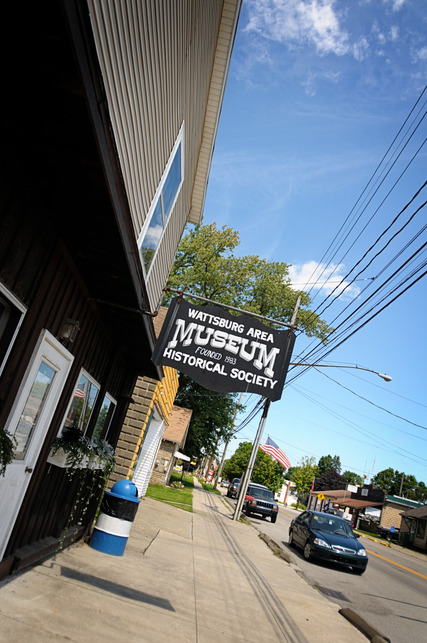
The Wattsburg Historical Society

Some of my fondest memories have to do with the Erie County Fair held annually at the Wattsburg fairgrounds. Gramps was in charge of the concessions at the fair for many years. As a young child, walking through the midway with gramps was magical. Everyone knew him. I remember him motioning to one concessioner after I had spotted among his prizes a Barbie-type doll in a beautiful lace wedding gown. Next thing I knew, the doll was in my hands. (I’m sure he settled up later.)

Many years passed and, either in high school or college, I wrote an essay about the fair and grandpa. Later, I mailed it to him, thinking he would enjoy my reflections. He passed away not many years later.

So at the art gallery, I thumbed through the book about Wattsburg’s history filled with quirky stories, anecdotes, and people’s memories. I went to the spine and copyright page (hey, I’m in publishing–it’s a habit) and saw that it was self-published. The introduction stated that the material in the book had been gleaned from the Wattsburg Historical Society. Flipping pages revealed an index in the back. I wonder if gramps is in here, I thought. Chaffee, Chaffee–there he was!

And, to my surprise, so was I.

Wait. What?

Page 49. What’s on page 49?

And there, to my astonishment, was my little essay about gramps and the Wattsburg fair.

I’m guessing that gramps received my essay in the mail and stored it among his fair papers, most of which apparently ended up in the historical society. The editors of this collection must have discovered the typewritten pages (or maybe they were handwritten, I can’t remember) among the papers and decided to publish it in this collection.

It’s a little embarrassing to read the musings of my early life (not to mention my immature writing style) from so many years ago. In the midst of my article, the editors had put a black-and-white photo of the fair committee, and among them is my dear grandfather.

So as odd as it is to be published without knowing it, I suppose for the audience of this particular book (one being my dad, who received that book the next day as a Christmas present), my little essay might bring back some good memories.

If my writing can do that, I suppose that’s all I can ask.


Photo courtesy of http://www.city-data.com/picfilesc/picc64500.php


Senior “Citizen”-itis

I was speaking to a former student the other day, a 2013 Taylor University graduate who took my Editing class a few years ago. I mentioned that I am winding up my three-year endeavor to obtain my master’s degree. My final thesis/research paper was turned in and, at that moment, I wanted to be done. I said, “I guess I have senior-itis.”

He got a little glimmer in his eye and said, “It’s a joke, I shouldn’t say it.”

“What?”

“You really have senior ‘citizen’-itis.”graduation

Hardee har har.

I’m not quite there, Drew. But I’m getting close. And oh my. You’re probably right.

With a pile of copyediting projects to grade (the extensive project seemed like a good idea when I assigned it), several more class papers to write, and freelancing jobs stacking up, I was feeling so ready to put the whole “homework” thing behind me.

And I need my full eight hours every night. As my dear Grandpa Chaffee used to say, “Gettin’ old and decrepit.”

Being an older student has been wonderful and full of high points–which I talked about in this post. If I had to do it over, I don’t think I’d do it any other way.

I’ve found new friends I will cherish forever. I have some great new writing opportunities to work on in the coming year.

And I’ll admit. When I began the program I had a bit of an attitude: “I’ve been in publishing for thirty years, but apparently I don’t know anything until I have a master’s degree.” But thanks to amazing professors at Ball State I learned how much I needed to learn–and will always need to learn–when it comes to this wonderful field I’ve been occupying for so long. Writing never gets old. Editing is a skill that requires constant sharpening. Publishing is changing as fast as I can flip the pages in the nearest book. To truly be a professional, I need to keep up with my literary citizenship pledge and keep on writing!

It’s been tough, full of ups and downs. I’ve shed a few tears. I’ve felt on top of the world. I’ve felt like a total loser. When I’d look at a new syllabus and bawl my eyes out, my husband would always say, “You can do this. Every new class you think you can’t, and then you rise to the challenge. You can do this.”

We’re almost there.

It’s good to have a cheerleader. Even a senior-citizen one.


(Photo credit: By Cary Bass (Own work) [CC-BY-SA-3.0 (http://creativecommons.org/licenses/by-sa/3.0)])

Sniffles, Snorkels, and Shakespeare

I plopped down in the middle of the Shakespeare aisle in the library.

And I burst into tears.

Mind you, I kept my sobs silent, my mouth covered. No one could see me. This was in Range 107 and 108 on Third Floor East in the BSU library. The hundreds of floor-to-ceiling shelves of books are spaced just far enough apart to sit with legs crossed. I love this place, getting lost amongst the stacks. I love the smell and feel of real books, old books. I love that so many people at one time or another were able to hold a work in their hands and be proud to have had their words published–in this particular aisle, so many many words about the bard, Shakespeare.

The criticisms and handbooks and guides on his tragedies and comedies mocked me from the shelves. “You’ll never have time to learn everything you need to know. Just look how much has been written! Ha ha! And you think you have something to say?”

It was a tragedy that I, a grown woman, sat amongst the stacks bawling.

It was a comedy for exactly the same reason.

Please, no one come by.

I can just imagine: “There’s someone up there crying,” a concerned student reports to the circulation desk. “And she’s, like, really old. Maybe she’s, like, having a breakdown?”

I can imagine the words over the intercom system. “Clean up on Third Floor East, Range 107.” And someone will come looking for me with tissues and a concerned face and maybe a straitjacket.

“I’m all right. Really. Just a bad day. And I’m just really tired.”

I glance North and South from my spot on 3 East. Aside from the occasional student passing by, no one even seems to know I’m here having my little meltdown. I wipe my nose on my shirtsleeve (gross) and lean against the stacks. A few deep breaths.

“You can do this. Just finish this semester. You can do this.”

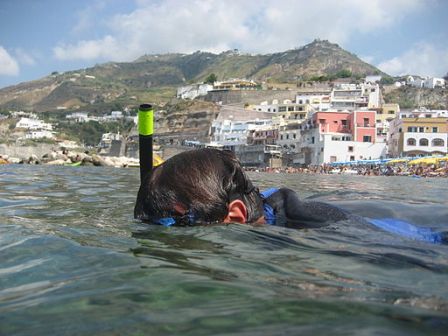
Snorkeling
By Nemoischia (Own work)

But it’s that little voice from college days that pushed me so hard to be perfect. Why do it if it can’t be perfect?

The doubts creep in. What am I doing here? Why am I doing this? What is the point?

A few more deep breaths. A prayer sob to the heavens.

“God, I know you want me doing this. I know beyond any doubt that you’ve walked me through this so far these last three years. I know that this is good for me in more ways than I can imagine. But I’m in over my snorkel . . .”

So God simply and quietly calms my heart and reminds me that he isn’t going to give me shallower waters; he’s instead going to provide a longer snorkel.

And maybe some swim fins.

(Photo from Wikimedia Commons [CC-BY-SA-3.0 (http://creativecommons.org/licenses/by-sa/3.0)], via Wikimedia Commons)

“As I Like It.” Sort Of. Attempting to Write about Shakespeare.

I have to admit–this has been a bit of a struggle, this whole grad school English major thing. This summer and this semester I’m taking literature classes. I’m trying to become an academic and think deeply and write position papers and do critical analysis.

I’m definitely out of my comfort zone.

As I noted in this post, much of my learning curve has to do with being back in academia after 33 years.  But, just as I advised my children during their college years, I made myself appointments with my professors.

I asked the first professor about critical analysis. “Really,” I asked, “hasn’t everything been said? How can I possibly find something more to say about Shakespeare or Hawthorne or Emerson or Twain?” He acknowledged that, indeed, there are whole conferences devoted to certain authors and their writings, and academics read papers to one another and everyone sits around and talks more about that particular author or book.

“We’re really kind of nerdy,” he admitted.

“And,” I added, “isn’t there a point where we’re starting to see things that never crossed the author’s mind? Isn’t there a point where we’ve beaten something to death and now we’re into territory the author wouldn’t recognize?”

His answer surprised me. Sure, it’s possible to beat something to death–and no one wants to do that. But, he explained, when these authors put their words out there in print, those words become ours. We can look at them through any lens we want. We can interpret by what we see there because, ultimately, that’s what all writing is. It calls for a response from us. Those authors are trying to say something, and it behooves us to figure that out, but ultimately we may never know completely. He explained that often there is indeed new scholarship that arises–new letters or papers written by the author surface somewhere and get published, thereby changing scholarship by showing that an author really wasn’t being sarcastic in that story (or was) based on opinions revealed in those papers.

So it can indeed be an ever-changing landscape.

And the classics are classics because of some timeless element that keeps us reading. They show us something about the time period but also something about ourselves. They cause a reaction in us. They make us look at ourselves or our own world differently.as you like it

And he encouraged me about what it means to be a scholar, an academic. “Anyone can have a response to a piece of writing. They like it. They don’t like it. It made them laugh or cry or think more deeply about something. But it takes a scholar to look at a piece of writing and consider the time and culture of its writing, compare it to other writing, look at the language, etc. Nothing is written in a vacuum; every author writes from (or against) influences in his or her life.” He encouraged me that by writing a paper or doing a critical analysis, I’m simply joining the academic conversation with another nuance, another point of view.

“Joining the conversation.” I like that. He told me to picture myself walking into a room with a whole bunch of nerdy people talking about As You Like It. Stand there and listen for awhile (translated as read a few academic journals and see what people have said about the topic I choose in that play). Then, from how I read it through my own lens of learning and life experience and study, I can add to the conversation. And I do indeed have something to add if I’ve done my homework, read the work carefully, and read what others have said.

An email to my other professor reiterated this. After I apologized for my seemingly basic question, she wrote this: “Focus on locating critical texts about AYLI and seeing what conversations currently surround the text. As you get familiar with the criticism, one or several things will likely happen: 1) You’ll find a gap where the critics aren’t quite touching on a theme or issue that you’d like to emphasize, 2) you’ll seriously or even partially disagree with someone’s point of view, which opens the door to your own argument, 3) you’ll see connections among previously separate arguments and you can help thread them together into a larger argument.”

I think I can do that.

So as I contemplate a position paper on Shakespeare’s As You Like It, I realize that maybe I have something to say.

I’ll let you know.

Punctuation? It Can Be Fun. . . . Seriously!

Did you see what I did there . . . in the title? Used lots of punctuation?

Trying to add a little humor to what appears to be an overwhelming next few months. One final semester where I play two main roles–I’m a student and I’m a teacher.

As a student, I am working to finish my master’s degree in December. I’m taking a class in research where I can finally officially learn how to navigate all of the electronic sources online. I learned a little along the way to get through some of my other courses, but I’m thrilled to get some real training (my last big research paper would have been written on an electric typewriter after doing research in the card catalog).

My second class is on Shakespeare, and here’s my reading pile for this class:

shakespeare

AND, I’m finishing my research paper where I’m working to prove the importance of Literary Citizenship in university creative writing programs.

Then, I’m also teaching my Editing class at Taylor U. This is the first time I’ve had the class twice a week, so that meant revamping my syllabus. There’s so much I want to teach . . . and I soon found myself frustrated trying to lay out all of the pieces in logical order to fill all the class periods. I kept crossing out and erasing on my notepad, and then I remembered that we had a whiteboard in our basement. I pulled it out from behind some boxes, located dry erase pens and an eraser, and set about writing up my syllabus. Here’s what it looked like:

White board 1

Green for class activities, red for papers that need to be prepped and photocopied, black for homework and notes to myself. Basically we’re doing content editing in September, copyediting in October, and proofreading in November.

So the middle of October we work on proofreader marks (which certainly come in handy in copyediting), and they get a chance to learn about the Chicago Manual of Style and house style guides (I know–this is beyond exciting for you).

white board 2

And I show them this clip of “phonetic punctuation” by the amazing Victor Borge, a pianist who was also a comedian. We lost him in 2000, but his brilliance lives on.

You see, punctuation can be fun! And that’s just what I hope I can teach my students!

(Now if only Victor had done something on library research . . . )