What’s in Your Wallet?

The things we carry tell a lot about us.

In my Writer’s Craft class, we studied the value of details in our stories — you know, those little words or tiny descriptions that can make a whole story turn and give a complete description without having to say much at all.

To illustrate how this can work, we read part of the first story of Tim O’Brien’s work, The Things They Carried. This essay collection details some of O’Brien’s experiences in the Vietnam War. Published in 1990, twenty years after O’Brien returned from the war, the story still resonates with its gritty realism. Such a story could only be written by someone who lived it.

The titular essay describes the various soldiers in the 23rd Infantry Division with vivid descriptions mostly of — you guessed it — what each soldier was carrying. From these lengthy paragraph descriptions, my students and I could detail on the board the job each soldier had within the unit, what he cared about, and even a bit about what he was like (the things carried could be something like “fear”). Here’s just a taste:

obrien

The things they carried were largely determined by necessity. Among the necessities or near-necessities were P-38 can openers, pocket knives, heat tabs, wristwatches, dog tags, mosquito repellent, chewing gum, candy, cigarettes, salt tablets, packets of Kool-Aid, lighters, matches, sewing kits, Military Payment Certificates, C rations, and two or three canteens of water. Together, these items weighed between 15 and 20 pounds, depending upon a man’s habits or rate of metabolism. Henry Dobbins, who was a big man, carried extra rations; he was especially fond of canned peaches in heavy syrup over pound cake. Dave Jensen, who practiced field hygiene, carried a toothbrush, dental floss, and several hotel-sized bars of soap he’d stolen on R&R in Sydney, Australia. Ted Lavender, who was scared, carried tranquilizers until he was shot in the head outside the village of Than Khe in mid-April.

This first essay gives a brilliant picture of this group of men, together by necessity, bound to one another, trying to do the tasks assigned and stay alive.

So my students did a writing exercise. I asked them to dig into their backpacks or purses or pockets or wallets and list everything they were carrying. Then they did some free writing. My challenge to them was to write a couple of paragraphs describing what the things they were carrying revealed about them.

There’s the girl who was lugging around in her backpack papers that she didn’t even need (and she couldn’t remember what class they were from). There’s the girl with the detailed calendar. There’s the guy with the extra pens and the other who probably needs to bum writing implements. Almost all of them were carrying books (one read Shakespeare constantly!). The students carried pictures or other items that brought back memories.

I looked in my purse. First, it’s way too big, but I like a big purse when I need to carry extra — you know — stuff. I have a big make-up bag with extras of all the basics after one day a couple years ago when I arrived at school and had forgotten to put on any make-up! I vowed that would never ever happen again! I have a notebook like what I tell my students to carry so that they can write down brilliant ideas when they strike. It’s pretty much bereft of brilliant ideas, although I do use it to jot down names of books I want to read.

In other words, I’m carrying things I hope not to need (extra make-up) and things I hope to need (a place to write down brilliant ideas).

I have a wallet and three sets of business cards and too many pens. I like to be prepared. I have my datebook because I don’t have nor want a smart phone. I like to have lists and organization and for that I need my datebook.

My bag tells me a lot about myself. My students learned a lot about themselves by looking at what they carried. We talked about using such details for the characters in their fiction–how can what the character carries be part of the description of him or her?

So, what’s in your wallet? What do the things you carry say about who you are and what you care about?


.
Building an Author Platform – One Board at a Time

The students in my “Building Your Author Platform” class have been busy. We spent the first couple weeks of this class figuring out who we are as writers and who we need to be out there online. They thought about what they write, their interests in both reading and writing, where they want to take their writing, and who they want to meet out there and add to their “tribes.” I have a couple of students who write psychological horror/thrillers, several who write fantasy/sci-fi, a Star Wars fanatic, some YA writers, a student who doesn’t want to write but wants to promote books (bless her!), a scientific writer (she even has a moth of the month you can learn about!), and a couple who are also just multi-talented and still figuring it all out.

They then built their websites to go along with the sort of “brand” they’re creating of themselves. Then, following principles of literary citizenship, we’ve talked about how the best way to “network” is not to “network” per se but to simply to be interested in what other people are doing. They’re writing charming notes each week to someone they admire. They’re following and commenting on one another’s blogs and blogs of writers they admire and want to add to their tribe. They’re tweeting (and tweeting and tweeting and tweeting . . .).

I love it when a student stops by my office to say, “My tweet just got ‘favorited’ by my favorite author!” and they begin to realize that reaching out simply means a tweet, a retweet, or a kind comment on a blog. I want them to understand that, once they leave this college cocoon where they’re surrounded by likeminded writers who understand them, they will be out in the bigger world where, chances are, fewer people “get” them as writers. They will need that online “tribe” that continues to discuss the various virtues of the new Star Wars trailer or the plot line of the latest Brandon Sanderson book or whether their own character in the latest story is speaking in a believable way (“Let me just read you this . . .”). The tribe is a place where they can continue to join the conversation about things that matter to them.

Your platform--where is it taking you? How's the view?
Your platform–where is it taking you? How’s the view?

I tell them that they will need to attend a writers conference — hopefully once a year — to get recharged and reinvigorated. They will need to continue to buy and read books (that doesn’t seem to be an issue with this group).

This past week we also listened to the pitches of those students who have books in the works. I wanted them to both practice writing proposals and pitching those proposals to agents. Half the class is in that position, so the other half acted as agents and I gave the authors five minutes to sit down in front of an agent, give their book’s synopsis, and be calm and professional all at the same time. It was great practice for that opportunity they will have sooner or later to actually pitch that finished book.

Platform building isn’t all about me, myself, and I — which I think is why many people are scared of it. No, platform building is about building a network of likeminded folks both in your physical world and online — caring about them, sharing their work and their words, joining the conversation, and rejoicing with the successes that happen in the group. Then, one day, when success comes knocking on my students’ doors (as I have no doubt it will), they have a group ready to celebrate with them.

One board at a time. Reach out to your favorite authors in your genre. Thank them for something. Comment on their blog posts. Share your work and your thoughts on your own blog. Take your time, because it will take time. But the time to start is now–even if you don’t have a book to sell. Just go out there and join the conversation. You have something important to say.

Word Power

I tried an experiment in one of my writing classes this past week. We’re talking about the power of words and learning to, as Francine Prose writes in her book Reading Like a Writer, “put every word on trial for its life.”

We looked at the words used (and not used) in Cynthia Ozick’s ‘The Shawl.” (They were amazed to realize that the word “Nazi” is nowhere in the story, even though that’s what it’s about and they knew that’s what it’s about, even without that word and many others one might expect.) We studied the descriptions of place and people in Guy de Maupassant’s, “The Piece of String.” We watched how Flannery O’Connor chose words and led us along in “A Good Man Is Hard to Find.”

Then I read them some quotes from one of my recent favorite books, Markus Zusak’s The Book Thief. Here are some of the beautiful, lyrical lines:

When the train pulled into the Bahnhof in Munich, the passengers slid out as if torn from a package.

All was dark-skied and hazy, and small chips of rain were starting to fall.

In Liesel’s mind, the moon was sewn into the sky that night. Clouds were stitched around it.book thief

That was when a great shiver arrived. It waltzed through the window with the draft. Perhaps it was the breeze of the Third Reich, gathering even greater strength. Or maybe it was just Europe again, breathing. Either way, it fell across them as their metallic eyes clashed like tin cans in the kitchen.

<a scene of the Nazis burning books> The orange flames waved at the crowd as paper and print dissolved inside them. Burning words were torn from their sentences.

The cold was climbing out of the ground.

Snow was shivering outside.

The window opened wide, a square cool mouth, with occasional gusty surges.

Pimples were gathered in peer groups on his face.

I love how Zusak uses words, putting them together in surprising ways to make descriptions that are exact and yet so unusual and unexpected. It’s that very unexpectedness that delights me.

So we did an exercise in class. I gave students four small pieces of paper. On each paper they were to write a word — two papers would have adjectives, two papers would have nouns. Any adjective, any noun. I gathered the papers into two piles, shuffled them, and then each student chose one adjective and one noun and had to find a way to use them together in a sentence.

We got “chilling sun” and “soft children” and “shiny dream.” And the students wrote amazing new sentences, allowing these unusual pairs to work together.

In a weekly journal post, one of my students wrote, “I liked the adjective and noun game. Combinations like chilling sun made me think about the ways I described things throughout the week. Instead of relying on easy, conventional descriptions, I searched for different, more unusual word pairings that still made sense.”

Couldn’t have said it better myself!

What are some of the most lyrical, surprising, and unexpected sentences you’re read — and where did you read them?

So I’m Studying to Earn an MFA

This summer I began a Master of Fine Arts (MFA) program. In keeping with the advice that I give to my students in my Building Your Author Platform class (advice from Austin Kleon’s book Show Your Work), I’m here to let you in on the process of being a student in an MFA low-residency program, teaching four classes at my university in the Professional Writing program, continuing to freelance, and attempting to have a life.

I chose a low-residency MFA program as that works best for my schedule. I do two weeks onsite for three summers with two years in between of online teaching, reading, writing, and discussing with a cohort of other writers in creative nonfiction, completing in summer 2017. I chose Ashland University’s program in Ohio because of its reputation and  faculty–some of whom I knew from my Master’s program at Ball State. My first two-week stint was this past July.

Note from my journal: “Now I know what my students feel when I hand them a syllabus. Today I went into syllabus shock when I was given the outline for my fall semester. But I know enough to breathe deeply. I can do this. Take the elephant one bite at a time.”

Thought: “Where does the Master in Master of Fine Arts come from? How does anyone truly master the craft of writing? I think the point is that I will spend two intense years studying this craft and creating something from that study. That’s what will allow me to take the title of master. I hope I can live up to it.”

The focus of my program is to create a thesis–a creative work, a book–by the end of my two years. I am in creative nonfiction, so we talked a lot about essays and memoirs and writing that is true, real, and genuine. We talked about the works of wonderful nonfiction writers like Annie Dillard and Mary Karr and Philip Lopate and Lee Martin (some of these folks also write fiction). We talked about spirituality in writing–how to talk about that inner spiritual life. We studied how memoirists have to write from various viewpoints–who they are now, who they were then, who they are reflecting on who they were, and who they have become based on how those two persons relate.

I’ve been told in this first semester to experiment with my voice, to see where my writing takes me. Part of my problem, however, is that I’ve spent so many years editing and working in other people’s voices that I’m still trying to find my own.

Note from my journal: “It helps me to have a focus, a direction, for my writing. Ah, the age-old question: What should I write about?”

I’m experimenting right now with a series of essays talking about the whole process (and brilliance) of editing when it’s done well. I am thinking about tying in my research into the great editors (some of which I’ve begun doing on this blog) and extracting lessons from them. And maybe I’ll think about what lessons I learn in the editing process that pertain to life. (Such as, “What if God took this rough draft of my life, marked it up with a red pen, and gave me a do-over? What would I do differently? And would I want to do that? The changes I make to my past will affect the future that I do not yet know.”)

I know. Deep.

So that’s a glimpse into my MFA musings. Right now I need to write a review of Jean-Dominique Bauby’s The Diving Bell and the Butterfly. (If you haven’t read it, drop everything and do it now. It’s a short book that will leave you stunned and amazed. You don’t even need to know that he wrote the book by “transcribing” to a writer by way of eye blinks since he was completely immobile. Read #2 in this list for more about that.)

So I have a paper to write about the structure and voice of this book, the narrator’s persona and his reflections on his life. Then I need to write more about editing to see if that is going to work for a thesis project.

But first, I’m going to eat some dinner.

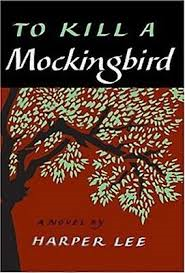
Great Editors–Tay Hohoff and To Kill a Mockingbird

to killYou’ve probably never heard her name–I hadn’t until last night when watching a TV special about Harper Lee, To Kill a Mockingbird, and her unknown and previously unpublished second book titled Go Set a Watchman.

The editor’s name was mentioned in passing, and I asked my husband to pause, replay, and help me catch it. Tay Hohoff is described in a blog post by Clarissa Atkinson, a fellow employee at J. B. Lippincott, as a “respected editor” and a “challenging presence.”

Ms. Atkinson goes on in another post to describe the To Kill a Mockingbird years at the publishing house:

J.B. Lippincott . . . was a family-owned Philadelphia firm, old-fashioned even in the 1950s.  I worked in the branch office at Fifth Avenue and 43rd Street – an editorial office, in which the New York tail wagged the Philadelphia dog. My tenure at Lippincott coincided with a few of the many years during which Harper Lee was working on To Kill a Mockingbird. According to office legend (more or less substantiated by Wikipedia), Lee had arrived from Alabama with a trunk full of mixed-up parts and pages of an enormous manuscript, she lived in a garret on macaroni while she transformed the pages into a stunningly successful book, and this was accomplished through the faithful support and encouragement of her Lippincott editor.

Is anyone surprised by this “faithful support and encouragement” from an editor? Not me.

We’ve all heard the story by now. How friends of Harper Lee’s gave her a year’s worth of pay and told her to just go write for that year. The result was this astounding book published in 1960 that was an instant classic and won a Pulitzer Prize in 1961. 

And those of us who write wonder how in the world this writer crafted one book (well, now we know of two) that had this kind of success. We can only dream of that.

I think it has much to do with her upbringing–her father was a well-respected lawyer in her small hometown of Monroeville, Alabama, in the deep South in the days before the Civil Rights movement. She touched a nerve by taking on the topic of racism and showing what it takes to stand up for what’s right.

Still, she also had a good editor who helped to shape the book into something readable. In 2010, celebrating the fiftieth anniversary of the book’s publication, Newsweek ran an article titled, “Who Helped Harper Lee with Mockingbird?” that discusses Tay Hohoff’s role in the book:

Lee had dropped out of college during her senior year to move to New York to become a writerto the dismay of her father, who wanted her to be a lawyer. She spent nearly a decade doing odd jobs and scraping by before she submitted five stories to a Maurice Crain, an agent who, frankly, wasn’t overly impressed. But he and his wife liked Lee, and he encouraged her to try a novel. The result, then called Atticus, was a mess. “There were dangling threads of plot, there was a lack of unity—a beginning, a middle, an end that was inherent in the beginning,” said Tay Hohoff, an editor at J. B. Lippencott, who described the submission to Lee’s biographer, Charles Shields. Still, Hohoff and the others at Lippencott saw something promising in it and took a chance. Lee clearly needed guidance—but she would get it. Lee rewrote the novel three times over the next two and a half years. At one point, she threw the manuscript out the window and called Hohoff. Her editor persuaded her to go outside and gather the floating pages.

It’s a good thing, wouldn’t you say?

That’s the role of a great editor. Sending a writer back to keep rewriting. Being there when the writer is facing a brick wall and muddled pages. Making sure the pages tossed out the window get gathered up and worked on because the editor sees something that maybe even the author can’t yet see.

ADDENDUM 7/14/15: Reviews of Go Set a Watchman are popping up online, and most of them are not kind. This one, in particular, gives credit to Tay Hohoff for the work she did in shaping To Kill a Mockingbird, a touch clearly missing from this most recent publication. But I disagree with the sentiment that there aren’t editors like that around anymore–there are, and they work very hard to bring diamonds out of the rough.

7/25/15: Excellent commentary from The New York Times. Unfortunately, I do feel that this may have been far more about money than about the writing or the writer.

The Writer’s Craft–Learning from the Best

That’s it–The Writer’s Craft. That’s the name of a required class in our Professional Writing department at Taylor University–a required class that I will be teaching for the first time this fall. I’m so excited to teach this class because we’re going to read great writing, unpack it, understand what makes it great, and learn what we can use to improve our own writing.

ProseThe class has traditionally used Francine Prose’s book, Reading Like a Writer: A Guide for People Who Love Books and for Those Who Want to Write Them (New York: Harper Perennial, 2007).

I love this book because it gives examples of great writing in areas of words, sentences, paragraphs, narration, character, dialogue, details, and gesture. All of this is studied by way of what she calls “close reading,” taking the time to annotate a chosen text and study it carefully.

So I’m excited to bring to the students stories from John Steinbeck and Ernest Hemingway and Flannery O’Connor and John Updike and Tim O’Brien and Edgar Allan Poe and James Joyce and Anton Chekov, among others. I can’t wait to have my students do close reading of amazing writing, discuss it, learn from it, be inspired by it, use it.

I’m just a little thrilled to teach this class.

It is important that writers read “textbooks” about writing–and those textbooks are the great works that have stood the test of time. Prose (don’t you just love that the author’s name is “Prose”?) writes that these great works are “textbooks, private lessons in the art of fiction” (3). What is it about this piece of writing that makes it great? that has stood the test of time? that makes it classic? She continues, “A masterpiece can inspire us by showing us how a writer does something brilliantly” (11).

We’re not going to look at the big picture–the why of the writing. Instead, we’re going to focus on the mechanics, the how. What words does the writer use? How are those words making this piece sing? What about sentence structure? Paragraphing? How is this dialogue telling us the story without telling us the story? (For the last one we’ll read Hemingway’s “Hills Like White Elephants.”)

In his wonderful little book Steal Like An Artist, Austin Kleon talks about making sure we artists surround ourselves with other great artists (I talked about this book more in this post). He advises us to be collectors, collecting the things we love.

You’re only going to be as good as the stuff you surround yourself with. My mom used to say to me, “Garbage in, garbage out.” It used to drive me nuts. But now I know what she meant. Your job is to collect good ideas. The more good ideas you collect, the more you can choose from to be influenced by. (13-14)

Seeing yourself as part of a creative lineage will help you feel less alone as you start making your own stuff. I hang pictures of my favorite artists in my studio. They’re like friendly ghosts. I can almost feel them pushing me forward as I’m hunched over my desk.

The great thing about dead or remote masters is that they can’t refuse you as an apprentice. You can learn whatever you want from them. They left their lesson plans in their work. (17)

So we’ve got our readings, our lesson plans, our pens, and our desire to collect and learn from the greats.

Can’t wait!

What great writers or particular pieces of writing have inspired you?

Committing Acts of Literature, Thanks to William Zinsser (RIP)

On May 12, 2015, the writing world lost a great encourager, teacher, and mentor. At age 92, William Zinsser passed away. Author of the book that is (or should be) on the shelf of every writer and editor, On Writing Well, Zinsser left a legacy of helping people learn how to put words together. On Writing Well was first published in 1976 and has gone through seven editions as Zinsser updated it to take into account new technologies.

on writing well

The focus of the book is writing nonfiction, but the principles of good writing span all genres. Simplicity, economy of words, style, usage, voice, and understanding one’s audience are important for every type of writing–from the business email to the fantasy novel.

Zinsser spent his career writing and teaching writing. During the 1950s, he wrote editorials and features for the New York Herald Tribune. In the 1960s, he was a freelancer, writing for the likes of Saturday Evening Post, Life, Look, and Sports Illustrated. The 1970s saw him at Yale University teaching nonfiction writing and humor writing. In the 1980s, he worked as editor of the Book-of-the-Month club, a mail-order book sales club that operated from 1926-2014. The remainder of his life he continued freelancing, writing eighteen books, and (of all things) playing jazz piano!

But he’ll be most remembered and loved for what he did for helping writers understand their craft.

Referring to writing, Zinsser wrote:

There isn’t any “right” way to do such personal work. There are all kinds of writers and all kinds of methods, and any method that helps you to say what you want to say to the right method for you. . . . All [writers] are vulnerable and all of them are tense. They are driven by a compulsion to put some part of themselves on paper, and yet they don’t just write about what comes naturally. They sit down to commit an act of literature, and the self who emerges on paper is far stiffer than the person who sat down to write.

So Zinsser set out to help writers not be stiff, but instead to be able to truly commit acts of literature. I love that! But he also encourages:

Writing is hard work. A clear sentence is no accident. Very few sentences come out right the first time, or even the third time. Remember this in moments of despair. If you find that writing is hard, it’s because it is hard. . . .  Writing well means believing in your writing and believing in yourself, taking risks, daring to be different, pushing yourself to excel. You will write only as well as you make yourself write.

It’s not an easy life–this writing life. Those of you who have chosen to live your life with words–reading them, studying them, marveling at them, talking about them, writing them–you know this all too well.

But it’s that moment when it all comes together, when we have written well, when we have committed an act of literature–it’s that moment that makes it all worthwhile.

Thank you, William Zinsser, for your encouragement.


It’s Hard to Say Good-bye: The Annual Heartache of a College Instructor

When I signed on to teach at the college level–first as an adjunct and now as a full-time instructor–no one told me that every year in May I was going to experience the heart-throbbing pain of good-byes.

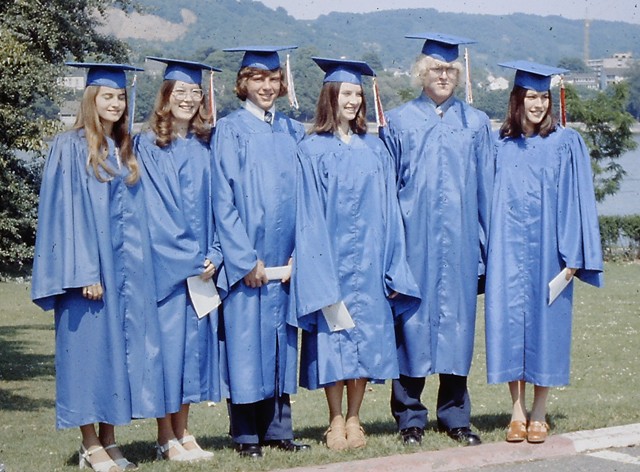
Don’t get me wrong. I’ve said a lot of good-byes in my life. I grew up as a military kid and we moved a lot, so good-byes were pretty standard fare. I went to high school in Bonn, Germany, at what was then Bonn American High School (Go Crusaders!). After our class of fifty-some students moved the tassel in 1976, we scattered all over the globe (literally–and I am using literally correctly).

Some of my fellow graduates. BAHS 1976. That's me second from the left. Our tassels were red, white, and blue to commemorate America's 200th birthday.
Some of my fellow graduates. BAHS 1976. That’s me second from the left. Our tassels were red, white, and blue to commemorate America’s 200th birthday. By the way, that’s the Rhine River behind us.

Then, after college, I said good-bye again to dear people who had been my roommates, my suitemates, fellow residence staff, professors, and friends.

Good-byes are never easy.

So no one warned me that now every year I would have to say good-bye to an entire group of students that I had come to love–literally. Students I had watched grow into great writers. Students I had talked to about their future dreams and plans. Students I had prayed for and with, cried with, laughed with. Students who, each year, taught me a little more about myself.

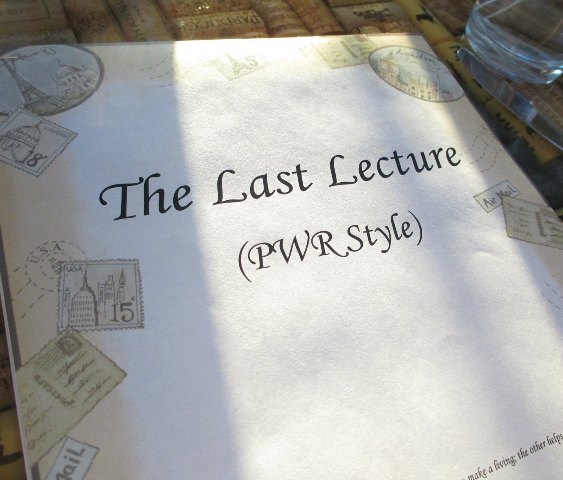
This evening we had a dinner to honor our seniors. Yesterday one of them asked that each of the profs in the department provide a letter to all of them, a “last lecture” of sorts. We wrote those letters, and she put them into a packet for each senior.

I thought long and hard about my letter. Writing should be easy, right? I’m a writer, right? But what do I say? What words of advice can I possibly give to these young people moving the tassel and scattering to the winds?

I told them to expect bittersweet. Graduation has been in their sights for years–but when it comes, it also means good-bye. And that’s hard. It means for the first time in four years they may not know where they will be come August. That can be frightening.

I told them to expect loneliness and confusion. Even if life is mapped out, even if there’s a job or grad program waiting and a wedding in the works, there will be times when they will miss the craziness that is dorm life. They’ll wonder if they’re making the right decisions. If they’re still job hunting and spouse hunting, at times the loneliness can be overwhelming.

But lest you think I’m Negative Nellie (or maybe just Realistic Rachel), let me assure you, I am all about the positive. I just want them to not think they’re alone when those feelings hit.PWR10

I also told them to keep the faith. Follow their path and stay close to the God who brought them this far and has a plan.

I told them to live this crazy adventure called life to the fullest.

I told them to keep writing and to expect rejection (yes, Realistic Rachel, it happens all the time) but to keep writing anyway.

I told them to stay in touch with one another and to continue to encourage one another in life and in writing.

I told them to find their tribes “out there” and to go to writing conferences just to remember what it’s like to be around a writing community.

I told them that they have a gift–the gift of words. Open it, enjoy it, share it, use it.

Good-bye, dear seniors. Thanks for being part of my life.

The Tax Man Cometh . . . and He’s Here to Help

If you’re like me and you’re a word lover, the IRS tax forms with all their lines and numbers send you into a panic attack. I get it. No matter what political persuasion you are or whether taxes bring you joyous refunds or difficult fees, filling out the dang forms can be a stressful endeavor.

If only you could get help—good help, help who knows what they’re talking about. If only there was a website that would answer your questions about your life as a writer and whether or not all of those expenses count on your tax returns (even if that long-sought-after royalty check has yet to arrive . . . or be promised).

Today, my friends, “if only” is here. I offer a helper whose passion is Tax Solutions for Writers (which also happens to be the name of his website). Gary Hensley was an accountant for his entire life, an IRS agent and auditor for part of it, and one of the guys who answered the phone for TurboTax if someone needed help.

He knows whereof he speaks. [Update: Gary Hensley passed away in 2018.]

Every year, our Professional Writing department at Taylor University invites Gary to talk to our students about acting like writers and filing their taxes as such. (In addition, you can catch Gary every year at numerous locations, including Midwest Writers Workshop where he is always one of our most popular speakers.) Or you can go to his website that has every question you can think of, and many you probably haven’t.

Here are just a few things I have learned from Gary about handling my tax returns.

(1) You don’t need to be an official “business” to be in business as a writer and to file a Schedule C for deductions. If you are busy writing (sending out articles, researching that novel, attending conferences to improve your skills), you are a writer and should treat yourself as a professional on your tax return.

(2) Purchase a $5 planner that you can carry with you. In it, document every single activity that you do that shows your activity as a writer. Write down what you did at your desk (your home office area) each day. Track the time you spent writing and what you did. This separates you as an active writer (even if you’re not published) from someone who is sitting around thinking he’d like to write a book someday. You are actively writing. That makes you a writer.

(3) Then use those daily slots to document writer expenses. Maybe you subscribed to a particular magazine or website to help you with information for an article or book. Maybe you attended a conference. Maybe you purchased books about the topic you’re writing about or simply to improve your writing skills. Then, of course, find a place to keep those matching receipts.

(4) In that diary, also keep track of mileage for writerly activities (not just miles, but write in the actual odometer readings to and from anything that had to do with your work—and write next to it the business/writerly purpose for your trip). Perhaps you drove to the library to do research. Maybe you drove to interview someone and purchased lunch for you both. Track the mileage to that writers conference.

(5) Get a separate bank account for your business that has a debit card attached. Again, you don’t need to be an official DBA or LLC or Ltd. or anything. But this particular bank account holds only the money that you earn as a writer (yes, even that $35 for the column you wrote), and it tracks anything you purchase for your business (printer paper, stamps, books, conferences). Maybe you don’t have income, or nothing really worthy to call that. Doesn’t matter. Get in the habit of separating out your writer life from the rest of your life. I know, you may need to lend yourself money back and forth in order to cover a business expense (like a conference—the $35 article won’t cover that), and Gary explains how to do that on his website. The point is to keep your writerly income and out-go separate from the rest of your household.

All of this documentation will make it easier both when you go to fill out next year’s form and if you ever get audited. These expenses are deductible on the Schedule C, so you want to take advantage of them and you want them to be accurate.

I know. The forms are difficult, but it’s time to take hold of your writer self and claim your professional status. Check out Gary’s website for answers to other questions.

And go purchase that journal to track this year’s activities! (Oh, and write down the odometer reading before you go and when you get back!)

Great Editors: Betsy Lerner Helps Writers Understand Editors

I love this book and was so excited when I found it a few years ago. I go to it often and read excerpts to my editing class. Betsy Lerner created a product that helps writers understand editors and vice versa. Titled The Forest for the Trees: An Editor’s Advice to Writers (Putnam, 2000, updated 2010), the first section of this book describes some general types of writers, and the second section peeks behind the editor’s desk and into the publishing world. Lerner knows wherof she speaks having been an editor for fifteen years before becoming an agent. forest She says, “This book is about what I’ve seen and what I know. I wrote it to help writers achieve or get closer to their goals. At the very least, I hope that in contemplating your life as a writer you may get some perspective on your work and in gaining that perspective, see the forest for the trees” (9).

I teach my students that, as editors, they are working in tandem with authors–Betsy describes it as an intricate dance.  The manuscript arrives on the editor’s desk. The editor will close the office door (or bring the manuscript home where she won’t be interrupted, she hopes) and sit back to read through the entire manuscript–either electronically or on hard copy. The scary red pen may be wielded–perhaps on the manuscript itself but certainly on a nearby notepad. She’s taking notes about first impressions–what’s working and what isn’t, what’s clear and what isn’t, when the pacing seems slow or a character seems out of place. She’s not correcting grammar or sentences; she’s seeing if the book in its entirety works.

The best editor is a sensitive reader who is thinking with a pencil in her hand, questioning word choice, syntax, and tense. An editor is someone who probes the writer with insightful questions, who smooths transitions or suggests them where none exist. A good editor knows when the three pages at the beginning of a chapter are throat-clearing. Start here, she’ll mark in the margin, this is where your book begins. And she’ll know when you should stop, spare you from hitting your reader over the head as if your point were a two-by-four. (194)

A good editor is careful. She needs to explain her point clearly and she needs to be respectful of the author. She knows that it’s never easy for an author to finally turn in a completed manuscript only to have it come back covered in comments and suggestions.

Editing is a science and an art. There is a basic architecture to every book, and if the author has a wobbly narrative leg or an insufficient thesis to stand on, the editor must find the blueprint or create one. What an editor learns as she gains experience is that while no two manuscripts are exactly alike, certain predictable patterns crop up, and as with math problems, the more experience you have, the more readily the solutions appear. (196)

I tell my students that, while they may see the problem in the manuscript clearly, they need to be careful and kind when making the suggestions. The best editors build trust with their authors by giving positive as well as negative feedback. They need to be respectful of the words (most of my students, writers themselves, understand that). In short, they need to be good dance partners. But then, so does the author. If you’re fortunate enough to be working with an editor, trust that person. Yes, it’s still your book, but the editor is going to be your very best reader. No one else is going to read your book with the same attention and care. Let your editor help you, as Betsy Lerner so aptly explains, “see the forest for the trees.”

Tell me about your experiences with editors. How have they helped your manuscript improve?