5 ways to stay sane on social media

We all probably have a love/hate relationship with social media. In these difficult times, how can we stay sane (and Christian) on social media?

I have talked often about the Social Media Strategy class I teach each semester at Taylor U. This summer, I wanted to rethink the class to make sure I am staying on the cutting edge of what’s happening in the social media world. I read (and highly recommend to you) two books:

Following Jesus in a Digital Age by Jason Thacker (Downers Grove, IL: InterVarsity Press, 2022)
Posting Peace by Douglas S. Bursch (Downers Grove, IL: InterVarsity Press, 2021)

I’d like to share with you a few takeaways that I also shared with my students, sourcing some quotes from these books as I go.

One key thing to realize right from the start: Technology is shaping our lives and our expectations.

We are so used to getting anything we want quickly. Amazon delivers in a couple of days. Have a question? Google it and have the answer in a matter of seconds. Click a button; get what we want.

The problem with this is that what’s real in life doesn’t work that way. Spiritual growth is a long, slow process that takes us a lifetime. There isn’t an app that will make us spiritual. Relationships — whether marriage or family or friends — take time and must weather ups and downs. How easy it is to decide something is too hard or taking too long, so we shut it down, let it go, turn away.

Technology has made us incredibly impatient. It has changed our expectations for how life should work. And not for the better.

So from these two books, I came away with 5 key points regarding our use of technology and social media that I shared with my class and I’d like to share with you. These are the things we need to keep in mind:

1. Keep in mind how social media is shaping us.

Wondering why social media can be such a toxic place (my goodness, especially now in a very divided country staring down a very divisive election)? Here’s what Bursch writes:

“Social media is more than just a medium for communication. The internet does more than magnify or amplify our expressions. Social media fundamentally changes what we say, when we say it, where we say it, why we say it, and how we say it. Most importantly, social media modifies who we are and what we are becoming. … [It is] revising our foundational understandings of moral decency, truth, and humanity.”  (Posting Peace, 25)

What can we do? We can slow down and process our thoughts. Not everything we think needs to be shared. It can be easy to hide behind a screen. We would be far better to chat with people in real life. It’s so simple to share posts without taking the time to actually educate ourselves, look for sources, find the facts. And, the capital T of God’s Truth should guide our every post and interaction.

Also realize that technology is monitoring everything we do and where we go online. If you’re more of a political liberal or a political conservative, you probably read certain sites and follow certain blogs. The algorithms are watching that and so sending you more of the same. What this does is entrench us into our divisions because we often don’t even see anything that disagrees with what we think.

2. Keep in mind how social media is causing us to lose our ability to build relationships.

Again from Bursch:

“Many individuals lack deep connections or the ability to form deep relational connection because they no longer have to maintain strong ties to function well in our online society. …Online communication ‘provides just enough connection to keep us from pursuing real intimacy. In a virtual community, our contacts involve little real risk and demand even less of us personally.’” (Posting Peace, 38, 39)

What can we do? We can realize that anything of value takes time to build, and what matters are those real people who are in our lives. Yes, we may have 900+ “friends” or “followers,” but, at the end of the day, who is going to be there for us? Are we taking the time and putting in the effort to strengthen our real relationships — the ones we have today, the new friends we could find tomorrow?

3. Keep in mind how social media affects our ability to handle conflict.

And life is full of conflict. But when we are impatient and don’t want to do the hard work, when we have not learned the basic skills for conflict management, we end up divided in our own camps, with no one able or willing to work on a compromise. We hunker down into our own little groups who agree with us and treat anyone who believes differently like an enemy. Bursch writes:

“In-person communication includes various verbal, facial, and environmental cues lost in online communication. … Because we’re not fully present online, capable of using all our senses, we don’t use our full brains to solve the relational complexities we face. When conflicts arise, we have fewer mental conflict processing tools at our disposal, which frequently leads to argumentative, depersonalized, detached, non-empathetic interactions.” (Posting Peace, 48)

What can we do? Think about how differently people deal with conflict online vs. conflict in person. People say things online they might never say to someone’s face. And rarely do those online conflicts lead to any kind of mutual respect and understanding. Real life discussions — even with differences of opinion or outright conflict — can do both. Let’s try to have more of those.

4. Keep in mind how we as believers must engage wisely.

Unfortunately, our world is filled with lies, manipulation, and gaslighting. We are at a point where we don’t know who is telling the truth; we don’t know who to believe. We as believers, writes Thacker,

“ . . . must engage any manipulation of truth in our world with eyes wide open. … We seek to understand the issues at stake and seek to apply God’s unchanging truths to our post-truth society. … We look bad news square in the eye (and learn more about it so that we might respond in a godly way) because our current hope and future security are in Christ, not in the culture around us.” (Following Jesus, 61-62)

What can we do? We need to be willing to do the work of seeking out the truth for ourselves, not simply believing and reposting every tweet or every Facebook post. We need to be people who focus back on the Truth, who can cut through the noise to the issues that are really at stake, and stand strong for what we believe.

5. Keep in mind how we as believers must honor the image of God in others.

Jesus must be our guide and model even as we engage in a world vastly different from 30 A.D. He taught us how to love others, and this must carry over into our online lives. Thacker writes:

“As Christians, our job is to testify to the reality of who God is and how he has made us to reflect him. The people we interact with online are not simply avatars. They are divine image bearers, just like you and me (Gen. 1:26-28). This means we must engage others online with grace and humility.” (Following Jesus, 66-67)

What can we do? Turn that social media time into prayer. Remember that behind that faceless X handle is a human being, and that human being has beliefs and opinions shaped by a plethora of experiences in his/her life. That’s why in-person conversations are so important, because that person becomes flesh and blood and you can get at what’s going on, why the person believes as he/she does. You can ask questions, follow up, share your own thoughts, reach an understanding or agree to disagree while still respecting each other’s place in God’s world. Absent the ability to chat in real life, let your social media feed become your prayer list instead of a place to argue (you’re not going to change anyone’s mind anyway). Everyone can use prayer.

We need to be careful today more than ever. What advice do you have for how you engage technology as a believer?
Writing Real — More than a Dum Dum

In my Freelance Writing class this week, we’re working on the “art of living” article — writing that seeks to inspire or help readers live life just a little better based on our ability to share our own joys and struggles.

Our text puts it this way: “The key to writing art-of-living articles is to write an article that will make a difference in someone’s life—to provide the reader with something to hold on to and take away into her own life.” —Handbook of Magazine Article Writing

To really make this work, however, that piece needs to provide transparency into the life of the author. Readers want writers to be real, to dive deep, to share their stories.

But it doesn’t need to be dark or traumatic. Sometimes the sweetest and most inspirational pieces of writing come from memories, moments, minute details of life that draw us back and make us think. To give my students that opportunity, I gave them a handout with their lives (so far) divided into segments. They were to write down five or six memories from sets of years: 0-5, 6-10 (elementary school), 11-14 (junior high), 15-18 (high school), and 18+ (college). As they began to scribble, I explained that the memories that came quickly are worth thinking about further. There’s a reason that those bubble to the top.

Their job then was to choose one of those memories and describe it. That gets the scaffolding in place. Now to get a solid art-of-living piece, to get to something that will resonate with our readers, we need to go deeper.

So we considered some questions. I asked them to close their eyes and go back to that memory. What was going on in their lives at that time, in their family life, in the world? Where were they living? Who else was part of their lives at the time? What else do they see, hear, feel, smell, taste? As they looked at that memory in a bigger picture and considered why that particular memory surfaced at all, they can write a story with heart. They can begin to see how that minor thing matters, and in turn, help their readers put themselves into their own similar story.

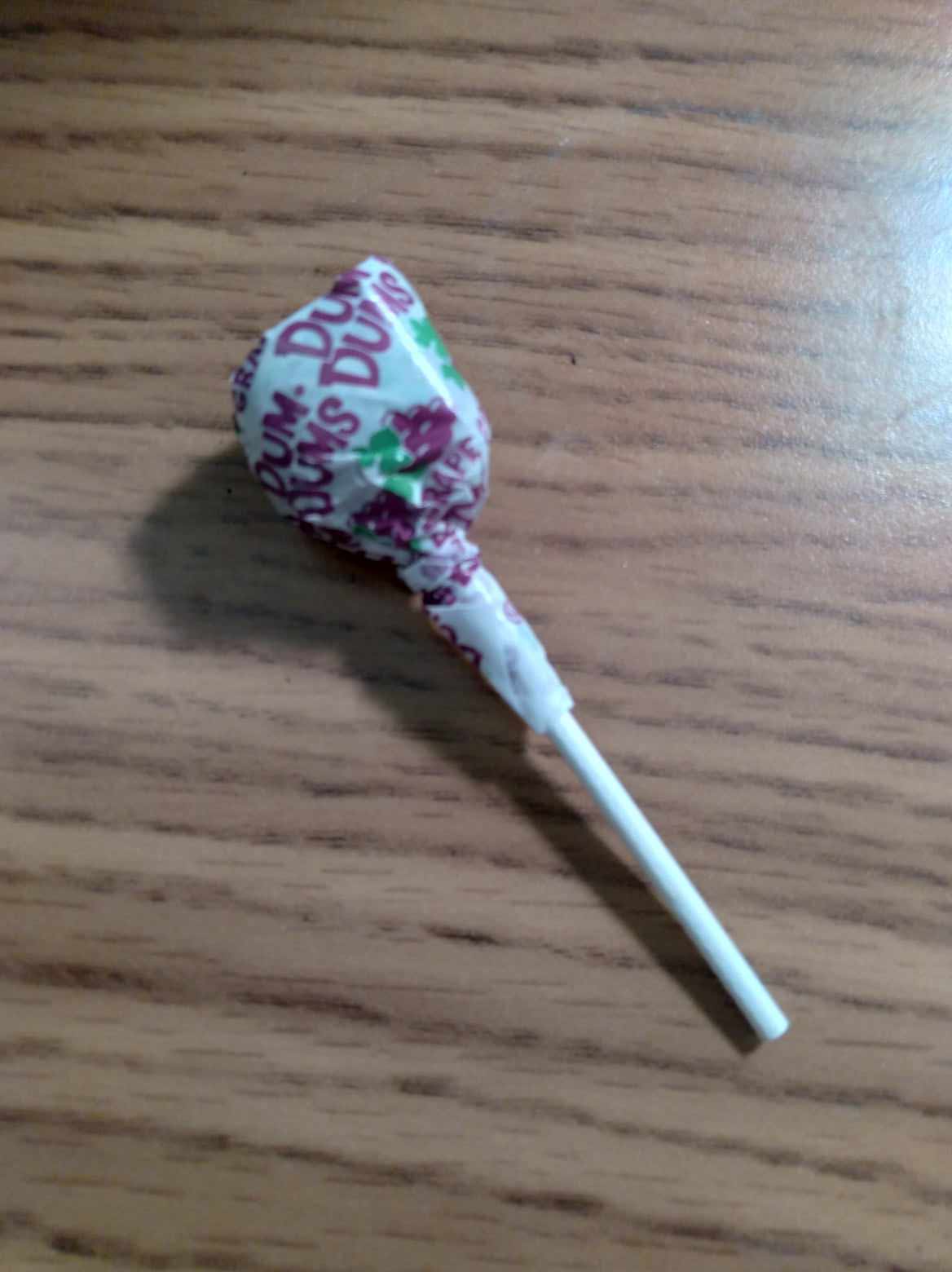
As if to make me take my own advice, today, a sweet college student dressed as a bunny rabbit stopped into my office and let me draw some Halloween candy from her outstretched pumpkin basket. I drew out a Dum Dum.

The Dum Dum that arrived today.

In that moment, I saw my Grandpa Chaffee’s face. He had been a rural mail carrier in the little town of Wattsburg, PA, and its environs. He drove his massive Oldsmobile Toronado to deliver mail — and there was always a big bag of Dum Dums on his front seat. The children on his route knew he’d give them a sucker. Even though our family visited him only once a year or so, whenever I got into that enormous car to ride with him, I drew a Dum Dum from the bag and stuck it in my mouth, sucking happily as we zipped down twisty dirt roads.

Gramps, me, and Trixie, circa 1964.

That Dum Dum sent me back. The joy of our traveling military family always returning to deep extended-family roots in western PA. The legacy of love and faith I’ve been privileged to receive. The deep loss of grandparents and now both of my parents. Changes as decades pass; foundations that remain solid. Heaven’s certainty. A loving family that shaped who I am. Sweet memories and sweet candy.

It’s just a Dum Dum, but now there’s something there worth writing. Something to help readers also think about how life changes yet some foundations are worth holding onto and passing on. It was just a Dum Dum, but it’s so much more.

What simple things in your life have a depth of meaning? What memories rise to the surface? How might you write about them?

Family Legacy

Today is my 65th birthday. This is the first birthday in my entire life when both of the people directly responsible for my existence are no longer here. I will miss my dad’s annual feigned question, “HOW old are you now?” and then the follow up, “I’m not old enough to have a daughter that old!”

Every. Single. Birthday.

So I guess today, I feel a little melancholy. Missing them both, yet so grateful for the legacy they gave me.

I learned from my parents how important family is … immediate family, extended family, friends who become like family. From our annual summer gatherings with extended family to watching my parents trek around the country after retirement in their big motor home to catch up with friends scattered far and wide, I learned how important it is to maintain the relationships in my life.

I learned from my parents to be respectful—of them (my early days were filled with “yes sir” or “no sir,” “yes ma’am” or “no ma’am”) and of everyone else in my world, no matter the color of their skin or their age or their background or their religion.

I learned to respect other cultures as we traveled around Europe in our little Audi, constantly aware of ourselves as tourists but always attempting the language and showing high regard for the people.

I learned to love other people, to be there when needed, to serve and help out. I learned that the behind-the-scenes people are extremely important.

As part of a proud military family, I learned from my parents to love my country. I learned to stand for the flag and put my hand over my heart—because it matters. I learned that freedom isn’t free; it takes brave men and women to defend it. I appreciate that every moment of my life, and I honor the military personnel and veterans who care enough for the rest of us to put their lives on the line.

But most important, mom and dad gave me the legacy of faith in God. They taught me my worth not only as their child, but also as a child of the heavenly Father, brought into this world to live in these particular decades for a purpose. They taught me to always seek God’s guidance and follow it. They showed by example that sometimes that’s difficult, sometimes the way is unclear, sometimes it doesn’t seem logical. But God’s path is always the right one.

They taught me right from wrong, taught me how to stand up for the right, and taught me how to be kind and winsome while doing it.

I can only hope and pray that I’m continuing their legacy and living the things they taught me.

Thanks, mom and dad, for this life you gave me.

“The boundary lines have fallen for me in pleasant places; surely I have a delightful inheritance. I will praise the Lord, who counsels me; even at night my heart instructs me. I keep my eyes always on the Lord. With him at my right hand, I will not be shaken.” (Psalm 16:6-8 NIV)

When the year begins hard

I’ve never been one of those people who takes the turning of the calendar to a new year too seriously. I don’t make lots of resolutions or feel that I can somehow start over, but I admit to at least thinking positively about some fun things coming this year. From watching my newest granddaughter explore her world to my new book coming out to a great lineup for our writers conference to some fun class plans, I was feeling enthusiastic.

That is, until January 4. After chatting with my 89-year-old dad and several of our family members together on Jan 1, to then dad suddenly needing to go to the ER with difficulty breathing on the 2nd, to thinking we lost him, to having him rally for a couple days, to then die in an ICU in Pittsburgh, PA, on January 4.

The sheer shock and suddenness threw us all for a complete loop. I had arrived on Dec 29 to help family with moving him to a new apartment in his complex to end up staying to plan his funeral … well, let’s just say the roller-coaster of emotions is not something I want to experience again anytime soon.

I’ve talked about my dad before. I am incredibly proud of him as a Colonel in the United States Air Force, honorably serving his country for 24 years. If you’re interested, here’s his obituary. He was truly one of the good ones. He was my hero.

Not to be morose, but all of this along with losing my mom, my mother-in-law, my brother-in-law, some of my husband’s aunts, another of my aunts and then, just yesterday, an uncle. This all in the past 15 months.

It’s dumb and not really true, but I just always figured my parents would never die. Everyone else’s would, but not mine. I knew I couldn’t handle it, so they’d just have to stick around. They certainly tried, both dying in their late 80s.

I know all of us have lost loved ones. Death is the part of life that comes whether we’re ready to face it or not. The loss is numbing. I’ve been surprised how this has shaken me.

Yet, I do not grieve as those who have no hope. While faith in Christ has in many ways fallen by the wayside in our current culture, looked at as either merely quaint or downright anathema, I remain grateful for parents who instilled that faith in me at a young age and encouraged my growth in it.

I know absolutely beyond a shadow of a doubt that one day I will be reunited with those I love in heaven. I can’t explain it (if I could, well, then where would faith be needed?). Paul wrote in 1 Thessalonians 4:16-18,

For the Lord himself will come down from heaven, with a loud command, with the voice of the archangel and with the trumpet call of God, and the dead in Christ will rise first. After that, we who are still alive and are left will be caught up together with them in the clouds to meet the Lord in the air. And so we will be with the Lord forever. Therefore encourage one another with these words.

People can believe what they will about those of us who hold to these promises, but that doesn’t change the promises. Over my 64 years of life, I’ve watched God at work in my life and the lives of others. I’ve watched new years come and go with new joys and new sorrows. I’ve watched the world spin around me. I’ve felt the ground move beneath my feet. But no matter what, I’ve always always had that solid foundation below me — the foundation that says I am loved by almighty God beyond anything I can imagine and that I was created for a purpose.

So in this new year, as I move forward from grief, I go in peace and deep abiding joy. “I know whom I have believed, and am convinced that he is able to guard what I have entrusted to him until that day” (2 Timothy 1:12 NIV).

Is your 2023 starting off hard? Feel free to comment below or message me so I can pray for you.

Freedom Isn’t Free: Thank You, Veterans

I’ve posted this very similar post every Veteran’s Day over the last cycle of elections. It seems fitting that this special day to honor those who have served our country in the military comes right around the time that we elect those who lead us. And it seems fitting when those very elections have been so contentious. I’d like to step back and take a moment to think about elections and freedom.

This day means a lot to me because I get to honor my father, Col. USAF Ret. Philip Chaffee, who served 25 years in the military, trained pilots in the T-38 and other trainers, flew F-4 Phantoms in service to his country in Viet Nam, and taught me what it means to love my country (yes, my imperfect country). I get to honor numerous relatives, friends, folks who sit at breakfast beside me and my husband in the local diner, proudly wearing their veteran caps, and men and women I don’t know whose pictures are proudly displayed on banners in numerous small towns as their “Hometown Heroes.” It’s a way to honor my mom and all the military spouses and their families.

I thank you.

I’m here to thank you who swore to protect our freedoms. I’m here to thank you who, answerable to your commander-in-chief (for anyone who might not know, that’s the president of the United States), do what you are called to do. I’m here to honor you who take that job seriously, who are compassionate when you need to be and deadly when you need to be. I’m here to thank you who fight for freedom.

I wish that more people understood the sacrifices you make—in families separated for long stretches and, when not separated, uprooted and moved to new places; in facing enemy fire; in PTSD and things you can’t unsee when you close your eyes to sleep; in doing all of this for pathetic pay and, too often in this day and age, for little respect.

You make these sacrifices because you believe in America.

This is what I thank you for. Too many people just don’t seem to understand that freedom isn’t free. It has to be protected.

My dad is the coolest.

Let’s not let it go. Let’s be careful to be worthy of the sacrifices these people have made and make every day to protect our nation “from enemies foreign and domestic.” On this day we honor those who have served; on Memorial Day we honor those who have died in military service.

The best way we can honor our veterans is to handle carefully and respectfully — and dare I say, in awe of — the amazing gift of freedom. When we see it being chipped away, we need to fight back. We are a strong nation because we are a free people.

But here’s the other side of the coin. With freedom comes a huge amount of responsibility. We’re free—but not to hurt one another. Not to badmouth those who disagree with us. We’re free to express opinions, but we must always do so respectfully, realizing that the person across from us with a very different opinion came to that opinion in his or her own reasoned way just as we did.

Being able to express ourselves is the very essence of freedom.

Has America had some very bad policies? Oh yeah. Have some presidents made some really bad decisions? Heck yes. Does America have some really big problems to work on? You bet.

But it has always been that way. Always. No country is perfect just as no person is perfect. We are all fallible and the best we can do is, when we see a problem, decide that we need to fix it. And we start to figure out how to do that. We need all of the voices in the conversation—but there is no conversation if everyone is offended or upset or name-calling. The way we get to the best decisions is when we sit down and hear one another.

It’s what the Founding Fathers did. It’s what helped build a country that has been unmatched around the world.

Thank you, veterans. We will attempt to honor your lives and sacrifices.

3 Questions for Imposter Syndrome

I feel it (almost) every day. “Imposter Syndrome.”

Defining terms:

An imposter, a fraud. Someone who pretends to be someone else in order to deceive.

A syndrome, a group of symptoms that occur together creating some kind of abnormality. Over at the U of Utah Health site, it says, “A disease usually has a defining cause, distinguishing symptoms and treatments. A syndrome, on the other hand, is a group of symptoms that might not always have a definite cause.”

Put together, one feels like a fraud because of some undefined group of symptoms with no definite cause.

The full definition, as noted by Psychology Today, is:

People who struggle with imposter syndrome believe that they are undeserving of their achievements and the high esteem in which they are, in fact, generally held. They feel that they aren’t as competent or intelligent as others might think—and that soon enough, people will discover the truth about them. 

It looks like me asking such questions:

“What am I doing teaching at a college? I never trained for this! Everyone else on faculty is so much more [academic, interesting, challenging, capable, professional, creative] than I am.”

“What am I doing writing a book about publishing? Everything has already been written. How can I possibly add anything new to the mix? All the other authors [are better writers, have deeper knowledge, have stronger writing voices, can promote their books better, are already on the circuit, are more fun to be around].”

Then basically choose any other task or role, and I’ll find a way to feel like either I shouldn’t try to do it or shouldn’t be there if I am doing it … because, you know, someone else could do it so much better.

I’m not alone. Again according to Psychology Today, 70 percent of adults may experience this at least once in their lifetime. But my imposter syndrome is less about me feeling undeserving of accolades or awards (don’t currently have any to speak of); instead, it’s more about me feeling like I’m merely acting a part and, yes, someone at some point is going to find out I’m not as competent as I pretend to be and they’ll call me out.

Photo courtesy Wikimedia Commons

Ever feel like that?

I don’t want to feel like an imposter, even as I humbly acknowledge my shortcomings in so many areas. So I’ve learned to ask myself three questions because, as a Christian, I look not just within but outside myself as well, to my heavenly Father, for help in dealing with this negative thinking and self-doubt.

(1) Did God call me to this job or give me this opportunity?

(2) Have I sensed his clear guidance and peace in pursuing it?

(3) Do I continue to sense his presence — whether things are going smoothly or not?

If I can say yes to these questions, then I can look imposter syndrome in the face and calmly explain that I am NOT a fraud. I am not perfect, I’m still learning, I’m still striving to improve, but I’m not going to let imposter syndrome cause me to do less than my best or refuse to take risks or try new opportunities. I won’t let it stifle me or God’s plan for my life.

(Well, at least I’m going to keep trying …)

What’s that verse we all love? “I can do all things through Christ who strengthens me” (Philippians 4:13, NKJV). When Christ is giving me strength to do a task he has clearly called me to, then who am I to feel like I’m just an imposter?

Have you ever been inflicted by imposter syndrome? What has helped you through it? Share in the comments!

To the Old Man Working at Starbucks

You sort of stand out. Most Starbucks employees are pink-haired, nose-ringed youngsters happy to have a first job that isn’t sitting behind a desk. I can say this because my daughter used to work as a shift-manager at a Starbucks right out of college. She was not pink-haired and nose-ringed, but she was young and happy to have a job that wasn’t behind a desk. She loved that job, although a marriage and three daughters later, she has moved on to—you guessed it—a job behind a desk.

But you, sir, you’re tall and grey-haired with glasses. You’re very distinguished looking. You have on the green apron and the headset. I’m at the cash register getting my chai and watching you heat up my blueberry scone. You’re staring into the microwave window as the scone circles. There’s a lag in the activity, a rare quiet moment for you in the day of busy baristas. You’re looking in that window, but you’re not seeing anything.

Image courtesy of Annie’s Eats, Flickr

Why are you here amongst these young bouncy extroverts? Do you have this job because you have to or because you want to?

Is this a job to get you out of the house because a beloved wife passed away and being alone at home all day is just too much?

Is this a job to give you some money because social security just isn’t enough to live on?

Did you get hammered in the stock market? Did your mortgage get under water? Is the economy taking such a hit on you that you have to be here taking latté orders with a shot of this or that?

I’m sorry. I want to come around the counter and give you a hug.

I want to tell you it’s okay that it takes you a little longer to get my drink or to heat my scone. I want to tell the flurry of baristas to just slow down a little.

After all, I bet you have a story to tell. Are you a veteran? What have you seen?

Were you at the top of your game—a CEO or an academic?

Were you a solid and loyal employee for a company that repaid you by downsizing or moving away?

Why are you here?

I could ask but I just think that would be rude. But I want to hear your story.

Why are you here?

And then I think about how I’m suddenly seeing so many older people in jobs where they shouldn’t be—at the checkout line at Walmart, handing me my burger through the McDonald’s window, mopping the floor in the grocery store.

All of them are someone’s mom or dad, someone’s grandpa or grandma. What if you were my dad? What if an impatient punk lit into him for taking an extra ten seconds to gather his thoughts and count the right change? I’d wanna punch that kid.

I really hope you aren’t doing this because you have to, but I suspect that isn’t the case. I wish the economy wasn’t tanking and COVID wasn’t turning everything upside-down.

Sir, I’m not sure why you’re here. I don’t know what circumstances led you to put on the green apron and headset and heat up my scone for me.

But I appreciate you. Whatever your story is, I appreciate you.

Love Letter Legacy

I won’t sugar-coat it. Christmas this year kind of sucked. I mean, it was good to be with family, but the gathering was because we knew my mom was not going to live much longer. My family and I arrived in the early hours of her 87th birthday, December 24, and that was the last day she was somewhat coherent and knew us (a blessing in itself). She breathed her last late in the evening of December 27th (although hospice confirmed it in the wee hours of the 28th, so that is her official death date). Her obituary is here. (Incidentally, this followed on the heels of losing my mother-in-law in October and brother-in-law in November.)

The blessing side was having family together to surround her. During those final days, she was never alone (whether she knew it or not). Between dad, my sister’s family, and my family, someone was always there to talk to her, read to her, sing hymns and carols to her. She died peacefully and entered heaven’s glory. What a blessing to know that fact and rejoice even in sorrow.

In the days following the funeral as we began to help my dad adjust to his new normal, he shared lots of fun stories. This one stands out and I simply have to share it, for it is the power of the written word and letters to begin a legacy of love that, for my parents, lasted for 67 years.

The power of the written word and letters begins a legacy of love that, for my parents, lasted for 67 years.

My dad shared the story that, home from college during his senior year, he went to the local roller rink for an evening. A lovely young woman caught his eye. He finally got a chance to skate with her and was able to get her name and city: “Reva Grover, Corry” (Corry, PA). Then she went home with another guy, saying he couldn’t take her home because she didn’t know him.

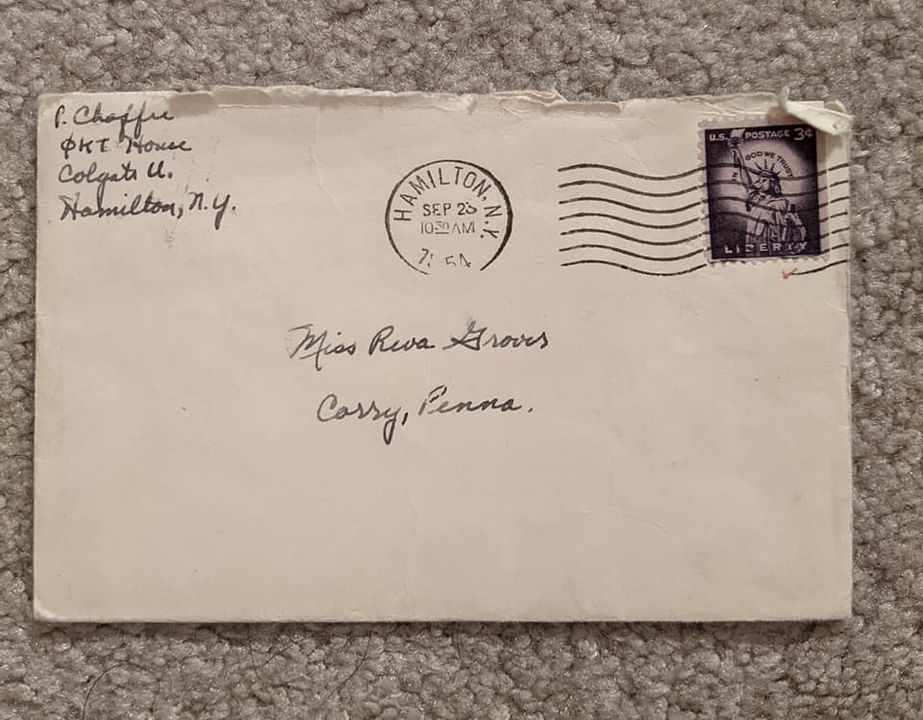
But dad couldn’t forget her. So from his dorm room at college 300 miles away, he wrote her a letter, telling us that the envelope had nothing more than her name, city, and state (this was pre-zip code days). He mailed it on the truly off chance that she would ever receive it.

And thank goodness for small towns, because the letter found its way to her.

The actual letter my dad sent with only my mom’s name and her city and state because that was all the information he had. Notice the cost of the stamp (3 cents!).

My daughter went to mom’s “hope chest,” which has been in their bedroom for my entire life. Sure enough, buried beneath various memories was a box of every letter she and my dad exchanged, starting with this one. We couldn’t believe we had the actual letter!

Of course, we wondered what in the world dad had said in this letter so, with his permission, we pulled it out and read it aloud. The letter began: “9/23/54 Hi, This is going to be a shot in the dark if I ever made one.”

Then, of course we wondered what she had said in return. Finding that letter, we pulled it out and read it aloud.

My dad, leaned back in his easy chair and said upon our finishing that letter, “Well, don’t stop now!”

So began an evening reading each back-and-forth letter as my parents, having only met once, began to learn about each other. They asked questions about family and about faith. There were local Corry football scores from mom; tales of fraternity life, final exams, and chorus travels from dad. The letters became more and more frequent with Thanksgiving being their next opportunity to meet. Clearly their first official date and time together went well, for the post-Thanksgiving pre-Christmas letters become more frequent, all the while both of them counting the days until Christmas when they would meet again (on her birthday, December 24).

Clearly, they had fallen in love over the Thanksgiving holiday and knew that Christmas was going to be very special.

Dad’s college photo on the left, mom’s high school photo on the right. Left bottom is the photo of mom pinning dad’s wings on him as he graduated Air Force ROTC from Colgate University in the spring of 1955.

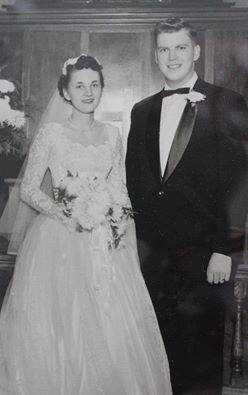
Indeed, another set of letters from January to May surely lays out their future (we didn’t have time to get to those letters; dad said they were probably pretty mushy anyway). That next summer, after dad graduated from Colgate University, he proposed to mom and they were married in Corry, PA, on November 5, 1955.

Mom and Dad’s wedding photo.

Before she passed away, they’d had 66 years of marriage.

During those 66 years, they had also weathered a separation for eight months while my dad served his country in Viet Nam. Also buried in that hope chest are eight months’ of daily letters back and forth between them. A future task for me is to transcribe all of those letters, along with daily entries from my dad’s journal while he was there, as a legacy for our family.

I can’t help but feel that, in the future, we’ll be missing something of our heritage for our children and grandchildren and beyond without having physical letters. While I’m sure my dating parents would have been delighted by the technology of texts and phone calls without the prohibitive long-distance charges, I’m thankful they wrote (and my mom saved) these letters. It’s a window into their story.

A story that has become my own.

6 Masks I’ve Worn This Week: Pros & Cons

It’s a brand new school year and a brand new way of thinking and teaching. If I thought that going completely online with my classes last March was a challenge, I’m now trying to teach in masks. Below are pics of me trying these various masks and the pros and cons of each. 

I’m only a few days in and already trying to determine what’s going to work for me. I started with the standard mask that I’ve been wearing into stores since March.

Pros: Lightweight and easy to wear, easy to speak through. Cons: Soooo boring.

I purchased some nicer, heavier-duty masks that I thought would be healthier by maybe screening out those germy germs better …

Pros: Heavier duty (keep germs out better?). Cons: These pull on my ears and begin to give me a headache during an hour of teaching.

Received this cute one with cats on it from my sister. (Does anyone else find it odd that these masks are now fashion statements?)

mask-2
Pros: So cute! And so appropriate.
Cons: Kept slipping down as I talked and needed to constantly readjust. Best for wearing when I’m not going to be doing a lot of talking.

Received this one from our department chair who felt it would be especially appropriate for me.

mask-1
Pros: Yay for a grammar mask! Cons: Kept getting caught in my mouth as I talked. Best for silently correctly people’s grammar.

Got hold of this one because … well … school spirit.

mask-3
Pros: School colors, school logo. Comfy. Cons: As with most of the other masks, a bit of a fogging issue on my glasses.

But still, the issue became that I really like to smile at my students. It’s bad enough that I’m looking at masks and eyes and receiving very little feedback visually. It seems worse that they can’t get any kind of visual feedback from me. So I have now opted for this:

mask
Pros: I can smile at my students and they can see it. Cons: I look like a welder. It messes up my hair. When I speak, it goes straight into my own ears so I feel like I’m in an echo chamber. Beware of a sneeze or spit. Can’t wave my hands a lot. Can’t scratch my nose or eyes. Oh, and I can’t take a drink with it on, unless I have a loooong straw.

So, why choose the one mask with the most cons? Well, I feel like the ability to offer some kind of visual feedback to my students is very important — hair, spit, echoes, itchy nose, and all.

Around campus, I’ve seen masks of various materials, colors, and styles. We are indeed making these into statements to try to reflect a bit about ourselves, even … ahem … behind the mask.

What about you? How are you dealing with the masking situation and what are you doing to make your masks reflect you?

Good Old Summertime: Or Why I Got Nothing Done and I’m Okay with It

I truly tried. I had a list. I had a schedule. I had good intentions. I was going to GET STUFF DONE.

Write some articles. Work with writing prompts. Submit. Start a more vigorous exercise program. Learn InDesign and Google Analytics. Write some letters.

Image courtesy memegenerator.net

Instead, you know what I did? Not that.

I rested. I slept. I read books. I spent more time in God’s Word. My husband and I spent many hours deciding on paint colors for our three rebuilt rooms. I cheered him on as he painted all those rooms (I offered to help, but he knows my shoulder problems would only be made worse). We brought some furniture to replace what was destroyed in the fire. We bought a dining room set at a garage sale. We planted and maintained our gardens.

Painting, painting, painting.
Butterfly garden in its third year. Mostly perennials, a few annuals.

I freelanced on a manuscript style tagging job. I ran our Taylor University Professional Writers’ Conference again — only virtually this time, with great help from my Taylor University IT friend and fellow writer and editor T.R. Knight, who managed our Zoom conference with great skill and patience.

But, honestly, I feel like I accomplished nothing.

I frustrate myself so often. What is it that makes me create lists and check off the little tasks (buy coffee) but let the bigger ideas, the longer-term items (finish that creative nonfiction article) go from week to week in my schedule book, carried over as if I can do so indefinitely?

What makes those writing tasks so hard for me?

Some if it is rejection. Some of it is imposter-syndrome. Some of it is being just plain tired. I could blame the pandemic and all of the stress of online teaching this past spring. I could blame the pandemic for lack of personal contact with many of the people I love most. I could blame the worries over the many issues bombarding our world today and how my brain is tired trying to navigate them. I could blame our house rebuild that has dragged on because of scheduling issues with various contractors. I could blame my age.

OR I could just let it go and say it’s okay. I did what I did and it was all good. Time with books and in God’s Word and resting were probably what I most needed considering everything else going on in my life and in our world.

Yeah, I think I’ll go with that.

I’m a Type A personality who always feels the need to “be accomplishing something.” Everything I do needs to be something I can check off a list or post on Goodreads or have something to show for it. My writing so often doesn’t. It sits on my computer because no one else should ever see it. Or I took the chance to send it out and get rejected.

Maybe I need to add “take a nap” and “get a rejection letter” and “write X number of terrible pages” to my daily to-do list.

That’s actually not a bad idea. I could at least trick my brain into thinking I’m accomplishing something. I already know that rejections and terrible pages are the stuff of good writing (well, probably naps as well).

And I’m okay with that.