Words Matter (and So Do Fish)

Thought you’d like to see a glimpse of my fan club.

My fishy fan club.
My fishy fan club.

Seriously, these little guys totally love me. They’re like groupies (not group-ers, group-ies). Whenever I walk outside my back door into the garden, they all come as one and follow me as I walk by. They dog-paddle (fish-paddle?) at the edge of the pond and watch my every move.

They totally love me.

Or, more likely, they totally think I’m going to feed them.

But still . . .

I like the fact that they notice me. I think it’s funny how they come as an entire group with their little mouths up out of the water looking at me so longingly.

When we moved into this house a few years ago, the little pond was already there with all of these fish (a neighbor recently ‘fessed up that she had taken some of the overflow from her pond and dumped them here during the year that the house was vacant). We had moved in at the end of October and didn’t have a clue what to do to winterize a pond. We figured that the house had sat vacant the winter before and no one had done anything, so we’d just let it go and see what would happen. Sure enough, the little pond froze over and got covered with a layer of snow. We figured we’d have to skim out the dead fish and start over come spring.

Then, as the water thawed, so, apparently, did the fish. By the time the Indiana air turned warm, the fish were back to their usual selves.

The moment I drop some fish food in the pond, I’ve got myself a fan club.

Wouldn’t the writing life be nice if we just dropped a few of our choice words into the world’s pond and we suddenly had such loyal fans? Fans who waited on our every word? Fans who knew we posted on our blog every week and sat by their computer, eyes wide, mouth agape, waiting for us to toss the morsels their way?

Eh, maybe not. fishies2

I just reach into the bag of fish food and toss the same morsels to those fishies every day. And they love me for it.

I can’t do that with my writing. I’m not looking to recycle a formula or take the easy route. In my blog post a couple weeks ago, I talked about the hard work of writing. Our words matter. That’s why even though only a few people may read something we write, we still agonize over what we want to say. We want to represent ourselves well, say what we mean, write something that will be enjoyable or helpful or compelling or inspiring to those folks who take a few minutes of their day to read our musings.

We do that because our writing matters so much to us.

We do that because we instinctively know that the words we put out there can have a life of their own.

Back before everyone was blogging, before Facebook and Twitter, I had a couple little books published. They’re long out of print, so imagine my surprise when a couple of years ago I found one of those books at a garage sale. (You know you’ve arrived when you find your book at a garage sale.) Then, a few years after that, when everyone was blogging and Facebooking and Tweeting, my son sent me a link to a YouTube video a woman had done to recommend another of my books.

Our words live on.

So I guess that’s my encouragement to my writing friends. You never know when a piece of your writing will rise again. Even if a book you wrote years ago went out of print causing you untold despair, it still lives on.

I tell students in Writing classes that they never know how or when a piece of writing will inspire someone. That’s why it matters so much. That’s why we do that hard work of writing. We put ourselves out there because we have something to share and we want to join our friends in digital conversation.

I’ll never know the paths my words have taken. I only know that they’re still out there with little lives of their own.

Our words matter. They live on.

Just like my fishy fan club.

A Classic Summer (#tweettheclassics)

I have plenty to do to keep myself out of trouble this summer, what with fish to feed and gardens to weed and cats who keep having kittens and a research project to finish and a syllabus to write, not to mention the great time to be had at the Midwest Writers Workshop at the end of July.

But what is summertime about if not reading? I’ve been focused on the books I’m reading for my classes, and in the fall I’ll be up to my ears in Shakespeare and the English Romantics, so I’m enjoying this little window to choose my own reading. I got inspired by my summer intensive class where I read:

The Great Gatsby
The Great Gatsby

The Blithedale Romance–Nathanael Hawthorne
Their Eyes Were Watching God–Zora Neale Hurston
The Great Gatsby–F. Scott Fitzgerald
Frankenstein–Mary Shelley
The Awakening–Kate Chopin
The Adventures of Huckleberry Finn–Mark Twain

I also reread Crime and Punishment (just for fun) by Fyodor Dostoyevsky.

Now I have decided to devote this summer to revisiting some classics. Here’s what’s on my reading list for the remainder of the summer (so far):

Moby Dick
Moby Dick

Moby Dick–Herman Melville
The Adventures of Tom Sawyer–Mark Twain
The Scarlet Letter–Nathanael Hawthorne
The House of the Seven Gables–Nathanael Hawthorne
A Portrait of the Artist as a Young Man–James Joyce
Uncle Tom’s Cabin–Harriet Beecher Stowe
Walden–Henry David Thoreau

So what are some of your favorite classic books?

And how about a little challenge. . . . What if I asked you to tweet the classics?

Join me at #tweettheclassics on Twitter (@LindaEdits) and see if you can condense a classic work into about 100 characters (you need to save enough room to add the hashtag and at least some of the book title).

Here’s what I have so far:

In class, we talked about how Dr. Frankenstein (remember the creator is Frankenstein; the monster is not named) is so narcissistic, so self-absorbed, that he willingly lets the monster dash about the countryside killing people because he’s unwilling to deal with the consequences of his actions. In the end, Dr. Frankenstein is more like a monster than the monster himself.

Here’s another one:

Everyone was so willing to party for free at Gatsby’s house, but, despite Nick’s Carraway’s best efforts, “nobody came” to his funeral. Not even Daisy, the object of Gatsby’s obsession. You’d think she could have torn herself away for a few moments? You’d think that the obvious fact that Jay Gatsby took the bullet (literally) for her killing a woman might have softened her narcissistic little heart? But no.

Speaking of narcissists:

I had never read The Awakening before. Edna Pontellier is such a complex character, but I have to say I’m glad she isn’t in my circle of friends or family. Sure, she’s trying to be empowered. Sure, she’s trying to find herself. Sure, this was the timeframe when women didn’t have the opportunities that we take for granted (they couldn’t yet vote, for pete’s sake). But her self-centeredness grates on me.

So here’s my challenge to you. Can you tweet the classics? Either sum up the book in those few characters or tweet a favorite (short) line. Put the title of the book with a hashtag and “tweettheclassics” with a hashtag. I have a column on my Tweetdeck so I can see what we get! I’ll feature some in future blog posts. I’ll be adding more of my own as well.

The Hard Work of Writing

“Do what you love and you’ll never work a day in your life.” I’ve been guilty of saying just that to students in my Editing class. And while it’s true that I get to do what I love (and that, in itself, is a blessing), it’s not true that I’ve never worked. Many many days have been “head-down-plod-through-get-it-done-keep-going-don’t-give-up-the-manuscript-is-soon-ending” kind of days.

Editing is hard work.

And so is writing.

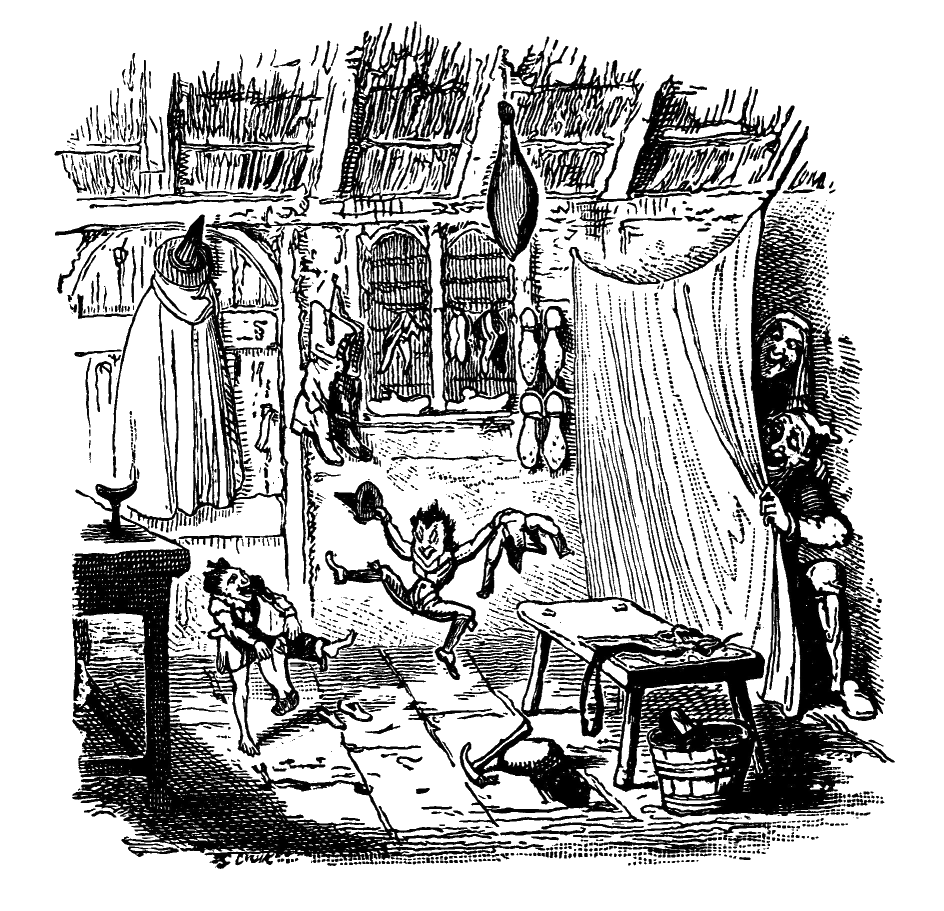
So my friend Kameron McBride (a BSU student and Midwest Writers social media intern) writes in his blog and makes the point that, indeed, writing doesn’t just happen like the cobbler going to sleep while the elves make the shoes. It’s sweaty, difficult, and painstaking work. We don’t (ever) wake up to a manuscript magically completed.

An illustration for the Brother's Grimm story "The Elves and the Shoemaker"
An illustration for the Brother’s Grimm story “The Elves and the Shoemaker”

So it’s a good thing we love it!

To be good at writing takes constant practice. Another BSU student and MWW social media intern John Carter discusses the importance of trying to create a schedule to keep him writing regularly over the summer. Then, of course, once “real life” is in place and summer vacation is a thing of the past (at least if you aren’t in academia), then that schedule and routine will be invaluable.

My friend L. Marie has been posting lots of writing process interviews. We writers must juggle life and overcome fear and discouragement. I love her post about this. (And, if you want more, read her whole lineup–especially if you’re into YA.)

Yep, this writing life is hard work–discouraging at times, frustrating, often unrewarded (except when we’re outstanding in our own minds).

And, like any skill, we need to work to improve. Sure, maybe some of us were born with an innate ability to put words together, but that doesn’t mean we shouldn’t continue to learn or to hone our craft. As Barbara Shoup (director of Indiana Writers Center and, incidentally MWW faculty this year) points out in this blog post, the craft can be learned if you’re patient and willing to work at it.

Work at it.

Here’s what my friend and mentor Cathy Day says about it:

Convincing yourself each day to keep going, this means that you are a writer. The world will be sure to declare, “You matter, but you don’t. Wow, your work is exciting, but yours is old fashioned and dull.” What do you do when someone says, “Eh, you’re okay, I guess.” Do you stop? Or do you keep going? That’s the moment when you know whether or not you’re a writer.

Cathy says, “You must do it simply because you want to.”

Kind of like what Mo Smith (yet another MWW social media intern) describes here.

And it’s hard work.

But therein lies the glory. We want to do it so much that we’re willing to work at it. To stare at the screen on the tough days. To get up early and write when that’s the only time available. To keep on plugging when it fights against us.

That’s the hard part for so many. I hate to sound like an old fuddy-duddy (even if I am one), but in a culture where crimes are solved in a TV hour and purchases are made immediately online and we get upset if someone doesn’t answer our text within 60 seconds–well, have we lost what it means to work at something tirelessly?

We each have to answer that for ourselves.

Love Those Summer Interns

One thing about teaching is the enjoyment I get from watching my students take what they learn and use it. I have to admit, I love the feeling of giving them something that will help them land a job and succeed at it.

That’s why I love teaching editing. I tell my students that if they can master the skills I try to teach them, they’ll have a foot in the door for working in publishing.

So I love it when summer comes and my students are interning somewhere. For instance, Nathan tweeted this last week:

It isn’t easy, Nathan, but it’s a great lesson.

Speaking of great lessons, I guess he learned this one yesterday:

It may have been because of this . . .

Then there are the shoutouts that let me know that what I’m teaching does matter and is helping them in their professional lives:


Yep, working with style tags is vital. I tell my students that learning this will give them a huge advantage and so much value to their supervisors. My students learn how to work with the technical side in order to prep a manuscript for typesetting and for e-booking.

And according to Alex, I guess I was right!

Alex is also getting some terrific hands-on editor-style training:

I’m so thrilled that the publishing houses where these students are interning are giving them more responsibility than just sorting, filing, or making coffee. They’re getting real world experience, they get to see the publishing process up close, they get to get their hands dirty (well, in Nathan’s case, perhaps learning how to stop the printer in the middle of a several hundred page manuscript).

As someone who, in the business side of my life, has worked with interns, I know it can feel a little overwhelming trying to train another person and keep him or her busy on top of your own work. But also as someone who teaches in the college classroom and attempts to prepare my students for those internships (and indeed find them), I thank you from the bottom of my heart. What you’re giving to these students–your knowledge, your expertise, your skills–is invaluable.