A Little Language Etiquette

I love to haunt old bookstores. Even at Goodwill or the local resale shop, you’ll always find me, head turned sideways, scanning the titles of those used and lonely books.

cat
When scanning bookshelves, I look sort of like this.

There’s just something about used books. Our shelves at home are groaning under the weight of books because, when my husband and I want to go “shopping,” we both know that we’re heading to a place where we can look for books.

We bring them home, often wondering why we thought we needed more and, more importantly, where we’re going to put them. But that’s just a minor issue for us book lovers. We always find a way.

This past summer I came across this wonderful little textbook that I must share with you. It’s titled Language Etiquette, copyright 1949. From what I can tell, it’s an elementary school grammar text.

Here’s the cover. First, I have to say that I just love this snotty girl being rude to the friendly red-haired guy, tipping his hat at her. What is that about?

eti-3
Umm, I guess the guy used bad grammar?

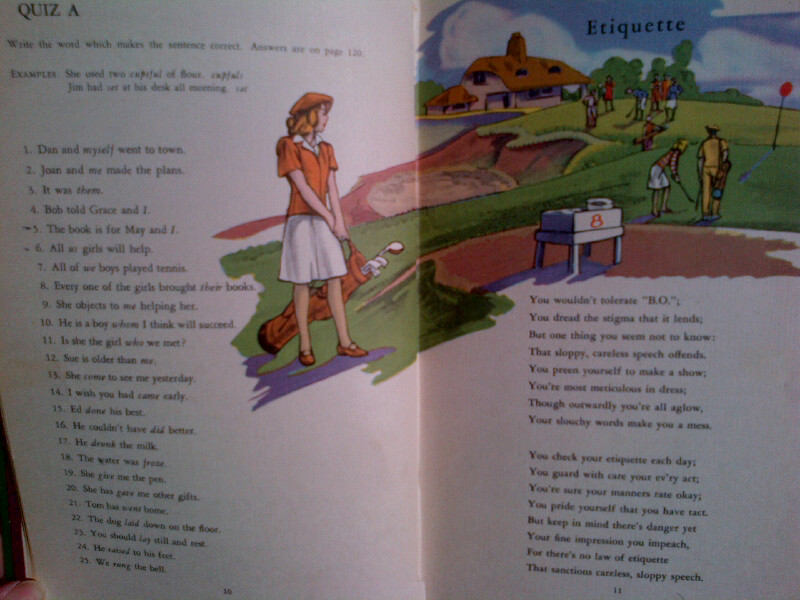
Then, as I work my way through the book, I’m treated to rules of grammar and usage laid out in numbered lists, quizzes, and several poems to, you know, drive home the point. Like this gem titled “Etiquette”

You wouldn’t tolerate “B.O.”;
You dread the stigma that it lends;
But one thing you seem not to know;
That sloppy, careless speech offends.
You preen yourself to make a show;
You’re most meticulous in dress;
Though outwardly you’re all aglow,
Your slouchy words make you a mess.

You check your etiquette each day;
You guard with care your ev’ry act;
You’re sure your manners rate okay;
You pride yourself that you have tact.
But keep in mind there’s danger yet
Your fine impression to impeach,
For there’s no law of etiquette
That sanctions careless, sloppy speech.
eti-1
I have no idea why the drawing here features golfers.

Or this one, titled “Super ‘Guy'” (I really don’t know why “guy” is in quotation marks):

You know that you’re a super “guy”–
Your mom has often told you so;
In looks and brains you rate so high
No triumph that you may not know.
Though you’re so sure you’re “on the beam”
To high performance that you’d reach,
He seen and knowed may spoil a dream–
There’s sabotage in vulgar speech.

Though you possess a super mind
And strut in fashion ev’ry day,
If speech you use is unrefined,
You’re still considered just a “jay.”
Of highest triumph you’ve no doubt;
You’re sure you look like Robert Young;
But you’ll be rated super lout
While you’ve a careless, sloppy tongue.

eti-2
So, the guy in the suit speaks better than the guy in the wagon with the donkeys pulling it . . . apparently?

Well, if that doesn’t convince you not to be a lout, I don’t know what will!

But I have to say one good thing about this little book. Several pages have lists with guidelines for having good manners in conversation. So this was more than just a textbook about grammar and grammar usage, it was also offering to those elementary-aged minds advice on being decent human beings when it comes to speaking and having conversations.

Some of the points are a bit dated (i.e. “A lady keeps her voice low and quiet”), yet overall, I find a few pieces of etiquette advice that we ought to take to heart. Today, some of my students were sharing in class about various other social media sites that writers might want to use as they build their platforms. We were warned about a couple of them because of “frequent vulgarity” or just plain “meanness” by users.

What is wrong with our world? What happened to decency, niceness, etiquette? So for our edification (and maybe a few politicians might take heart, along with the “mean” folks on social media), I offer a few chosen language etiquette rules circa 1949 yet so needed today:

  1. You are judged by your conversational manners.
  2. He who talks most loudly is not necessarily he who talks best.
  3. No gentleman enjoys talking smut with a girl. (Is this not priceless?)
  4. Your conversation shows what you are–regardless of exterior signs.
  5. Don’t be an overwise, know-all.
  6. Always congratulate your successful rival.
  7. Malicious gossip appeals only to little minds.
  8. It is difficult to be a good listener, but it pays to try.
  9. It is much better to be silent than to say too much.
  10. Use tact and common sense–lest you hurt someone.
  11. Don’t interrupt or contradict without a very good reason.
  12. Try to say that which gives pleasure–don’t cause pain to others.

A little etiquette might go a long way. And I think today, in our social media world where we can say whatever we want either anonymously or without having to deal with a person face to face, we have become far too “vulgar” and “mean.”

I may think the poetry is hilarious, but many things in this little book are on the mark.

If you could create language etiquette rules for today, what might you include?


Cat image courtesy of: https://goo.gl/images/TvMfdR
Looking Back, Looking Ahead

It’s the end of the year, always a time to look back at the past year and look ahead to the future. I believe a few thank-yous are in order.

Thanks to my family for supporting me in my crazy schedule when at times a week or more would go by and I barely came up for air, much less cogent conversation. My husband for standing behind me and being my sounding board. My children, I will always worry about you even though you’re off on your own with jobs, marriages, children, but thank you for being so resourceful, happy, hard-working, and faithful. I miss you like crazy and wish I could see you more often, but you have to be off doing what God has called you to do. My five grandchildren are adding a new dimension to my life. Again, I wish we lived closer, but the times I get to see you are full of so much joy that it carries me along — at least for a little while. In the in-between times I send you lots of prayers. My family is there when I need them, providing a safe harbor in life’s storms.

Thanks to my students. You give me a reason to get up in the morning and joy in my work that I never knew I could have. I love opening my office door every morning, planning my lessons, and trying to give you tools that will carry you into awesome writing and publishing careers. Your enthusiasm in the classroom, your hard work on the assignments, and your willingness to cut me some slack (I’m still new, after all, and learning the ropes) keep me fulfilled and happy and constantly trying to improve.

Thanks to my fellow students and mentors in my MFA program. I love being a student again, and I am so thrilled to be getting to know you. You amaze me with your writing and your insights into my writing. You’re helping me to write better and encouraging me in the daily grind. You’re giving me tools to use in my writing. You inspire me. I love how different we all are yet how much we love the art of writing.

Thanks to my friends past and present who encourage me with your Facebook posts and your blogs about your lives. You’re raising amazing families and doing amazing things. Sure, we may have our differences spiritually or politically, but we have made great memories and I’m so glad we’re still in touch.

So going into 2016, I have a few goals:

  • Call my various family members once a week. Life is all about relationships, and my family means the world to me.
  • Write to my grandchildren those old-fashioned things called “letters.” I started this last year but didn’t keep it up very well. I need to do this at least twice a month to all of them.
  • Write every day–for publication, for my MFA thesis, for myself. I have gotten lazy in this area, discouraged at times. But if I make it a goal in front of all of you, I will be more inclined to do it. My goal is 500 words a day.
  • Read at least two books a month. I’d really like to do more, but I don’t want to overextend myself.
  • Blog twice a month.
  • Continue to be a good literary citizen sharing others’ work and encouraging fellow writers and writing teachers.
  • Run a 5K. I’m working with my trainer to prepare for this. It’s sort of a bucket list thing, but I plan to be ready in May.

Thanks to all of you who check in and read. I appreciate you. Wishing you a wonderful new year!

It’s Hard to Say Good-bye: The Annual Heartache of a College Instructor

When I signed on to teach at the college level–first as an adjunct and now as a full-time instructor–no one told me that every year in May I was going to experience the heart-throbbing pain of good-byes.

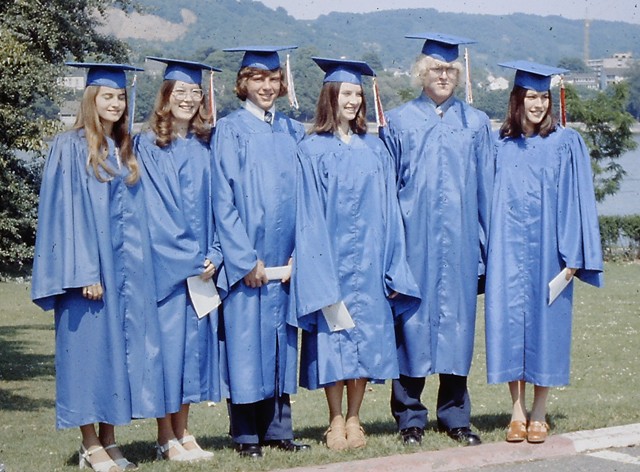
Don’t get me wrong. I’ve said a lot of good-byes in my life. I grew up as a military kid and we moved a lot, so good-byes were pretty standard fare. I went to high school in Bonn, Germany, at what was then Bonn American High School (Go Crusaders!). After our class of fifty-some students moved the tassel in 1976, we scattered all over the globe (literally–and I am using literally correctly).

Some of my fellow graduates. BAHS 1976. That's me second from the left. Our tassels were red, white, and blue to commemorate America's 200th birthday.
Some of my fellow graduates. BAHS 1976. That’s me second from the left. Our tassels were red, white, and blue to commemorate America’s 200th birthday. By the way, that’s the Rhine River behind us.

Then, after college, I said good-bye again to dear people who had been my roommates, my suitemates, fellow residence staff, professors, and friends.

Good-byes are never easy.

So no one warned me that now every year I would have to say good-bye to an entire group of students that I had come to love–literally. Students I had watched grow into great writers. Students I had talked to about their future dreams and plans. Students I had prayed for and with, cried with, laughed with. Students who, each year, taught me a little more about myself.

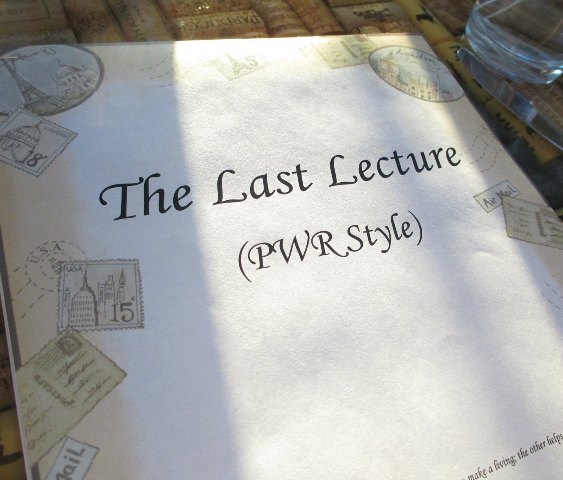
This evening we had a dinner to honor our seniors. Yesterday one of them asked that each of the profs in the department provide a letter to all of them, a “last lecture” of sorts. We wrote those letters, and she put them into a packet for each senior.

I thought long and hard about my letter. Writing should be easy, right? I’m a writer, right? But what do I say? What words of advice can I possibly give to these young people moving the tassel and scattering to the winds?

I told them to expect bittersweet. Graduation has been in their sights for years–but when it comes, it also means good-bye. And that’s hard. It means for the first time in four years they may not know where they will be come August. That can be frightening.

I told them to expect loneliness and confusion. Even if life is mapped out, even if there’s a job or grad program waiting and a wedding in the works, there will be times when they will miss the craziness that is dorm life. They’ll wonder if they’re making the right decisions. If they’re still job hunting and spouse hunting, at times the loneliness can be overwhelming.

But lest you think I’m Negative Nellie (or maybe just Realistic Rachel), let me assure you, I am all about the positive. I just want them to not think they’re alone when those feelings hit.PWR10

I also told them to keep the faith. Follow their path and stay close to the God who brought them this far and has a plan.

I told them to live this crazy adventure called life to the fullest.

I told them to keep writing and to expect rejection (yes, Realistic Rachel, it happens all the time) but to keep writing anyway.

I told them to stay in touch with one another and to continue to encourage one another in life and in writing.

I told them to find their tribes “out there” and to go to writing conferences just to remember what it’s like to be around a writing community.

I told them that they have a gift–the gift of words. Open it, enjoy it, share it, use it.

Good-bye, dear seniors. Thanks for being part of my life.

Getting Published–and Not Even Knowing It!

It’s an odd experience to get published and not know it.

I suppose I should be glad, but it wasn’t something I ever submitted, nor did I write it for publication.

Let me explain.

Over Christmas I was visiting with family in Corry, a small town in western Pennsylvania. My sister happens to be quite the photographer and recently had two of her large photographs on display at the Painted Finch Gallery in Corry (displayed, that is, until both sold at a juried art show!). Anyway, several of us made a stop in at the gallery on Christmas eve. The gallery is an eclectic mix of wildlife oil paintings, flowers and scenery in watercolors, color and black-and-white photography, pottery, jewelry, and work in other types of mediums that I, as a non-artsy person, can’t name but can appreciate.

While the others chatted with the proprietors, I wandered. In the back, near a glass case holding jewelry and pens, was a small holder with some greeting cards and a couple of paperback books.

Of course, I picked up the books.

One was a little paperback history of the town of Wattsburg, Pennsylvania. The little borough of Wattsburg, nestled about fourteen miles northwest of Corry, happens to have been my dad’s hometown. My grandfather had lived there most of his life–even was the mail carrier for many years (I talked about that in this post). We visited nearly every summer with him and cousins who lived nearby.

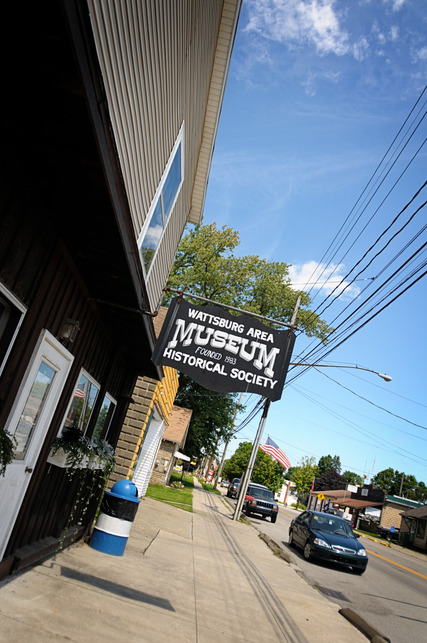
The Wattsburg Historical Society

Some of my fondest memories have to do with the Erie County Fair held annually at the Wattsburg fairgrounds. Gramps was in charge of the concessions at the fair for many years. As a young child, walking through the midway with gramps was magical. Everyone knew him. I remember him motioning to one concessioner after I had spotted among his prizes a Barbie-type doll in a beautiful lace wedding gown. Next thing I knew, the doll was in my hands. (I’m sure he settled up later.)

Many years passed and, either in high school or college, I wrote an essay about the fair and grandpa. Later, I mailed it to him, thinking he would enjoy my reflections. He passed away not many years later.

So at the art gallery, I thumbed through the book about Wattsburg’s history filled with quirky stories, anecdotes, and people’s memories. I went to the spine and copyright page (hey, I’m in publishing–it’s a habit) and saw that it was self-published. The introduction stated that the material in the book had been gleaned from the Wattsburg Historical Society. Flipping pages revealed an index in the back. I wonder if gramps is in here, I thought. Chaffee, Chaffee–there he was!

And, to my surprise, so was I.

Wait. What?

Page 49. What’s on page 49?

And there, to my astonishment, was my little essay about gramps and the Wattsburg fair.

I’m guessing that gramps received my essay in the mail and stored it among his fair papers, most of which apparently ended up in the historical society. The editors of this collection must have discovered the typewritten pages (or maybe they were handwritten, I can’t remember) among the papers and decided to publish it in this collection.

It’s a little embarrassing to read the musings of my early life (not to mention my immature writing style) from so many years ago. In the midst of my article, the editors had put a black-and-white photo of the fair committee, and among them is my dear grandfather.

So as odd as it is to be published without knowing it, I suppose for the audience of this particular book (one being my dad, who received that book the next day as a Christmas present), my little essay might bring back some good memories.

If my writing can do that, I suppose that’s all I can ask.


Photo courtesy of http://www.city-data.com/picfilesc/picc64500.php


5 Notes about Being an Old(er) Student

Just as, over three decades ago, I entered college with fear and trembling, I did the same when I decided to go back to continue my education. When I graduated with my BA in 1980, I swore I would never go back to school. I am a perfectionist and I put myself under so much pressure. When I got out, I couldn’t wait to just have a normal life. And, to be honest, an advanced degree probably would not have made a whole lot of difference on the path I chose since experience has been my trump card.

However, when I decided three years ago that I wanted to teach at the college level, the doors were closed without an MA. And so, I once again entered the academic setting as a student with classmates as old as my children. Here are my words of advice to you if you’re middle-aged (or older) and considering going back to school. gray hairs

(1) Scope out all the options.

Depending, of course, on what you’re studying and what degree you’re pursuing, there are technical programs, low-residency programs, online programs, and traditional on-campus programs (full and part time). Online may be right for you given your job and other life circumstances. Low-residency means that most of the coursework is done online and then you travel to the school for an intensive class time. Schools are different–it might be two weeks twice a year or four weeks in the summer, etc. The point is, as you consider continued schooling, think about how you might work best.

If you’re near a campus that has a terrific on-campus program, don’t be afraid to try it because you’re “too old.” Yes, it’s a little scary but the amazing folks I have met, the new friendships I’ve made, and the new connections I’ve forged have made it all worthwhile. (And I’m an introvert!)

By the way, if you do this, you’re called a “non-traditional” student.

(2) Know your reasons and be ready to commit.

In this economy, many folks are heading back to school to get that extra edge they hope will help them get a job. You have to carefully weigh the cost of school versus what the outcome may be. It’s an expensive endeavor and should be entered into wisely. You can get loans if you go at least half time (most places). One good thing about being our age and heading back to school is that we often do have a pretty specific picture of who we are with a lot of years and experience under our belts. I had a specific goal in mind when I started and a reason to be there. That helped me keep going when the going got tough.

And you have to think about being a student–it’s a different mindset. This article (and the accompanying links) has tips for remembering how to be a student when you’re older. At least, at this point, you probably know that pulling an all-nighter is not a good idea . . .

Getting through any program will take some time. Are you ready to commit to one, two, three years? Are you prepared to plod through a class at a time? Can you set aside several hours a week to study and do homework? If you decide to do an online program, are you self-disciplined enough to stay with it?

(3) Let your life experience work for you.

Chances are you’re contemplating a particular program because you want to finish something you started or because, over the course of your lifetime, you’ve discovered a gift or desire that you never saw before and you want to see where the study can take you. You’ll be in classes with younger people who are still trying to figure out what life holds for them. You’ve been there. In one sense, you’re still in the process of discovery by going back to school, but in another sense you’re bringing loads of life experiences to inform your studies. No one is a blank slate, but your slate is probably really full. Don’t apologize for that. Embrace it. This article discusses some of the advantages you have as an older student–and they’re good ones.

My friend, L. Marie, writer and blogger, went back for her MFA later in life. She says, “I was a little intimidated at the thought of returning to grad school after so many years. But at Vermont College, I didn’t have to feel that way. In my program, Writing for Children and Young Adults, there were many students my age and even older. I love that!”

(4) Get to know your professors.

I said this in last week’s post for young students, but it’s no less true for you. Many of those professors may be younger than you, but place yourself in their classroom as a sponge ready to soak up whatever you can. I find that I am so ready to learn because going back to school is a very intentional choice for me and I want to get everything out of it that I can. You’ll find that as well.

(5) Get to know your classmates.

No, you probably won’t hang out together, but do your best to make them comfortable with you and you’ll be more comfortable with them. No, you’re not a kid anymore, but learn what you can from this next generation. To me it’s fascinating to be in a classroom with students who have always had computers and who have worldviews shaped by the fact that they can access so much information at any moment.

Besides, they help me figure out my Twitter account . . .

5 Notes to My Younger College Self

Well, another semester nearly done (being back in graduate school and doing adjunct teaching has suddenly put my life in the “semester” track again). One more semester to go in graduate school and the MA will be mine! One more final and I’ll send another batch of students out the door and on their way.

I realized last night that some of my new Ball State grad school friends are graduating and moving on. I said good-bye to one who’s heading to her doctoral program in another state in September. I was just getting to know her! And several of my Taylor students are graduating. This will be the tough part of teaching. Getting to know students, investing in their lives, and then letting them go. (It’s too much like being a parent!)

credit: istockphoto
credit: istockphoto

I’ve been thinking a lot about the dichotomy of being–at the same time–an old(er) graduate student and a professor of students who are my children’s ages. So here, for what it’s worth, is my advice to my younger self about how I would have done school differently if I knew then what I know now (and next week, advice to others, old like me, who are thinking about heading back to school).

(1) Take advantage of every opportunity you have to spend time with your professors.

I’ll say it. I was terrified of professors. They were “up there,” I was “down here.” They held my future (or at least my GPA) in their hands. I stayed as far away as I could.

Now that I’ve been a professor, I realize they’re just folks. Of course a lot more knowledgeable about said topic–which is why they are teaching–but many of them chose this profession because they really like students. My son told me he was able to talk more easily with his professors once I began teaching because he realized they are just people who have kids and take out the trash and mow their lawns and even cry sometimes.

Ask a professor to lunch or coffee. Take advantage of office hours to have a chat at some point in the semester. They really love that. They have a lot of life experience that they can impart. Draw from what they’ve learned.

(2) Don’t let fear about the future overwhelm you.

I’ll admit it . . . I wanted to be married. I wanted to have my dream job. And I wanted it all right then (or anytime during the month of May 1980 would have been fine). That moment when you arrive home after those four college years can be the most depressing of your life. “Now what?” Suddenly the comfort of knowing what’s happening in September is gone and the future is an empty road. As a Christian, I can encourage you that the plan is in place and all you need to do is take a step at a time. The road will turn and maybe lead you in unexpected places. Follow it. Of course be wise and strategic, but be open to surprises. God’s plans are way better than our own anyway. And don’t be afraid of being unmarried when you graduate. The right person will come along at the right time. Trust me.

(3) Follow your passions.

I ended up in publishing because I did what I loved. At college, when that moment of declaring a major arrived in the fall of my sophomore year, I panicked. I literally got out the college catalog, sat on my groovy bedspread, and figured I’d find out what Houghton offered. As I read through the majors (Accounting? gag. Biology? puh-leeese. Chemistry? not on your life), something jumped inside me when I hit it: English. “I can read my way to a major? Sign me up.” I followed what I was hardwired to do–love words. I signed up to double major in Writing (once I got to W in the catalog) and never looked back.

My path wandered various directions, but I believe God wastes no experience in our lives. And sometimes it was a few surprises from him that put me in the right place at the right time. I’m passionate about what I do. I absolutely love it. If you follow those God-given gifts, you’ll feel the same. As noted in #2, don’t worry about the detours. If you have to have a job at Starbucks or Babies-R-Us for the time being (I’m looking at two of my beloved kiddos), enjoy it, learn from it, do your very best at it. Keep your passion alive by working at what you love on the side.

(4) Stay in contact with your grandparents (or other significant family members).

And I don’t say this as a new grandparent. You’re busy, you’ve got so much going on, you’re doing your darndest to separate yourself from your parents and get on with your life. I get it. That’s all good and necessary. But please in all of the drama of your friendships and love life and future plans, don’t forget your grandparents. Stay in touch. Call grandma up once in awhile. Give grandpa an update. Those people are gone too soon from your life. Just as I noted in #1 that professors have so much to offer, grandparents have more. They are your blood, your family legacy. Don’t regret never getting to know them. For better or worse, learn about where you come from. Mine their memories. Learn from their experiences. You’ll be fascinated.

(5) Learn about budgeting, saving, and spending wisely.

You wanna be on your own? Living costs money. The better organized you are at keeping track of money and budgeting your expenses, the less stress you’ll have when you sign that lease for the apartment and pay for the cell phone and cover the electric bill and make the car payment and sign up for car insurance and get an internet connection and decide if you can afford to order HBO so you can watch “Game of Thrones.” Some of you may already be way down the road on this, but I beg you to be wise. Put the credit card in a bowl of water and put it in your freezer so you can’t get to it without a waiting period. Don’t run up debt. Live frugally. The time will come when you’ll have more, but don’t expect it right away. You’ll thank me later, just as I thank my parents for their good training.

So, Linda, here’s my advice to my younger self. Some things you did well, some things you could have done better (isn’t that always the way?). But maybe someone can learn from you . . .

Thanks for the Memories

My parents gave my sister and me a treasure of a gift this past Christmas, one of those gifts that make true the statement, “good things come in small packages.” It was a tiny camera memory card–one for each of us–that held a photographic record of our entire lives. My dad had spent hours and hours going through boxes and boxes of slides. I can remember many happy hours huddled on the couch in my parents’ living room, in the dark, watching slide shows. “Which decade shall we watch tonight?” dad would say as he wrestled the screen into the living room. He’d plug in the projector and let the lamp heat up while he dug into the upstairs closet, scanning the boxes for the chosen dates.

We’d watch the many many (many–ha! love ya dad) photos of airplanes. My dad, an Air Force pilot, always had his camera with him above the deserts of Arizona, often in the back seat as he trained the pilot in the front seat. I have to say, I have always been astounded and impressed by the power in those planes and the fact that my dad knew how to tame them.

We’d watch the old slides of mom and dad before my sister and I came along. Young people laughing, planning, wondering where life would take them.

My dad’s Air Force career took our family from Arizona, to New York, to Pennsylvania (to be with my parents’ families during my dad’s tour in Viet Nam), to Maryland (where my sister joined us), to Germany, to Massachusetts. Every decade held some new adventure.

So my dad went painstakingly through hundreds of slides and copied the ones that included me. The pictures take me from being a tiny baby up through my toddler years with my favorite red hobby horse, my elementary years, my awkward (trust me) junior high years, my high school years at the American School on the Rhine, my college years at Houghton, and the day I wed my soulmate.

As we’d sit in the dark often laughing at the old slides, someone would inevitably say, “Where did the time go?”

Where indeed . . .

As we anticipate the birth of our first grandchild and the marriage of our oldest son, I find myself asking the same question. My daughter in her little dress with the red apple on it going around the room asking every person if they were “happy?” My oldest son in his Thomas the Tank Engine pajamas asking me to read another book. My youngest son dashing down the hallway, giggling all the way.

Where does the time go?

As I look forward to these joyous occasions, I can’t help but feel a bit melancholy. I want to recapture every moment of all those busy years. The early days of marriage in that first tiny upstairs apartment. Our first home, remodeled from the bottom up and the inside out. The three tiny babies we brought home one right after the other. The massive sandbox and playhouse my husband built for the kids. The birthday parties. The many many quiet moments reading stories, one child on each side and one on my lap. I want all those moments back. So in quiet moments I try to recapture sparkling times from the corners of my memory or the yellowing pages of photo albums.

And I think I have a feeling how my dad and mom felt as they went through those boxes of slides and created these memory cards for me and my sister. Recapturing the blessed family moments.

I pray for my children as they do what we raised them to do–go out and make their way into the world. I pray for my daughter and her husband as they prepare for their first child and start to make those blessed family memories. I pray for my son and the young woman who will soon be his wife as they prepare to create a new family of their own. I pray for my youngest son as he seeks God’s plan for his life.

Family. That’s what it’s all about.

Thanks mom and dad for the memories. Thanks for what you did for me, letting me find my way. My husband and I did our best to do the same for our kids. They’ve given me joyous memories. The time went fast but I’m grateful for every moment.

Life, family, and memories. What a wonderful gift.

Enjoy the Blessings

It’s a new year—well, thirty days into a new year. I purposely avoided writing earlier this month because I didn’t want to think about new year’s resolutions or dieting or what I will do better this year.

But darned if I can’t get away from it.

I have to admit that 2011 wasn’t necessarily a banner year. It had its ups and definitely its downs. Some amazing highlights, but also some deep darkness. Self-doubt. Frustration. Fear. Depression. Sorrow. Days and days of barely coping.

Surely you understand.

So many people in my world faced difficult things in 2011—friends and family suffered through trauma, sorrow, fear, loss of friendships, betrayal, and big questions for God about how their past and their present can possibly come together and make any kind of sense in the future.

And I had many of those same questions. Suffice it to say, I want this year to have a little more brightness.

Alas, no amount of resolutions can keep bad things from happening. I can resolve to have a better year, but I don’t know what the next eleven months will bring.

So I don’t make new year’s resolutions. But I’ve certainly thought about a few things that might help this year be better—or at least help me react correctly to whatever God sends my way. I thought about this after reading my sister’s recent blog. She’s decided to purge from her life things that shouldn’t be there. (Go to my blogroll to the right and click on “Carol Fielding Blog.” Then subscribe!). She challenges us to “define necessity.”

So that’s what my husband and I are working to do. There are things we need to clean out of our lives, things we need to let go of, things we need to do better—for ourselves, for each other, for our family.

Sometimes we let things into our lives that shouldn’t be there. Sometimes we are, as my sister describes it, “drowning in stuff.” It could be physical stuff sitting around our homes crowding our focus; it could be negative attitudes crowding out our joy; it could be wrong actions taking our lives in wrong directions. We need to get rid of that “stuff” and get ourselves back on track so we can move forward with our focus on what’s most important. We need to “define necessity.”

What about you? What is taking your focus away from what’s most important? What is distracting you from your path? What do you need to purge from your life to keep you moving forward?

Sometimes that’s what it takes. I can’t control what happens in 2012, but I can do my best to stay where I need to be—close to my heavenly Father.

We’ve got some exciting and wonderful things happening this year and we intend to enjoy every moment. Actually, I would say that is what’s most important. There are only 365 days in this year (well, now there are 334) and it is absolutely a necessity that I enjoy every blessing God has given me.

That’s what I want for you, too.

The Tradition Continues

Some traditions are just worth continuing. As far back as I can remember, my family has decorated cut-out Christmas cookies. Mom would spend a day mixing up the dough and letting it chill. The next day I helped her (and later my sister joined us) as she patiently cut out the shapes in the dough, lifting them carefully with a spatula onto a cookie sheet, setting it into the oven, wiping her hands on her apron and starting again–mashing the dough together, adding more fresh from the refrigerator, and rolling it out. She has always been a master with a rolling pin. The recipe says, “Roll the dough to 1/8 inch thick” and I have no doubt that her dough, spread across the counter, was 1/8 of an inch thick all the way across, without a wave to be seen. Soon the counter was covered with piles of white cookies–trees and little men and little women and Santas and reindeer and stars and holly leaves.

Finally came the evening of decorating. Mom would once again don her apron, gather the bags of confectioners sugar, some milk, some vanilla, her biggest mixing bowl, and her beaters. She divided the mound of white frosting into several small bowls. Food coloring created red, blue, yellow, and green, along with the requisite white. Each bowl had a spoon (for stirring) and a knife for decorating (“Careful! Don’t mix the colors!”).

Out of the cupboard came sprinkles and red hots and little silver ball decorations and coconut (of course, makes great snow!) and chocolate chips. Those and the bowls of frosting went into the center of the kitchen table. Each person got a dinner plate that served as the palette and working surface.

And a glass of milk. The rule was, of course, you break it, you eat it. And one needs milk to wash down one’s creation.

My dad would meticulously create his little cookie men–working hard first with the white frosting and then, with a toothpick, putting on the trademark blue stripes of a New York Yankees uniform. I loved to make the Christmas trees “jawbreaker” style with as many of those little silver balls as I could make stick into the green frosting–or make the “hot tamale” style covered with red hots. My sister–ever the artist–made creations we always oohed and ahhed over. Mom was in charge of keeping the supply of cookies and frosting coming, and dutifully moving the decorated cookies to another surface to harden.

She usually made her trademark fudge and some popcorn balls as well, and those, along with carefully chosen decorated cookies, ended up in baskets wrapped in plastic wrap and ribbon that my sister and I delivered to all the neighbors.

Across the years as men entered our lives, my sister and I got to christen them into the family cookie decorating tradition. My husband tried to create cookies with deformities (don’t ask); my sister’s husband, a diehard Red Sox fan, created a Red Sox cookie to give the Yankee a run for his money. As children were born, they too joined in the process as soon as their little hands could sprinkle the sprinkles or hold a short knife and spread the frosting.

And so, last week, the day after Thanksgiving, I donned my apron and stirred up a batch of sugar cookies, duly dividing the dough and putting it into the refrigerator to chill. The boys were home (with their girls) and after they did the Black Friday thing and slept in, they pulled the boxes from the basement and Christmas proceeded to throw up all over our house (sorry, I couldn’t help using the analogy–it’s so appropriate). As they decided to find a place for every Christmas item my husband and I have gathered over the last 28 years, put up the tree, and wrap the porch in lights, I started cutting, scooping, and baking. And baking. And baking.

Maybe quadrupling the recipe wasn’t such a good idea . . .

And baking. And baking . . . placing the carefully baked white cookies on a line of foil on the table, preparing for the next phase. I was so thankful that the kids were excited to decorate. I recounted to them a time (probably when they were all in junior high) when all three of my kids got too cool for such traditions and my husband and I had sat at the kitchen table by ourselves splatting frosting on a hundred cookies, leaving the creativity for another Christmas. This time would be different–and it was.

I got out the confectioners sugar, stirred up the green and red and blue (no yellow–where is that yellow? Darn, I’m reminded that yellow is a primary color and we can’t make it by mixing). One person tried to make purple and sort of got a brown color–which worked great for the bottoms of the Christmas trees. We got beautiful creations–Van Gogh-inspired decorated Christmas trees and some with three-dimensional lights (thanks to artfully dipped and placed marshmallows), along with a zombie and Frankenstein.

And they stayed with me till the bitter end, licking fingers, munching broken arms and heads, and, like my mom before me, I moved the decorated cookies to another flat surface to dry.

The cookies are already on their way to two colleges and their sets of friends. I have no doubt that by tonight, the cookies will all be gone. Eaten, no doubt, with plenty of milk.

Some traditions are worth continuing. Thanks mom and dad.

And so, the Christmas season has begun!

How About a Nice Cup of Tea?

In my current grad school class that focuses on fiction writing, our assignment is to write a “diptych” or “triptych,” two or three stories that are linked the way stories would be linked in a composite novel. These linked stories are able to stand alone but are related in such a way that, when read together, they give the reader that much deeper an understanding of each individual story.

I have a visual diptych right here on my porch, two diverse stories that have very little to link them until today, because today my husband and I hung up the shelf and washed my teacup collection.

Now let me tell you my “diptych.”IMG_8925

The shelf is not just any old shelf, you see. This shelf means so much to me because it came from my Grandpa Chaffee. And it isn’t even a shelf; it’s a mail sorter that came from a post office in a tiny town many many years ago. My grandfather was a rural mail carrier all his life. He exemplified the old saying, “Neither rain nor snow nor sleet nor hail” would keep the mail from getting through. He drove his big old car all over those country roads. If he couldn’t get through due to western Pennsylvania snowfalls, he would strap on his cross country skis, grab the poles, and get the mail up to the house. My dad recalls riding with him at times and getting to be the one to cross all manner of difficult terrain to make sure the mail got through.

Somehow my grandfather ended up with this mail sorter and it ended up in the barn on his property (the barn my cousins and I spent many a happy afternoon exploring as our parents yelled at us to “stay off the second floor” because they were certain we’d fall through). The post office probably remodeled and updated, and gramps asked to keep the sorter. Maybe grandma thought she could do something with it. Maybe gramps just couldn’t bear to see it tossed away.

I’m glad he did that. My husband immediately saw the potential in it when we cousins were asked to take what we wanted from grandpa’s home after his death. We decided on the mail sorter.

Now for part two.

IMG_8927The teacups are a collection I began years ago when someone told me I should collect something and I couldn’t figure out what. Collections seemed odd to me–why have lots of something that just sits around? I decided if I was going to collect something, those things might as well be useful. Teacups seemed to fit the bill–beautiful yet usable. These teacups have special meaning to me because I began the collection when my family lived in Europe during my high school years. Every time we visited a country, I purchased a teacup. So these cups represent much of Europe. (Of course, my high school mind thought I would remember where I bought each one, and my 50-plus-year-old mind hasn’t a clue. I recall the one I bought in Paris, but that’s it. That’s kind of sad, really.) Many other cups are gifts from family and friends wanting to add to my collection. I have full-size cups and several demitasse cups. They are beautiful works of art. Just looking at them makes me happy.

Quite by accident, I discovered that the teacup saucers fit exactly in the spaces between the slats of the mail sorter. Voila. My own personal diptych–two stories now fit together. A mail sorter from a time past when folks stopped by and visited one another and shared conversation and a pot of tea.

Would you like to stop by? Tea’s brewing . . . and you can choose from a fine collection of teacups!