My next teaching challenge: The AI effect

The chair of my department came into my office and said, “Linda, brush up on AI. You’re going to need to teach your students to use it.” He was referring to my Essentials of Written Communication class, a class where I teach the format and strategy of different types of writing that is important to both their lives on campus and beyond into the business realm.

And I must teach my students to effectively and ethically use AI platforms (such as Chat GPT) to truly prepare them for their future careers. The world is heading that direction and they need to be ready.

I have to admit, I’m a little worried. I’m a veteran of the 5-1/4-inch floppy disk era. Even before that, I navigated my way from typing class in high school (on typewriters) to computers with various floppy disk sizes and on through the many, many versions of Microsoft Word (remember when “Clippy” would give writing advice?).
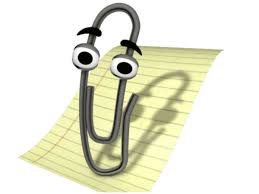
Clippy, courtesy of Mental Floss

And then came email (woo hoo! Files could be attached and sent instantaneously) and the Internet. So far I’ve managed to move through these past 50 years of my writing career with a minimum of turmoil.

But I have to admit that the world of Artificial Intelligence is setting me back on my heels a little. While many of my colleagues have embraced and are using it well, I’m setting aside January to catch up. Here’s my reading material, Teaching with AI.

I have my concerns. As a writer, I’m honestly worried about my students deferring to AI and not understanding the creativity needed for every kind of writing — an email, a news release, a report. Having an AI just generate these annoys every part of me.

But I’ve been teaching long enough to know that writing doesn’t come easily to everyone. Even as I teach my students to use programs like Grammarly or Microsoft Word’s editing tools on their papers means I already have been teaching them to use AI.

So as I prepare for my spring Essentials of Written Communication class, I will be rewriting my curriculum to continue to teach the formatting and structure of various types of writing, while planning for students to use AI. I plan to create assignments for them to write and then edit with AI; I’ll be showing them how their human touch is still vital to anything they use AI to create; I’ll be talking about the ethical use of AI so they understand its creative limitations (and potential for plagiarism).

As the book says, “It is essential that educators start to talk about these issues with students. if we want students to use AI responsibly, both in school and beyond, AI ethics must be baked into curriculum and include AI literacy, an emerging essential skill” (3).

Do you use AI? How has it helped you? What concerns do you have about its use?
A Song of Syllabi

I never appreciated the syllabi my professors handed me at the beginning of each of those college classes. I’m sure — studious and perfectionistic student that I was — that I lived and died by them during the semesters. I’m sure I monitored homework and project due dates in my student planner. Rarely was I late on an assignment. Rarely did I miss a class.

Now, forty years later, I am sitting with eyes crossed in front of my computer finishing the fifth of five syllabi. How did I never know or begin to appreciate how much work these things were for my profs? I’m grateful to do them because now my classes are organized for the next four months. These little sets of papers are — dare I say it? — works of art!

read

When creating a new class, the syllabus is my way of planning it, start to finish. I need to know what I will be doing during each class period, what homework I expect from my students, and then I want to prep all of the required material in the appropriate spot on Blackboard. Beside me as I do the syllabus is my notebook where I fill in the detail for each class period that goes with the general info on the syllabus.

At least, at this point, I’ve taught all of these classes before, so I can begin with last class’s template. But I have a new textbook in one class, another class went from meeting Tuesday/Thursday to Monday/Wednesday/Friday (which meant spreading out the material to fill the new number of class periods), and minor revisions I wanted to make to the other syllabi based on class feedback and my own desire to offer a class that is that much better each time.

It’s self-editing! I try to make my syllabi so thorough that the students can know exactly what will be happening every day of the semester in class — what’s due when and what to be prepared for.

So the self-editing part often includes:

  • dumping bad ideas that didn’t work (a class activity that fell flat, for example)
  • revising homework assignments from hard copy to online quizzes and reflections (saves paper, makes grading faster)
  • checking the links for required reading of online articles to make sure they’re still live, and then replacing some older material with more recent articles
  • revising point structure on assignments to reflect level of work and level of importance to the overall class
  • sometimes I remember how I thought at the time last semester, “I should make a PowerPoint for this section,” and now I need to make a PowerPoint for that section
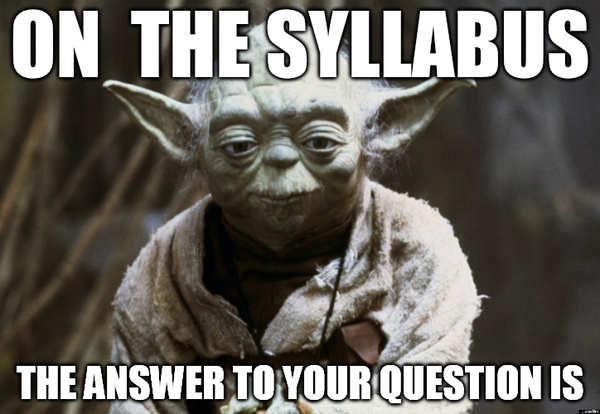
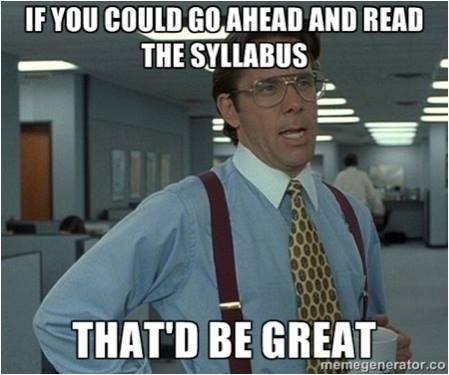
  • finding new memes for said PowerPoint, as well as to put on the syllabus itself (because, face it, memes are hilarious)

yoda

But suffice it to say, I really love both the process and the completion. And it makes me excited to get started teaching. I mean, that’s the point. The class should excite ME so that my enthusiasm can overflow to the students.

I went over to the university today and photocopied my works of art for each class (23 in Communication Writing Essentials; 19 in Public Speaking; 12 in Social Media Strategy; 18 in Manuscript to Book: How It Happens; the fifth syllabus is for my online Freelancing class). Next week, I will carefully and joyfully hand these to my 72 students . . .

. . .  who won’t have a clue how much work and care went into them.

But that’s okay. My job is to make sure they know where we’re going and to get them there. And hopefully, along the way, they’ll read the syllabus.

Images courtesy of memegenerator via Google images.