Writing Real — More than a Dum Dum

In my Freelance Writing class this week, we’re working on the “art of living” article — writing that seeks to inspire or help readers live life just a little better based on our ability to share our own joys and struggles.

Our text puts it this way: “The key to writing art-of-living articles is to write an article that will make a difference in someone’s life—to provide the reader with something to hold on to and take away into her own life.” —Handbook of Magazine Article Writing

To really make this work, however, that piece needs to provide transparency into the life of the author. Readers want writers to be real, to dive deep, to share their stories.

But it doesn’t need to be dark or traumatic. Sometimes the sweetest and most inspirational pieces of writing come from memories, moments, minute details of life that draw us back and make us think. To give my students that opportunity, I gave them a handout with their lives (so far) divided into segments. They were to write down five or six memories from sets of years: 0-5, 6-10 (elementary school), 11-14 (junior high), 15-18 (high school), and 18+ (college). As they began to scribble, I explained that the memories that came quickly are worth thinking about further. There’s a reason that those bubble to the top.

Their job then was to choose one of those memories and describe it. That gets the scaffolding in place. Now to get a solid art-of-living piece, to get to something that will resonate with our readers, we need to go deeper.

So we considered some questions. I asked them to close their eyes and go back to that memory. What was going on in their lives at that time, in their family life, in the world? Where were they living? Who else was part of their lives at the time? What else do they see, hear, feel, smell, taste? As they looked at that memory in a bigger picture and considered why that particular memory surfaced at all, they can write a story with heart. They can begin to see how that minor thing matters, and in turn, help their readers put themselves into their own similar story.

As if to make me take my own advice, today, a sweet college student dressed as a bunny rabbit stopped into my office and let me draw some Halloween candy from her outstretched pumpkin basket. I drew out a Dum Dum.
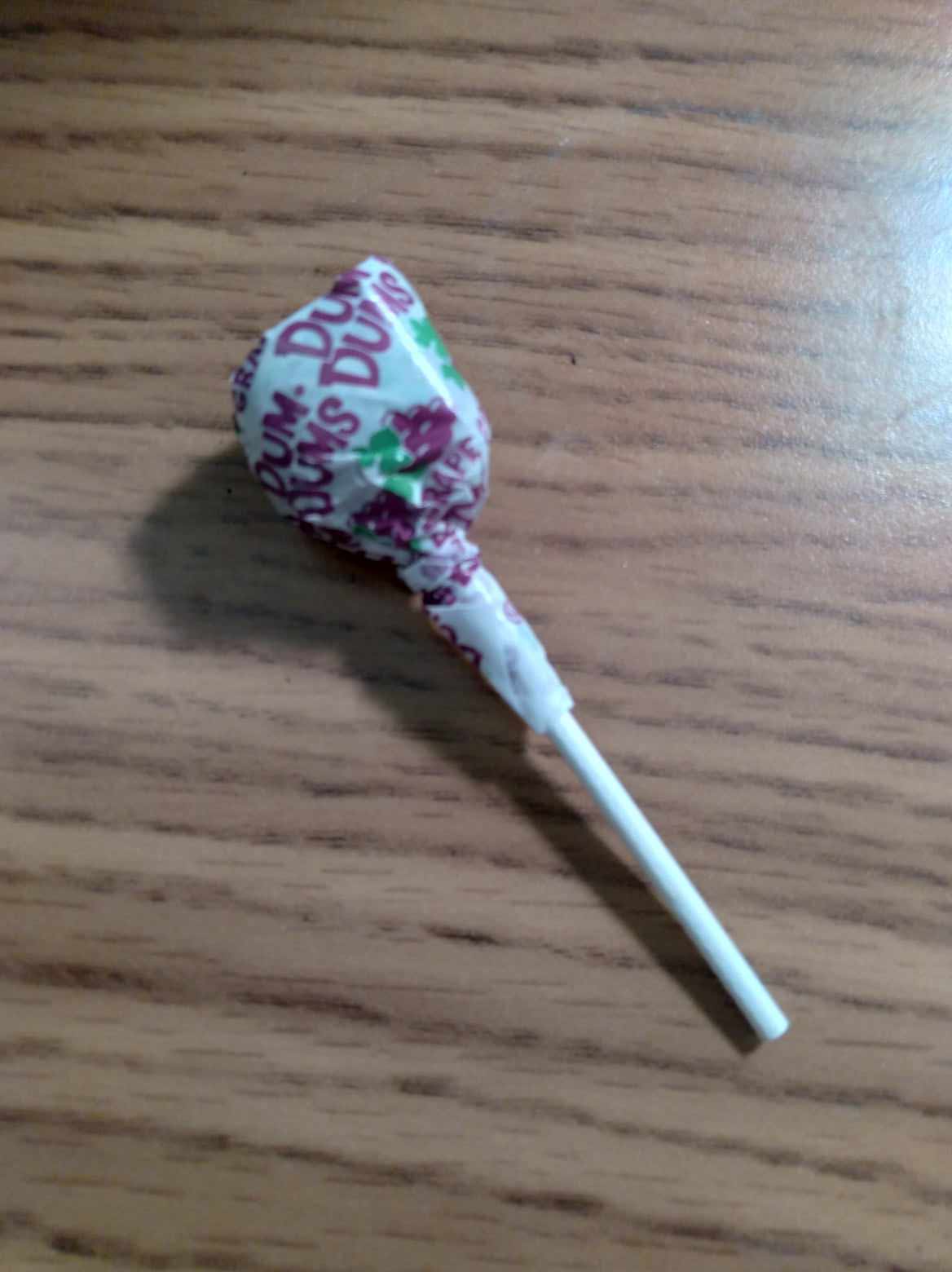
The Dum Dum that arrived today.

In that moment, I saw my Grandpa Chaffee’s face. He had been a rural mail carrier in the little town of Wattsburg, PA, and its environs. He drove his massive Oldsmobile Toronado to deliver mail — and there was always a big bag of Dum Dums on his front seat. The children on his route knew he’d give them a sucker. Even though our family visited him only once a year or so, whenever I got into that enormous car to ride with him, I drew a Dum Dum from the bag and stuck it in my mouth, sucking happily as we zipped down twisty dirt roads.

Gramps, me, and Trixie, circa 1964.

That Dum Dum sent me back. The joy of our traveling military family always returning to deep extended-family roots in western PA. The legacy of love and faith I’ve been privileged to receive. The deep loss of grandparents and now both of my parents. Changes as decades pass; foundations that remain solid. Heaven’s certainty. A loving family that shaped who I am. Sweet memories and sweet candy.

It’s just a Dum Dum, but now there’s something there worth writing. Something to help readers also think about how life changes yet some foundations are worth holding onto and passing on. It was just a Dum Dum, but it’s so much more.

What simple things in your life have a depth of meaning? What memories rise to the surface? How might you write about them?

Thank You, Dr. Leax, for Your Inspiration (part 2)

I am recently inspired by a book that I randomly picked up in a dusty resale shop in Marion, Indiana. You know how it goes — at least if you’re a reader or writer — the first stop is in the back where castoffs unsold at garage sales or lugged from overflowing home libraries rest precariously on makeshift bookshelves or in unorganized piles.

I’m usually looking for classics, memoirs, or books about writing, although our own overflowing bookshelves force me to try to be selective. But that day, I found a treasure. In Season and Out is a book by John Leax, my writing professor from Houghton College, whom I’ve written about before. A bonus is that the lovely illustrations are by a dear family friend, Roselyn Danner, now in heaven.

The book is simple, beautiful, lyrical. Divided into four seasons beginning with summer, the entries are dated and chronicle Dr. Leax’s woodcutting, vegetable gardening, teaching, and small town living. This passage, in particular, resonated with me:

Last night while walking Poon, I suddenly realized I had walked past nine houses within one quarter mile and did not know the occupants of any of them. I can rationalize my ignorance. The generation gap accounts for part of it, most of the houses are occupied by elderly couples or widows who keep to themselves. The cultural gap figures in it too; college English profs are not easily assimilated into the daily life of a small rural town. And the inevitable knowledge gap between old and new residents finishes it off; I’ve only been in this town nine years — I’ll never possess the local knowledge of those who go back generations.

(In Season and Out, Zondervan, 1985, p. 41)

My husband and I take a twilight walk. We’ve been in this tiny country town for almost exactly three years, slowly remodeling our 110-year-old house. We don’t know most of the 986 occupants of Swayzee. Fortunately, we do know most of our direct neighbors along our street, but any conversation quickly uncovers the truth that no matter how long we live here, we will always be newcomers who will “never possess the local knowledge of those who go back generations.” Folks here grew up together, went to school together, and lived around one another as they married, had children, worked, and grew older.

As much as I love our small town, I mourn the boarded-up and vacant buildings, the cafe someone bought to remodel and never finished, the houses unkempt or uncared for, the closed-up hardware store still full of supplies, the empty downtown building that fell (literally fell) because of neglect. At one time, this was a vibrant town — now the biggest news is that we watch a field outside of town slowly transform into a Dollar General.

But there is splendor here, splendor in the ordinary. The open fields, the sunsets, people’s care for one another, the annual rummage sales, the tractor day parade, the parks, the elementary school kids lugging their backpacks, the fresh wind bringing the scent of a new harvest.

Dr. Leax’s book inspired me to spend my summer writing about my small town, our butterfly gardens, our slow remodeling progress, our attempt at growing vegetables, my preparation for fall classes — all of which he touches on. I want to celebrate my very ordinary life, capturing its splendor as best I can.

I am not trying to get this published. I am writing to sharpen my skills and voice, to keep doing what I teach my students to do.

I owe it to my old prof, forty years later. Once again, Dr. Leax, thank you for your inspiration.

So I Finished My MFA

Back two summers ago (and Facebook reminded me with a photo I took of the dorm room I was staying in two years ago), I wrote a blog post where I discussed just getting started with this program here at Ashland University in Ohio. I talked then about how difficult it was to get started, to figure out what to write about, to discover my voice.

Well, it’s been two years and lots of writing. I ended up doing what I mentioned in my blog two years ago: “I’m experimenting right now with a series of essays talking about the whole process (and brilliance) of editing when it’s done well. I am thinking about tying in my research into the great editors (some of which I’ve begun doing on this blog) and extracting lessons from them.”

Indeed, that’s what I did. The final title of my thesis is Words with Friends: The Intimate Relationship Between Authors and Their Editors.

The struggles I faced in writing in the creative nonfiction genre were how to get a memoir out of my life as an editor and how to make that job an interesting read. As part of our study, we have to read similar books to help us understand the ways other writers approached what we are trying to do.

MFA-2
Without Bonnie Rough, I might still be wallowing in despair. She helped to create a coherency and shape that made the writing process that much smoother.

From my own reading, I learned that editors, as well as folks in other seemingly mundane jobs, could write memoirs. Reading the memoirs of book editors such as Diana Athill and Robert Gottlieb, of a copy editor at The New Yorker named Mary Norris, and even a house painter helped me to understand that the power of such a memoir lay in the presentation of needed information (with a balance, not too much) and the ever-present interesting anecdote.

Even so, as I wrote I kept wondering, Is this boring? How can I possibly keep my reader fascinated enough to keep turning pages? Is the tone right? Have I found my voice? I didn’t have famous names to drop or fame in my own right or the cachet of working for a publication such as The New Yorker, as did many of the editor memoir writers I read. What I did have, however, was knowledge and longevity in my field (editing and publishing), a passion for words, and an understanding and respect for the power of words. What I needed to do was share that knowledge (just enough, not too much) along with anecdotal stories to illustrate and entertain.

MFA
Joe Mackall, Tom Larson, and Steve Harvey honed the manuscript with me, asked the tough questions, and made me a better writer.

My theme is “the power of words.” Because words are so powerful, personal, and intimate, when we put our words into the world, we share a piece of ourselves. The special joy of being an editor is helping to shape words, sentences, paragraphs, and manuscripts by entering into that intimate space between the author and the work to help the author say what he or she really means to say. This requires a kind of familiarity and friendship with the words and the author.

I wanted to help my readers understand that if and when they enter the publishing world, the editors are generally there to be their best readers, their greatest encouragers, and their most strategic critics. The purpose is to help the writing be the best it can be—to help writers dig deeper, choose words carefully, and say what they really mean to say.

It’s all about the words.

Those powerful words.


So I’m Studying to Earn an MFA

This summer I began a Master of Fine Arts (MFA) program. In keeping with the advice that I give to my students in my Building Your Author Platform class (advice from Austin Kleon’s book Show Your Work), I’m here to let you in on the process of being a student in an MFA low-residency program, teaching four classes at my university in the Professional Writing program, continuing to freelance, and attempting to have a life.

I chose a low-residency MFA program as that works best for my schedule. I do two weeks onsite for three summers with two years in between of online teaching, reading, writing, and discussing with a cohort of other writers in creative nonfiction, completing in summer 2017. I chose Ashland University’s program in Ohio because of its reputation and  faculty–some of whom I knew from my Master’s program at Ball State. My first two-week stint was this past July.

Note from my journal: “Now I know what my students feel when I hand them a syllabus. Today I went into syllabus shock when I was given the outline for my fall semester. But I know enough to breathe deeply. I can do this. Take the elephant one bite at a time.”

Thought: “Where does the Master in Master of Fine Arts come from? How does anyone truly master the craft of writing? I think the point is that I will spend two intense years studying this craft and creating something from that study. That’s what will allow me to take the title of master. I hope I can live up to it.”

The focus of my program is to create a thesis–a creative work, a book–by the end of my two years. I am in creative nonfiction, so we talked a lot about essays and memoirs and writing that is true, real, and genuine. We talked about the works of wonderful nonfiction writers like Annie Dillard and Mary Karr and Philip Lopate and Lee Martin (some of these folks also write fiction). We talked about spirituality in writing–how to talk about that inner spiritual life. We studied how memoirists have to write from various viewpoints–who they are now, who they were then, who they are reflecting on who they were, and who they have become based on how those two persons relate.

I’ve been told in this first semester to experiment with my voice, to see where my writing takes me. Part of my problem, however, is that I’ve spent so many years editing and working in other people’s voices that I’m still trying to find my own.

Note from my journal: “It helps me to have a focus, a direction, for my writing. Ah, the age-old question: What should I write about?”

I’m experimenting right now with a series of essays talking about the whole process (and brilliance) of editing when it’s done well. I am thinking about tying in my research into the great editors (some of which I’ve begun doing on this blog) and extracting lessons from them. And maybe I’ll think about what lessons I learn in the editing process that pertain to life. (Such as, “What if God took this rough draft of my life, marked it up with a red pen, and gave me a do-over? What would I do differently? And would I want to do that? The changes I make to my past will affect the future that I do not yet know.”)

I know. Deep.

So that’s a glimpse into my MFA musings. Right now I need to write a review of Jean-Dominique Bauby’s The Diving Bell and the Butterfly. (If you haven’t read it, drop everything and do it now. It’s a short book that will leave you stunned and amazed. You don’t even need to know that he wrote the book by “transcribing” to a writer by way of eye blinks since he was completely immobile. Read #2 in this list for more about that.)

So I have a paper to write about the structure and voice of this book, the narrator’s persona and his reflections on his life. Then I need to write more about editing to see if that is going to work for a thesis project.

But first, I’m going to eat some dinner.